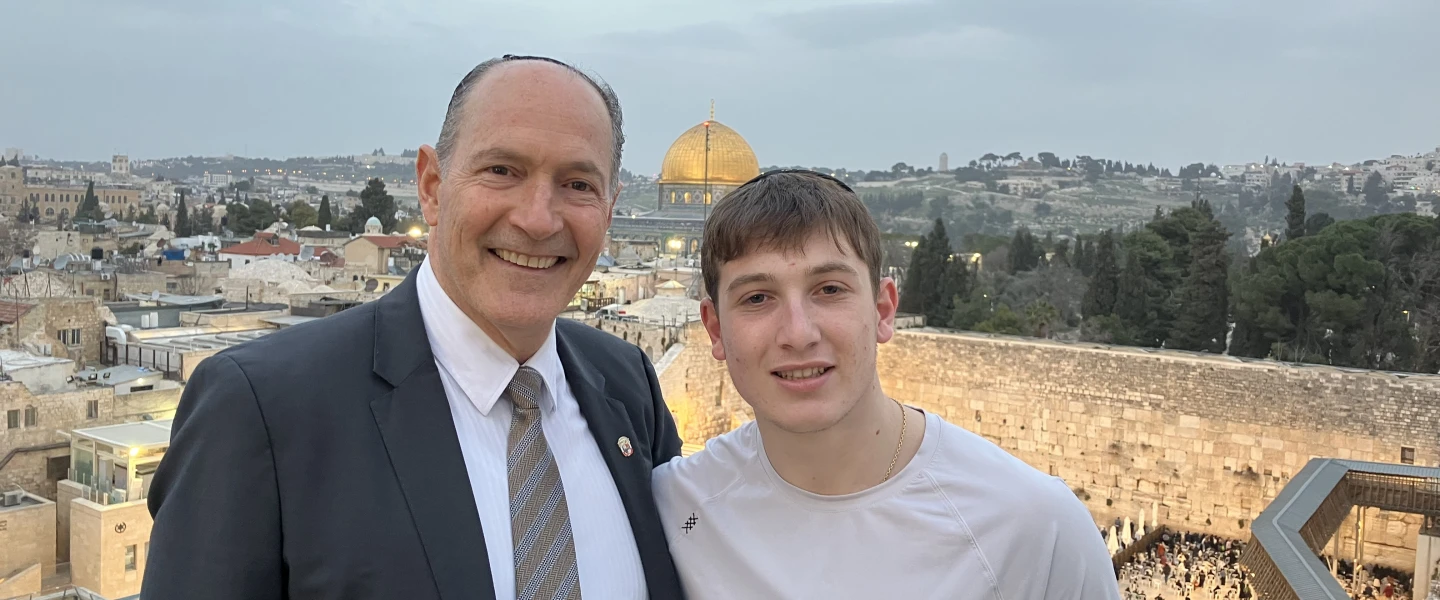
His father fought in Israel’s 1948 War of Independence, was captured in the Old City of Jerusalem and held prisoner by the Jordanians for nine months. Now his grandson is studying at a Jewish educational center in the same city streets.
Meet Panama’s ambassador to Israel.
Three quarters of a century after his father was taken prisoner by the Jordanians, Ezra Cohen arrived in Jerusalem as Panama’s envoy to the Jewish state.
“I’m closing the circle my father opened up,” Cohen told JNS during an interview on Tuesday at Panama’s embassy in Tel Aviv.
Rooted in the Land of Israel
Cohen’s remarkable family history dates back to the pre-state years of the British Mandate. His father, Moshe, came from Colombia to what would become Israel with his family as a boy of six after his mother’s death. When the War of Independence broke out a decade and a half later, he was enlisted and subsequently captured in the Old City of Jerusalem by the Jordanians. He was held for nine months in Jordan, where he was given stale canned foods caked with worms. An aunt in Panama offered to get him out of captivity via diplomatic asylum, but he told her that if she could not get the other members of his unit out, he would stay with them. He was eventually traded for 100 Arab prisoners. (“Things haven’t changed to this day,” the ambassador remarked.)
Newly released, Moshe told his family he wanted to go to a place “where there is no war and no winter” for a couple of years.
“This is how he ended up in Panama,” said Cohen.
His father would later find an Israeli wife on a short visit to his family in Jerusalem (a girl in a red dress he met in the 1950s during a stroll on King George Street who happened to be his uncle’s secretary), and the two settled back in Panama.
“All the time he told my mom next year we will move to Israel, but the entire life was spent in Panama,” Cohen recounted.
Coming full circle
It was his son, Ezra, who would relocate to Israel as Panama’s official envoy—at age 64, during the winter and in the middle of another war, this one not with Jordan but with Hamas and Hezbollah.
On his first day in Jerusalem, in a rented flat, the newly appointed ambassador accidentally stumbled upon the little synagogue in the city’s Makor Baruch neighborhood where his grandfather, after whom he is named, had routinely prayed nearly a century ago; he even found his name on a plaque on the wall.
“I realized then and there I was in the right place at the right time,” he said.
Job of a lifetime
It was just weeks earlier and a world away that the president of Panama had summoned him to his offices and told him that he wanted him to serve as ambassador to Israel. The president told him to get there in three weeks.
Cohen had served for nine years as executive director of Shevet Ahim, a Jewish community organization in Panama, after a successful career in business. He had caught the president’s eye for his work in bringing thousands of American Jewish tourists to Panama over winter break during “yeshiva week” in January as an alternative to more expensive Miami. He had also spearheaded, together with the Chief Rabbi of Panama, David Peretz, the opening of a whopping 48 kosher restaurants in Panama—unprecedented for Latin America—and the world’s biggest kosher supermarket by area.
“I always thought, ‘What am I doing staying so long working in the community when my DNA is business,’ and now I understand why: it was all preparation for my assignment as ambassador” said Cohen.
When he presented his credentials to Israeli President Isaac Herzog in October, Cohen shocked the Israeli head of state by responding to his English greeting in fluent Hebrew.
Settling in to his new life, Cohen is focused on buttressing bilateral relations between the two countries, often meeting Israelis who recall that he once hosted their children over Shabbat in Panama, giving him renewed zest for his daily work.
Even during the war, he convinced his daughter it was safe to send her 18-year-old son, Moshe, to study at Aish in Jerusalem, which he said was “the greatest spiritual preparation” ahead of his planned studies this year at Boston University.
With fluent Hebrew, Cohen quickly blends into Israeli society, breaking cultural and language barriers, and ends many meetings with a hug, “not as ambassador but as a friend.”