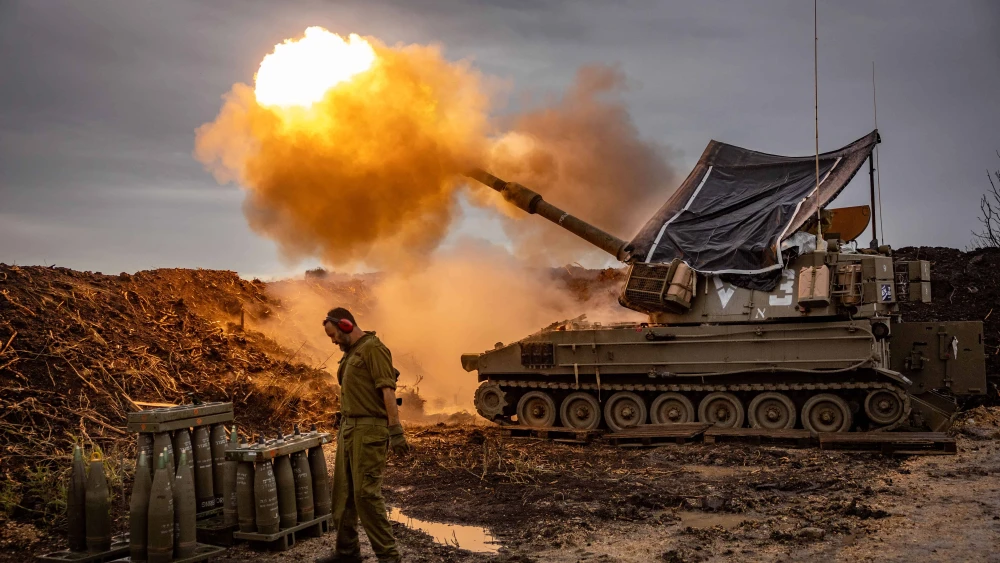
Israel told the United States late last month that the time frame to distance Hezbollah from the border via a diplomatic agreement was the end of January, according to The Washington Post.
Citing a Western diplomat and three Lebanese officials, the report, published on Friday, noted however that the Israeli government has not set a “hard deadline.”
Hezbollah launched a low-intensity conflict against the Jewish state in the aftermath of Hamas’s Oct. 7 massacre, firing rockets, drones and anti-tank missiles at northern Israeli cities on a near-daily basis and forcing the evacuation of some 80,000 civilians from their homes.
White House envoy Amos Hochstein has been conducting shuttle diplomacy between Jerusalem in Beirut with a view to negotiating a deal for Hezbollah to withdraw its forces several miles from the border. (U.N. Security Council Resolution 1701, forged in the wake of the 2006 Second Lebanon War between Israel and Hezbollah, called for the terror group to withdraw beyond the Litani River, some 25 miles north of the Israeli border).
In exchange, Hezbollah is demanding that Israel surrender territory to Lebanon from Nahariya in the west to the Syrian border.
Israeli Foreign Ministry Spokesman Lior Haiat told the Post on Friday that “we prefer a diplomatic solution, and if a diplomatic solution will not be possible, we will have to act on our own.”
Two days earlier, NBC News, citing senior Biden administration officials, reported that Israeli Prime Minister Benjamin Netanyahu had acceded temporarily to visiting U.S. Secretary of State Antony Blinken’s demand not to launch a war against Hezbollah.
Hezbollah’s terror army comprises a combination of 150,000 missiles of all ranges and an estimated 25,000 active-duty fighters, many of whom are veterans of the wars in Syria, Afghanistan and Iraq. The combined force is believed to have plans to invade and occupy large swaths of the Upper Galilee and destroy strategic installations across Israel while inflicting tens of thousands of casualties.
Earlier this month, Hezbollah terror chief Hassan Nasrallah hailed “a historic opportunity” for Lebanon to regain control of disputed borderlands “after this phase [of fighting] ends and after the aggression on Gaza.”
The same day, Israeli Defense Minister Yoav Gallant said the government “prefers a diplomatic path over a military one,” but warned, “We are close to the point of the hourglass turning over.”
An Israeli drone strike killed two Hezbollah fighters in Southern Lebanon on Saturday, Reuters reported, citing security sources. Their vehicle was hit in the Hezbollah stronghold and heavily Shi’ite Muslim district of Bint Jbeil. Their ranks were not revealed, but a source close to the Iranian terror proxy said that they were not senior figures.
Also on Saturday, the IDF carried out waves of airstrikes against Hezbollah terror targets in Southern Lebanon, in response to attacks on northern Israel.
The sites hit included an observation post, rocket launch positions and other infrastructure, according to the military.
Last week, a Hezbollah anti-tank missile killed Mira Ayalon, 76, and her son Barak Ayalon, 48, as they ate breakfast in their home in Moshav Yuval.
On Thursday, Gallant told his U.S. counterpart Lloyd Austin that Jerusalem was reaching an inflection point and would soon need to decide on whether to launch a full-scale war against Hezbollah.