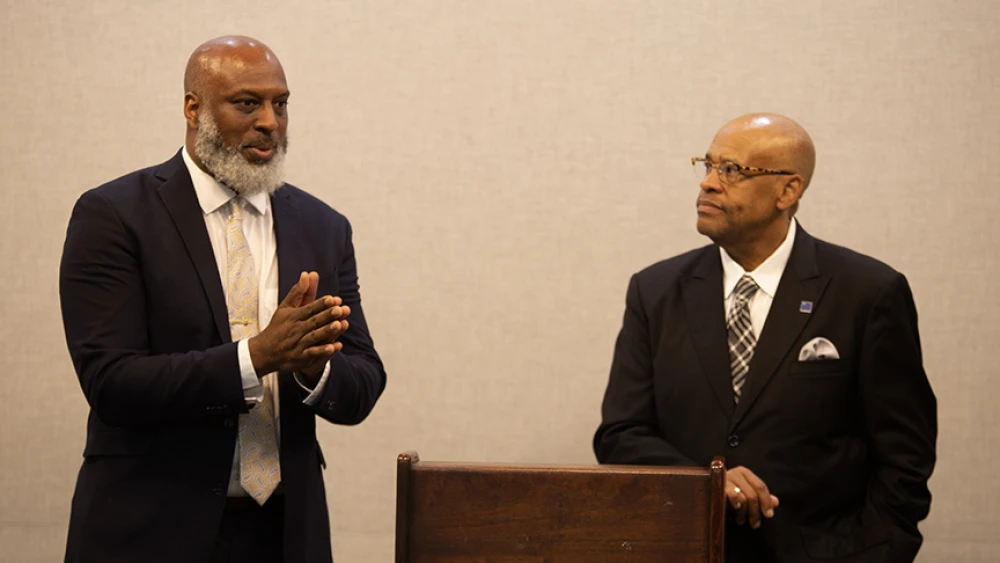
With the Jewish community looking for allies in the face of surging antisemitism and anti-Israel activism, a group of Black pastors with long track records in Israel advocacy and Black-Jewish relations has joined forces to establish the Black Christian Leaders Council on Israel Relations.
A major part of the June 25 announcement at the National Press Club in Washington focused on a planned Israel trip in November involving 500 Black pastors and Christian leaders, titled “Unfinished Business.” In 1966, Martin Luther King Jr. was working with former Israeli Prime Minister David Ben Gurion to bring several thousand Black pastors to Israel in November 1967. The Six-Day War led to a postponement to 1968, but with King’s assassination in April 1968, the trip never happened.
It was another trip to Israel by a group of pastors that led to the formation of this new organization. Pastor Michael Stevens explained that he and Pastor Dumisani Washington, founder of the Institute for Black Solidarity with Israel, were part of last December’s delegation of 1100 pastors organized by Friends of Zion founder Mike Evans. Stevens said that the trip was “beautiful, it’s historic,” but only 40 of the 1100 pastors were Black.
Back home, Stevens and Washington coordinated with Pastors Roger Cheeks, senior director of outreach at the International Fellowship of Christians and Jews; Valerie Washington of IBSI; and Pastors Reginald and Brandy Gibson of Birmingham, to establish the council “to help ensure that the essential Black American voice defending Israel and the Jewish people is clearly heard.”
Washington said, “There needs to be a more concerted effort in the black community, and we decide to take on that mantle,” and this is their “hineni moment” to say “here I am.”
“We’re not new to this; we’re true to this,” Stevens said, with participants averaging 25 years of experience in Black-Jewish relations.
Stevens said the goal is to be “a firewall” and “a very visible friend” to the Jewish community. He has a rapid response initiative, Shoulder to Shoulder, that is part of the new organization. Its goal is to have a network of Black pastors who can be “boots on the ground” whenever there is an antisemitic incident, being “in that Jewish community, standing with that rabbi, standing with that Jewish Federation,” not just to offer prayers, but “what tangibly, what materialistically can we do to stand in a minute of crisis?”
Stevens was the first African American Outreach Director for Christians United for Israel, and Washington was his successor. While Stevens said he loves the leaders of the Christian Zionist movement and owes “a debt of gratitude” to CUFI founder Pastor John Hagee, over the past eight or so years among white evangelicals, the movement has seemed increasingly polarized and has been identified with a more patriotic and nationalistic tone. “We love our country, we love Israel, we love the Lord,” he said. But the tone doesn’t resonate with the typical Black pastor, and the council is a place that they can identify with and express their support for Israel in their own way.
One of the best ways to bolster that support is by visiting Israel, but there is more to it than just going on a trip. Stevens said that he and Washington have probably brought 600 to 700 Black pastors to Israel over the years, and they have a “phenomenal time,” especially with rabbis they encounter, “and they said, wow, I want this back home,” but there were no relationships with the Jewish community to build upon. He said there is already interest from about 75 rabbis who want to join the November trip, so that by the time they get back to the United States, relationships are already being built.
The council is working with the Israeli Embassy in Washington and the Jewish Federations of North America, especially Rabbi Joshua Stanton, associate vice president for Interfaith and Intergroup Initiatives at JFNA.
“How would history possibly have been different had thousands of Black Americans been making a pilgrimage to Israel in the late 1960s? There was no such thing as mass pilgrimages to Israel, especially from the United States,” Washington said. “The black community was getting ready to start something that no one else was doing.”
Another bit of “unfinished business” they plan to address involves a group of Ethiopian pastors on the trip. Sigd, a major festival for Ethiopian Jews, falls during the trip, so an event is in the works for the pastors to apologize to the Ethiopian Jewish community for their mistreatment over the centuries.
Israeli Embassy Minister of Public Diplomacy Sawsan Hassan said when the council leaders first met with Israeli Ambassador Yechiel Leiter to discuss the trip, “he called me after that to his office, and he said this is history…we need to do everything to support their initiative.”
“The friendship between the Black American community and the Jewish people is not new,” Hassan said. “It’s old. It’s deep. And it was forged in some of the hardest chapters both our peoples have known.”
In November, “you will not come as strangers, you will come as family. Israel welcomes you with open hands and arms,” he said.
Chara McMichael, JFNA senior director of political affairs and government relations, “has been very instrumental in helping give us a kosher understanding of how we might serve the Jewish community in a very real and meaningful way,” Stevens said.
McMichael said, “This partnership is an extraordinary opportunity, and this initiative presents an opportunity to strengthen bonds between the Black and Jewish communities” and continue King’s vision of building together.
“The future of black Jewish relations will not be defined by our differences, but by what we can achieve,” McMichael said. “And the beauty of this partnership is that it’s not just about going to Israel. It’s about joining forces with the Jews that stand here in America and supporting one another as we move forward. Together we will stand shoulder to shoulder in the fight against racism and antisemitism.”
Black-Jewish Relations for 3,000 years
Washington said the first Africa-Israel summit “was when the Queen of Sheba traveled from Ethiopia to Jerusalem, 3,000 years ago, stood in Jerusalem and told the world God loves Israel forever.”
He added, “No other region can boast of a 3,000-year relationship with Israel, other than Africa,” and Black Americans and Africans are reclaiming their heritage of standing with Israel and the Jewish people.
The council will also have a strong presence in Africa, Washington said. After Oct. 7, they were among the founders of the African Jewish Alliance, established with Jewish friends including Charles Jacobs. The group was a way for Christians in places like Nigeria and Sudan to express support for Israel, because “Israelis and Africans have this real-time issue that’s going on in terms of security” against radical Islam.
Washington said that when members in Nigeria saw the videos of the Oct. 7 attacks, their reaction was “that happens to us every week, too,” saying “Hamas is Boko Haram, is Al-Shabaab, is al-Qaeda. They have different jerseys, but the same league” in terms of killing Christians, Jews, Druze and even other Muslims.
He said some will argue that the massacres of Christians in Nigeria are not genocide because Muslims are also being killed. But Washington pointed out it is Muslims killing fellow Muslims who are “standing with their Christian brothers and sisters. Imams who were hiding Christians in their mosques, who got killed because the extremists wanted them dead.”
The council also cites “over a century of partnership” between the Black and Jewish communities, including heavy Jewish involvement in the founding of the NAACP, the joint effort of Booker T. Washington and Julius Rosenwald to build 5,300 Black schools throughout the South from 1912 to the 1930s, and partnerships in the civil rights movement, such as the close friendship between King and Rabbi Abraham Joshua Heschel.
The council’s launch was a few days after the anniversary of the 1964 murder of three civil rights workers in Mississippi. Stevens said, “I grew up thinking it was two white guys and a black guy. No one ever told me it was two Jewish guys who came from the North, down to be with James Cheney, and they were murdered.”
In 1975, Bayard Rustin and A. Philip Randolph, “two lions of the civil rights movement,” formed the Black Americans to Support Israel Committee (BASIC). Washington reminded that this was the year the United Nations passed the Soviet-backed initiative to label Zionism as a form of racism. “When almost all other voices were silent in the West, it was the black community that stood out, formed, and organized” in opposition to the resolution, Washington said.
Despite that, Stevens said, the relationship between the Black and Jewish communities “lost traction” in the 1970s and 1980s. “Somewhere, we lost communication… and don’t have a plan.”
Stevens said, “The Al Sharptons, the Jesse Jacksons and the Louis Farrakhans- that’s what the last 60 years was. The Crown Heights Riots. That’s where the conversation was when it came to Blacks and Jews.”
Washington noted that the outsized attention given to “the negative mouthpieces in the black community are like someone telling my Jewish friends Jewish Voice for Peace speaks for you.”
He noted that in his book, “Zionism and the Black Church,” not only did he quote King’s Israel advocacy, but also the “vast majority of the civil rights movement” leaders, who were also pro-Israel.
In recent years, “the anti-Israel narrative, particularly the one that has been fueling of the pro-Palestinian narrative, has always exploited the black community. There was always the goal for those people to use our community as a bludgeon against Israel,” such as equating Ferguson or George Floyd with Palestinian liberation.
“There is a black Zionism, Christian Zionism, that is a mountain, and the base of a movement that’s untapped right now,” Stevens said, adding that their goal is to give it a voice.
“If anyone gets the Jewish conversation, it’s Black folk,” Stevens said. “If anybody understands slavery, if anyone understands oppression, if anyone understands being outcast from their own country, and the things that were experienced with the Holocaust and the slave trade, if anyone understands civil rights.”
Recruitment is underway for Unfinished Business. In addition to pastors, participants will be music ministers and recording artists, professional athletes and coaches, co-pastors and spouses, social media influencers and heads of para-church organizations. The pastors will be selected based on several criteria gathered from a survey. Sponsored participants are responsible only for getting to New York City and for some lunches during the trip, as the council and its partners are covering the other expenses.
There will also be a parallel track at a competitive rate, available to others who want to be associated with the trip and participate in many of the same events.
“In honor of that pilgrimage that never happened, we are going to begin by God’s grace,” Washington said. “By next year it won’t be 500, it’ll be 5,000” going to Israel.