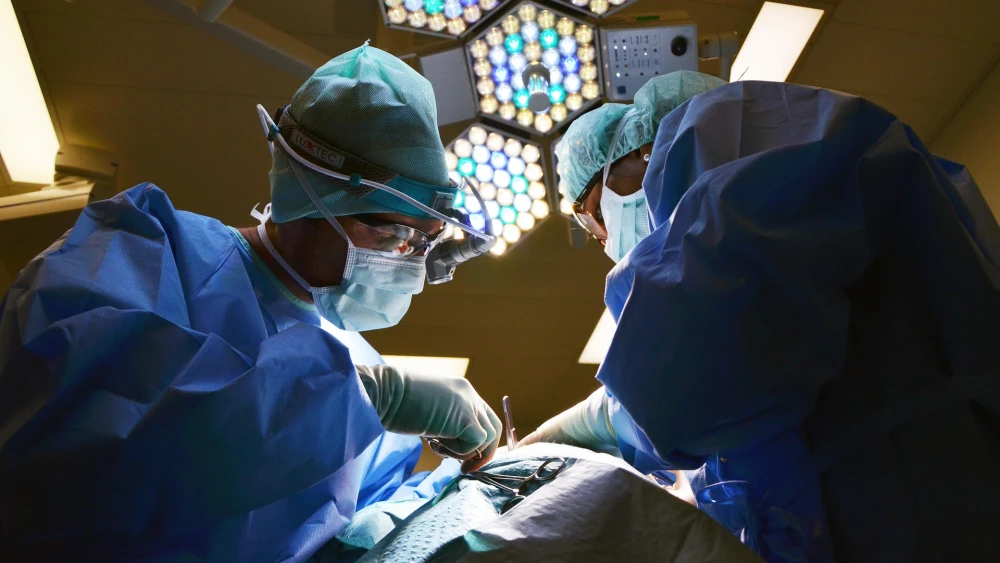

Before an operation, a patient has enough to worry about. Will the procedure succeed? How difficult will recovery be? When can I go home?
“Should I conceal that I’m Jewish?” should never be on that list.
Yet research released by the Anti-Defamation League on Nov. 18 describes Jewish patients, healthcare professionals and medical students making precisely that calculation. Participants reported concealing their identity, encountering hostility and questioning whether institutions would take their concerns seriously.
A hospital cannot promise compassionate care while leaving patients afraid to identify themselves.
The research comprises three qualitative studies examining medical education, healthcare workplaces and patients’ experiences. The medical school study, conducted with the American Jewish Medical Association, involved 31 students. The workforce study involved 44 healthcare professionals.
Their accounts deserve attention and appropriate care regarding what they establish. Interviews and focus groups illuminate experiences; they do not establish their prevalence throughout American medicine. The medical school report expressly acknowledges that its findings are not statistically representative.
Nor does a patient’s fear of receiving inferior care establish that a physician actually provided it.
But institutions entrusted with training physicians and treating patients have been put on notice of concerns that demand investigation.
There are reasons such fears cannot simply be dismissed. In February 2025, video emerged of two nurses at a hospital in Sydney, Australia, making threatening remarks about Israeli patients. One declared, “I won’t treat them. I will kill them.” Authorities subsequently reported finding no evidence that patients had been harmed.
That incident does not establish what happens in American hospitals. It does illustrate how statements by healthcare workers can damage confidence far beyond their workplace.
We must also distinguish threats from political advocacy.
For me, exclusion from medicine is not distant history. Our family physician in Middle Village during the 1950s had attended medical school in Europe because American quotas restricted opportunities for Jews. Jewish-sponsored hospitals also provided opportunities for physicians excluded elsewhere and care responsive to Jewish patients’ needs.
As those barriers fell, their role as a refuge from discrimination seemed increasingly unnecessary.
Today’s circumstances are different, but the question is unsettling: Are we allowing medicine to become a place where Jews again feel they need a refuge?
Patients arrive seeking relief from suffering. They should leave remembering both the competence and kindness of those who cared for them.
Healthcare workers have the right to condemn Israel’s conduct, including by calling its Gaza campaign “genocide”—an accusation I reject. Expressing that view does not establish a willingness to mistreat Jewish or Israeli patients. Suggesting otherwise would weaken a serious argument by making an unsupported accusation of our own.
The professional question is how those convictions enter the clinical encounter.
A physician making a political statement outside work presents a different situation from one confronting a Jewish patient about Gaza, demanding a denunciation of Israel or directing political accusations at someone seeking treatment.
Patients are vulnerable. They cannot easily walk away from the person preparing to administer anesthesia, perform surgery or care for a hospitalized child.
A Jewish patient who encounters accusations of Israeli genocide in that setting may wonder whether the person responsible for his care regards him with hostility. That fear is not proof of discrimination. It creates an obligation for the institution to protect the confidence on which treatment depends.
As an attorney, I understand the importance of examining allegations fairly. Through my involvement with Kav L’Noar, which provides mental-health services in Israel, I also appreciate how much depends on a person’s willingness to trust those offering help.
A patient must be able to disclose fears and vulnerabilities. A clinician must be able to ask sensitive questions. Neither should have to establish acceptable political credentials before that relationship can begin.
The principle applies equally to everyone. A Muslim patient deserves respectful treatment from a Jewish physician. A Jewish patient deserves respectful treatment from a Muslim physician.
Hospitals and medical schools already have policies addressing discrimination. Their responsibility is to demonstrate that those policies protect Jews in practice.
Complaints need accessible reporting channels and prompt, impartial investigation. Patients should know whom to contact without navigating an administrative maze while ill. Students and employees need confidence that reporting misconduct will not damage their careers.
Institutions should explain what follows a complaint. Confidentiality may limit disclosure, but silence leaves people wondering whether anyone acted.
Professional education should address recognizable antisemitism: stereotypes about Jewish power, collective blame and the assumption that Jewish colleagues answer for Israel. It should distinguish political disagreement from harassment and discriminatory conduct.
Jewish organizations can help by documenting incidents accurately and assisting those afraid to come forward. Sweeping claims that every hospital is hostile would undermine that work.
The ADL research should prompt hospitals to examine their procedures and medical schools to ask whether Jewish students trust their leadership. Patients arrive seeking relief from suffering. They should leave remembering both the competence and kindness of those who cared for them.
And they should never wonder whether concealing their Jewish identity helped keep them safe.