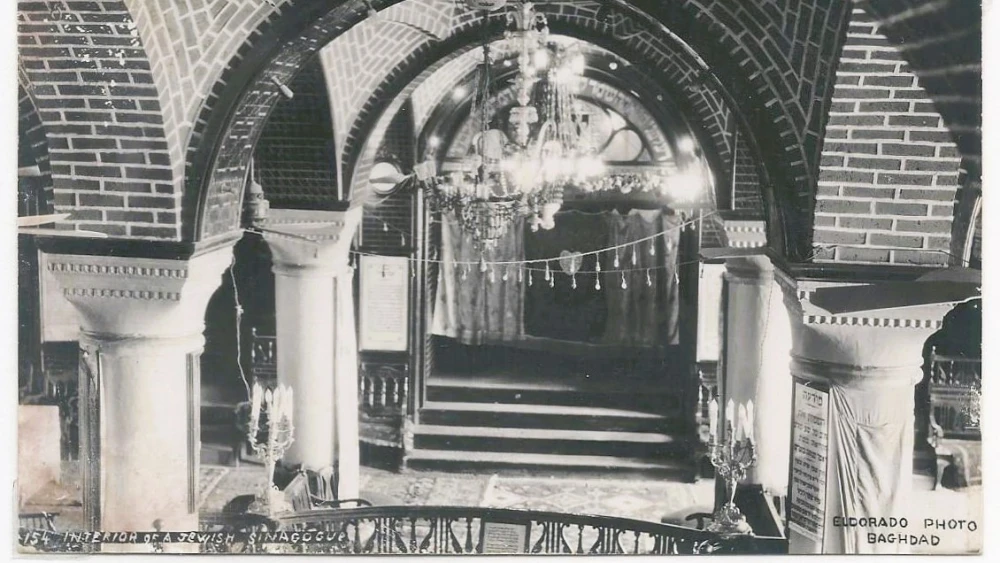

It was the largest single airlift of Jews to Israel. Some 120,000 were brought to the Jewish state during “Operation Ezra and Nehemiah” between 1950 and 1952.
Most historians agree that they had plenty of reasons to flee Iraq when a brief window of opportunity to leave opened up in March 1950: extortion, job dismissals, harassment, arrests and the threat of violence.
But the Iraqi-Jewish exodus has been haunted for decades by a suggestion that it was not Arab antisemitism, but the Mossad that was to blame for convincing the Jews to leave.
This staple of anti-Zionist propaganda was predictably repeated by Benjamin Moser when interviewed about his new book Anti-Zionism: A Jewish History.
More shockingly, however, British historian Simon Sebag-Montefiore, who is far from being an anti-Zionist, asserts in his new book The Cauldron that some Jews settled in Israel “aided by Zionist organizations and in Baghdad by false-flag bombings by Israeli agents.”
Has the “Zionist bombs” conspiracy theory now become received wisdom?
It has been given legs by emeritus Oxford professor Avi Shlaim. Shlaim was born in Baghdad, but his family left for Israel when he was only 5. He contends that five bombings “played some part” in persuading the Jews to leave, while glossing over Iraqi antisemitism.
Legal emigration from Iraq was allowed for one year only, until March 9, 1951, on condition that Jews renounced their citizenship. Then, on March 9, the Iraqi parliament passed a second law freezing the Jews’ property. The hapless refugees, waiting to be airlifted out, were left destitute.
If we look at the bombings in detail, the weight of evidence points to Iraqi nationalists behind at least two bombs—the April 1950 incident at the Casino al-Baidha and the most serious episode at the Messouda Shemtob synagogue on Jan. 14, 1951, in which four people were killed when a grenade was thrown at a high-tension wire.
Three incidents in May, June and July 1951 occurred after the deadline for registering to leave had expired on March 9, 1951, and caused no casualties.
Unforgivably, for a “respectable” professor, Avi Shlaim in his memoir Three Worlds falsifies the timeline by extending the deadline for registration until July 1951 in order to encompass the last three bombings.
Shlaim tries to connect the 1954 Lavon Affair, a failed Zionist operation to plant devices in Egypt, to confer retrospective guilt on Mossad for the bombings in Iraq.
People who want to believe the worst of Israel will not be persuaded by reason and facts.
We know that non-Jewish Iraqis planted the two bombs that preceded the March 9, 1951, registration deadline, although Shlaim claims to have found proof, without much corroboration, that Mossad bribed the Messouda Shemtob perpetrator.
By the time of this fatal bombing, the overwhelming majority of Iraqi Jews (90,000) had registered to leave, so the effect of the bombing was negligible.
It was more plausible that Iraqi nationalists were impatient with the slow progress of Israel’s airlift, as only 26,000 Jews had been transported to Israel by early 1951. Iraq’s Prime Minister Nuri al-Said threatened to dump the Jews in the Kuwaiti desert or at the Jordanian border.
Predictably, the Iraqi police blamed “Zionists” for the bombings.
Yusef Basri and Shalom Salih Shalom were executed in 1952 after confessing under torture. The kangaroo court did not, however, accuse them of the fatal Messouda Shemtob bombing.
Another reason why Mossad was unlikely to have been the culprit is that the Messouda Shemtob synagogue was being used as a registration center for Jews who had already decided to leave.
The “Zionist bombs” thesis received a boost recently when Israel’s national broadcasterKan screened “Baghdad Files,” a documentary by Avida Livni based on the findings of Baruch Nadel, an iconoclastic journalist working for the satirical magazine Haolam Hazeh. Nadel was sued for libel in 1977 by Mordechai Ben-Porat, Mossad’s chief operative in Iraq. Ben-Porat won his case, and Nadel was forced to apologize.
“Baghdad Files” is based on 117 interviews with Iraqi Jews conducted by Nadel in the ma’abarot transit camps of the 1950s. These Jews were deeply disappointed at the terrible conditions that greeted them in Israel and blamed Mossad for deceiving them into leaving Iraq by planting bombs. But not a single interview could produce concrete evidence that the Mossad was responsible.
Historians Tom Segev and Benny Morris have both disputed Avi Shlaim’s assertions.
It usually takes more than just a few incidents to persuade Jews to leave their homes. Since declaring war against the new State of Israel in 1948, the Iraqi regime had been tightening a noose around Jewish necks: dismissing them from their jobs, denying trade licenses, freezing bank accounts, extorting money to pay for its war against the Zionists in Palestine and jailing those who could not pay.
The last straw for the Jews of Iraq was the execution of the best-connected non-Zionist Jew in the land, Shafik Ades, in September 1948. If Ades could be hanged, what hope would there be for the rest of them? And underlying their anxiety was the fear that a second Farhud pogrom could take place at any time.
Sadly, “Baghdad Files” gives scant attention to these “push factors.” People who want to believe the worst of Israel will not be persuaded by reason and facts, and the film, bestowing a kosher seal of approval by Israel’s official broadcasting company, will only provide grist for the propaganda mill.