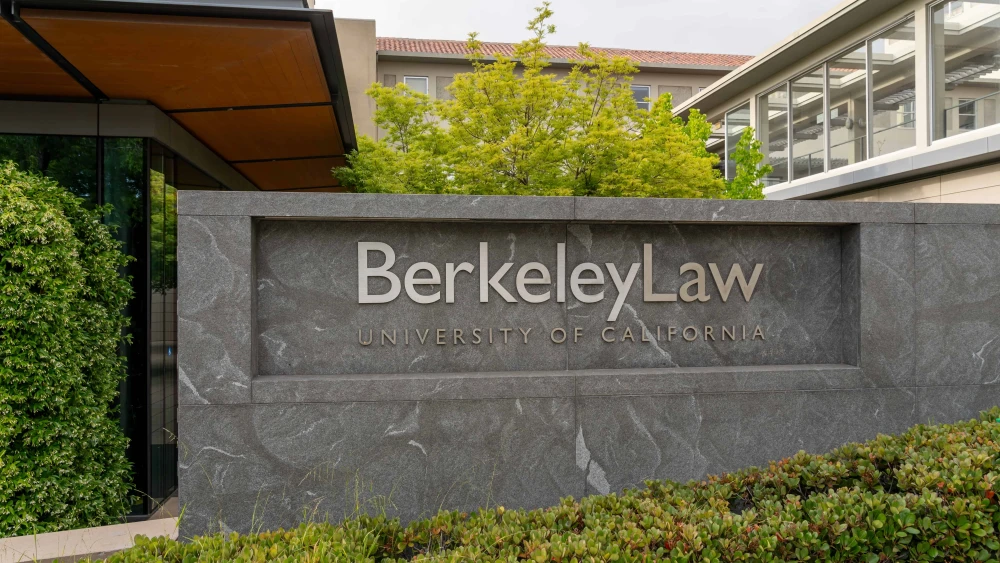
Law Students for Justice in Palestine and three of its members sued the regents of the University of California and four university officials on Wednesday, claiming that the University of California, Berkeley School of Law violated their First Amendment rights by denying the group official recognition over a bylaw barring Zionist speakers.
In the complaint, filed in the U.S. District Court for the Northern District of California, the group said it sought official recognition on Aug. 24, but the law school required its bylaws to “contain no restriction on who may speak at the organization’s events.”
In 2022, the group adopted bylaws excluding Zionist speakers. The Louis D. Brandeis Center for Human Rights Under Law sued in November 2023. It reached a settlement with the school in March.
Berkeley and the center were divided on what they agreed to in a settlement. Berkeley said that it will prevent student groups from banning speakers and limiting “officers, board members or speakers based on a category that is protected under federal or state law.” The agreement text made clear that “Zionist” doesn’t constitute a protected class but adds that “Zionist” can often be a code word used to discriminate against “Jews” or “Israelis,” both of which are protected groups.
Law Students for Justice in Palestine states in its bylaws that, as an expression of its “political commitment to Palestinian liberation and anti-Zionism, and consistent with its commitment to BDS, LSJP will not invite speakers that have expressed and continued to hold views or host/sponsor/promote events in support of Zionism, the apartheid state of Israel and the occupation of Palestine.”
The group stated in the complaint that it tried to register as a recognized student organization in August 2026, but “for the first time in LSJP’s 20-year existence,” the law school required it to confirm its bylaws “contain no restriction on who may speak at the organization’s event.”
The group said that without recognized status, it can’t reserve rooms, post notices on law school bulletin boards or access student government funding.
According to the complaint, it held a “Palestine 101” event on Oct. 7 on the law school steps because it was unable to reserve a classroom.
It listed events planned for the current academic year, including a letter-writing campaign for an activist who was detained by immigration enforcement, a panel titled “Big Law complicity in genocide” and a film screening.
Berkeley’s campuswide registration office approved the group with its bylaw intact. The complaint only addresses recognition and benefits at the law school.
The group is asking the court to declare that it is unconstitutional for Berkeley to deny it official recognition and to order the law school to restore the group’s access to benefits available to registered organizations.
Alizay Azeem, a plaintiff, is also asking for the right to apply for $644.96 reimbursement for a lunch for new and returning members that the group hosted in August before it applied for recognition for the academic year. The lunch was held after the March settlement.