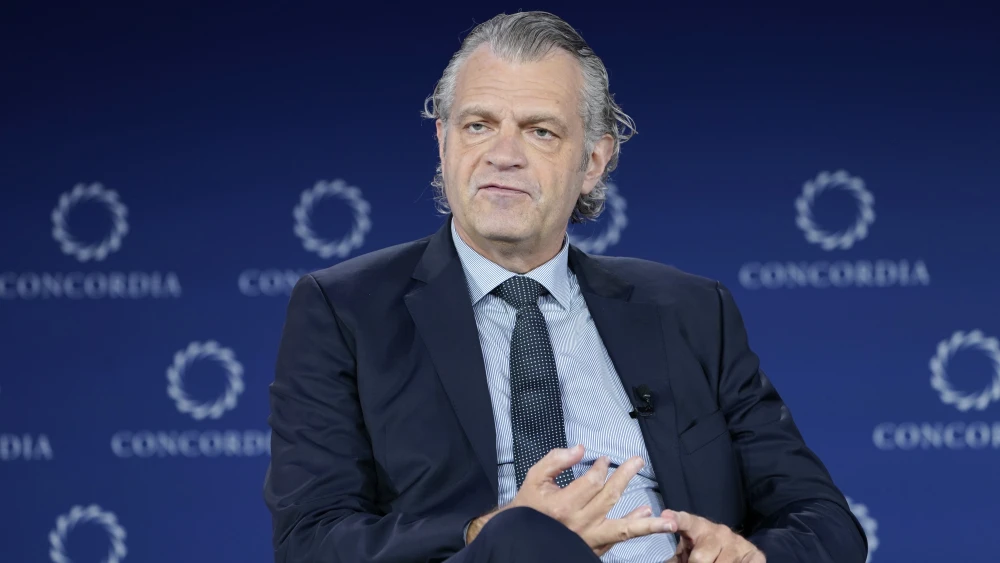
When the Berlin Wall came down in 1989, Daniel Diermeier was 24 and living in his native West Berlin. His memories remain sharp. The border guards, the land mines, the machine guns, and how the “nasty” men on the other side became, almost overnight, “the nicest people you were ever going to meet.”
“From one day to the next, it was gone,” the chancellor of Vanderbilt University told JNS, of the wall that had divided East and West Berlin. “That taught me that people and institutions really matter.”
The lesson of that experience—that institutions shape behavior, and strong ones depend on a clear set of values—has guided him during a decades-long academic career.
Diermeier spoke to JNS at length ahead of the opening of the highly ranked, private Nashville university’s opening of a campus in New York City, slated for Aug. 25.
At a time when universities across the country have struggled with political polarization and rising Jew-hatred, Vanderbilt has emerged as an increasingly popular destination for Jewish students and families.
Jewish students make up about 15% of the school’s undergraduate population, or roughly 1,000 to 1,100 students, according to Hillel International.
Diermeier spoke to JNS about why he thinks Jewish families increasingly seek out the rigorous institution and why, under his leadership, Vanderbilt has largely avoided many of the problems plaguing the nation’s top universities.
Central to Diermeier’s approach is what he calls a “clarity of purpose and values.”
“Universities are struggling, in part, because they’re trying to manage their external and internal constituencies, and there’s just no alignment on that or clarity on that,” he told JNS. “The moment you lack clarity, you’re in the soup, and then you’re forced to deal with the newest kind of challenge that comes to you without having the guidance of clear principles.”

At Vanderbilt, that approach was tested after Oct. 7. The university maintained what Diermeier calls a policy of “institutional neutrality,” even as it faced pressure to take a position on the war in Gaza and to divest from Israel.
Diermeier recalled one instance in which a group of students displayed photographs of the hostages taken by Hamas while another group displayed images of Palestinian civilians killed in Gaza.
“Make your case, but make your case understanding that we’re members of one community,” he said he told the students.
“The biggest problem is that students sometimes feel they have it all figured out—that they have the right position and that the other person’s position is not morally justifiable on principle,” he said. “So there’s kind of something wicked almost about the other position.”
“That is not very helpful,” Diermeier told JNS. “I think we should encourage each other to learn from each other, even if we disagree with each other. Like Ruth Bader Ginsburg said, to ‘disagree without being disagreeable.’”
For Diermeier, ensuring that Jewish life on campus is allowed to “thrive” is a top priority.
In addition to active Hillel and Chabad chapters on campus, the university makes its football field available for Chabad’s annual Pesach Seder, which draws athletes and “over 600 happy students celebrating their tradition and community,” he said
In addition, the school makes an effort to combat Jew-hatred not simply through enforcing rules against it but by creating a culture that refuses to invite it.
“You will never solve this if this is all about rules,” Diermeier said. “This needs to be a culture. The university needs to be crystal clear that every group of students on campus needs to thrive, and there needs to be a place where we can have civil discussions and disagreements on important issues.”
The Jews at Vanderbilt are “wonderful students,” he said, and bring a “particular perspective and particular cultural traditions” to campus.

“Especially in today’s polarized environment, it’s so important that we bring together students that have different backgrounds,” he told JNS. “That is so critical, and it is a really important mission of what universities are all about.”
Leading a university is “a very challenging and rewarding job” for Diermeier.
The first in his family to attend college, he served on the faculties of Northwestern University and Stanford University, and then as dean of public policy and later provost at the University of Chicago.
Since joining Vanderbilt on July 1, 2020, he has found that the role is most rewarding “when the times are challenging.”
“I think that’s really when, as a leader, you have the biggest opportunity to make an impact,” Diermeier said.
The job combines the roles of “CEO of a midsize company,” “mayor of a small town” and “academic leader,” Diermeier said. He believes it has also changed significantly in recent years.
“We’re not in calm waters,” he told JNS. “If you encounter calm waters, incrementalism and small changes work well. But we’re not in calm waters right now.”
He now has to navigate challenges posed by artificial intelligence, affordability and shifts in the “global environment” affecting international students. At the same time, he said, universities have become increasingly politicized—a change he believes began long before Oct. 7 and continues to pull them away from their core mission.
The role of a university “is to be a place of pathbreaking research and a transformative education,” Diermeier said. “Our purpose, our goal is to create knowledge and then convey it and transmit it through teaching and through research publications and the innovative work that our faculty do.”
“We’re not a political party, and we should not join political movements,” he said.
Asked what went wrong at some of the nation’s top schools, including Harvard University, Columbia University and Massachusetts Institute of Technology, Diermeier pointed, in part, to a “significant, not very large but not trivial either, group of faculty,” which believes that universities “should be combatants” and “take sides in a political battle.”
He traced the origins of this shift back to the 1960s, when questions about whether universities should choose sides in political battles began to take hold.
Those tensions resurfaced in later debates over political correctness and free speech but were never fully resolved, he said.
“We have not, as an industry, addressed it properly, and so we have been sliding over time,” he told JNS. “We have been drifting, if you will.”
What may have been easier to ignore before came to a head after Oct. 7, Diermeier said. The attacks “forced you to put that issue on the table,” because the movement to boycott Israel, for example, “wants the university, as an institution, to take a position on the Israeli-Palestinian conflict.”
“Institutional neutrality is basically saying, ‘OK. Unless an issue is directly affecting the core functioning of the university—its research and teaching mission—the university should not take any political positions,’” he said.
“Not only on the Israeli-Palestinian conflict, but not on any other foreign-policy, not on any other contested foreign-policy, domestic-policy issues that’s not directly connected to it,” Diermeier said.
That position does not impose limits on what students or professors may say, Diermeier stressed. Rather, it separates the speech of individuals from the institutional voice of the university.
“It’s not the role of universities to settle debates but to encourage them,” he said.
That principle works alongside Vanderbilt’s commitment to free expression and civil discourse, according to Diermeier.
“We don’t shout each other down,” he told JNS. “We don’t demonize each other just because we disagree.”
Most students are not prepared in high school to engage in this kind of civil discourse, according to Diermeier. Teaching them to “challenge conventional wisdom” and build enough trust to speak freely without fear of exclusion takes “a huge amount of programming that starts literally on day one,” he said.
“It goes on for months, arguably throughout their entire education at Vanderbilt,” he said.
Diermeier told JNS that he has observed a noticeable increase in Jewish students seeking admission to Vanderbilt. The university has not made an explicit effort to recruit more Jewish students, but through “creating a welcoming environment where they can thrive,” the word has spread, he said.
JNS asked Diermeier what he thinks other university presidents have failed to learn in the last few years and what they can do better.
“Clarity of purpose and the courage to act on your convictions is critical,” he said. “There’s a little movement on that.”
“There are a couple of universities that are moving in that direction now, but it needs to be, I think, more,” he said. “With more urgency and with more clarity.”
Schools need to admit, publicly and internally, that “we kind of lost our way a little bit, and now we’re committed to these principles, and now we’re going to act on them,” he told JNS.
“We need to act with more urgency as universities, because we are losing the trust of the American public. It’s not going well,” he said. “Careful maneuvering is just not going to do it.”