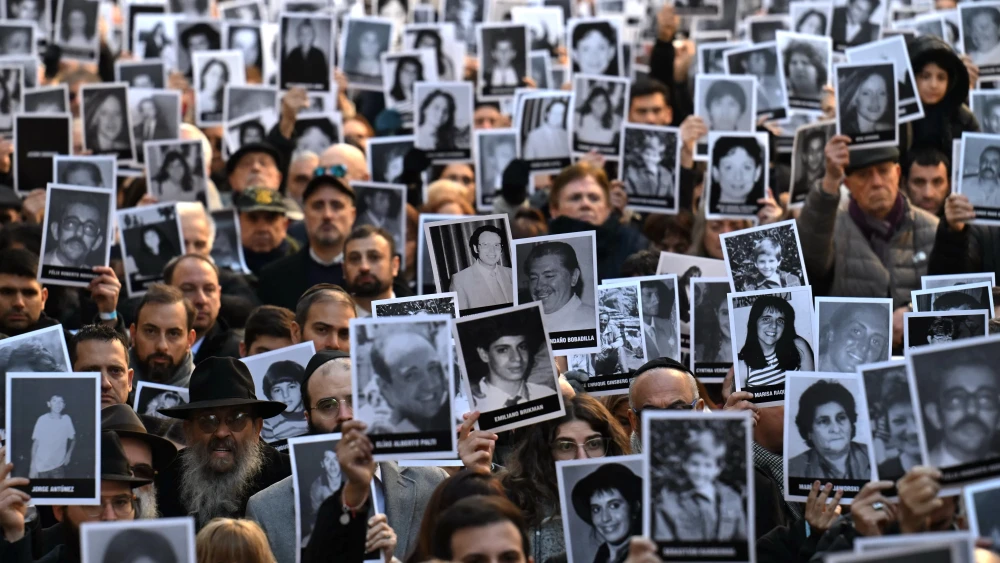
An Argentine court has formally charged seven Iranians and one Lebanese national with involvement in the 1994 bombing of the Jewish community center in Buenos Aires, in a historic legal advancement of the Latin American country’s deadliest terror case, Argentina’s Justice Minister announced on Monday.
The ruling, issued by Federal Judge Daniel Rafecas, targets the prime suspects who remain at large three decades after the attack on the AMIA Jewish community center, which killed 85 people and injured more than 300.
The Argentinian court found that the attack, which it described as “a crime against humanity,” was ordered by the highest echelons of the Iranian regime and was carried out by the Lebanese Hezbollah terrorist group, which serves as the Islamic Republic’s proxy.
The eight suspects ordered to stand trial include former Iranian Intelligence Minister Ali Fallahijan, former Iranian Foreign Minister Ali Velayati, and Lebanese Hezbollah operative Salman Raouf Salman.
Iran has refused to extradite the suspects.
The court slapped each of the accused with a $500 million lien, the Buenos Aires Times reported on Monday.
The judge also pointed to a possible connection between the bombing of the Jewish community center and the 1992 attack on the Israeli Embassy in Buenos Aires, which killed 22 people.
Because all of the suspects remain at large, Argentina is using a legal mechanism approved under President Javier Milei’s government last year to try the defendants without them being physically present.
A legal ‘milestone’ in the fight against impunity
“The processing order by the Federal Justice in the AMIA case marks a milestone in the fight against impunity,” Argentinian Justice Minister Juan Bautista Mahiques wrote on X Monday, announcing the move. “A historic step in favor of the 85 victims, their families and all of Argentine society.”
Milei welcomed the announcement, tweeting: “Morality as state policy!”
Argentina has long maintained that senior Iranian officials operating through its Lebanese terrorist proxy Hezbollah played a key role in the attack. But three decades of government probes delayed and marred by corruption, coupled with Iran’s refusal to hand over any of the suspects sought for trial, have not yielded any conviction for the bombing to date.
The Argentinian Ambassador to Israel told JNS Tuesday that the landmark legal action was “a moment of justice” after three decades of inaction.
“While previous governments signed a memorandum with Iran to cover up the terrorist attacks, we signed a memorandum with Israel in defense of life and democracy and against terrorism and antisemitism,” said Ambassador Axel Wahnish. “Under the leadership of President Javier Milei, Argentina has left the axis of evil behind to align itself with the side of good.”