
Recently, there has been much talk about the radical anti-Israel movement’s total imperviousness to logical thought and factual discourse.
A plethora of ideas have been pursued to uncover the roots of this problem. However, it can be argued that all these noble efforts have failed because the problem’s source lies outside rational thought in the twilight world of myth.
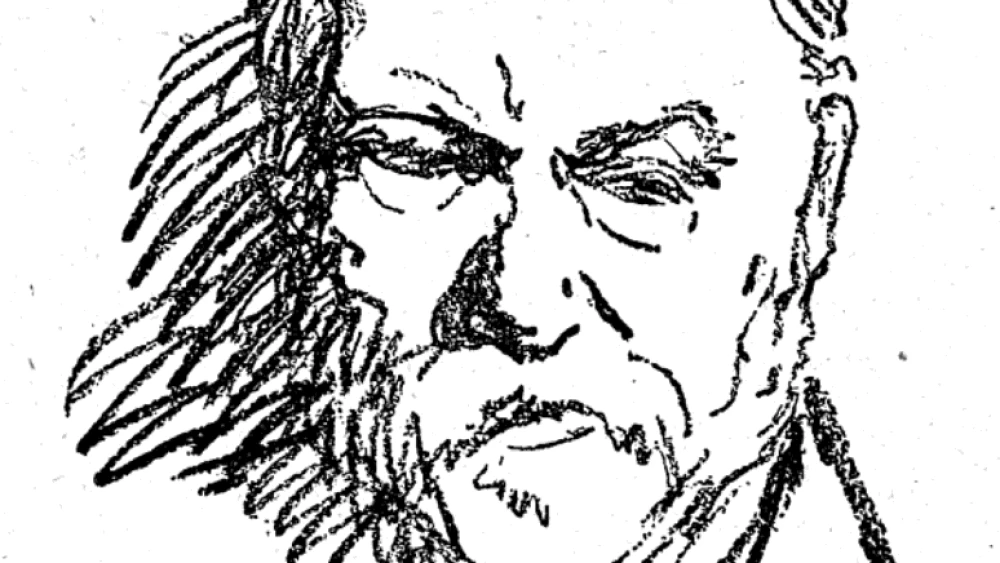
To understand this descent into the irrational, one must look to the French political theorist Georges Sorel and his seminal 1908 work, Reflections on Violence.
Sorel posited that mass movements are rarely galvanized by reasoned policy, economic calculations or verifiable history. Instead, the masses are swept up by what he termed a “social myth”—a grand, emotionally charged and unalterable vision of absolute good versus absolute evil.
As Sorel presciently observed, “A myth cannot be refuted, since it is, at bottom, identical with the convictions of a group, being the expression of these convictions in the language of movement.” Such a myth is, in other words, a secularized religious conviction.
The “Palestine First” fanaticism observed across Western institutions today is a modern manifestation of Sorel’s myth; one in which the act of revolutionary disruption becomes an end in itself.
Sorel’s myth was expressly conceived as a tool to destroy what he considered the corrupt parliamentary system of the French Third Republic. Many contemporary radicals echo his belief that direct, violent action can shatter a decaying bourgeois society and rejuvenate the nation, coupled with Sorel’s rejection of democratic compromise.
Indeed, Sorel explicitly argued that the social myth acts to isolate a revolutionary cadre from the rest of society, making it completely unyielding to the compromises inherent in a parliamentary system.
He sacralized violence itself as a means of regenerating the body politic through class warfare. In his view, violent struggle restores heroism and virtue to society, saving it from the corruption of compromise and soft moderation. He wrote, “Proletarian violence not only ensures the future revolution, but it also seems to be the only means by which European nations, stupefied by humanitarianism, can recover their former energy.”
Unlike orthodox Marxists, who demanded adherence to a strict historical determinism, Sorel championed the clash itself. It should come as no surprise that his ideas exercised a strong influence on Italian fascist leader Benito Mussolini, a former anarchist and socialist, who famously declared, “What I am, I owe to Sorel.”
“Palestine” is a new realization of Sorel’s political myth: an ahistorical nation whose liberation from the “perfidious Jews” serves as a galvanizing force for society’s malcontents. In the minds of the true believers, isolating, abusing and even killing Jews are purification rituals in the service of societal redemption.
The myth itself is self-contained and not open to criticism or contradiction. Attempts by Jews and others to refute it by referring to “Jewish indigeneity” or “Zionism as an anti-colonial movement” are thus an exercise in futility.
To understand how this myth achieved such dominance, one must examine its symbiotic relationship with the academic industry of “postcolonial theory.”
In the hands of contemporary campus radicals, decolonization is no longer treated as a historical, mid-twentieth-century process of administrative withdrawal or institutional transition. Instead, it has been elevated into a supreme Sorelian abstraction. Decolonization functions as an absolute metaphysical cleansing agent that divides the globe into static zones of pristine victimhood and irredeemable criminality.
This theoretical machinery transforms complex geopolitical realities into a binary morality play.
Consider the boilerplate language found in the immediate post-Oct. 7 statements issued by various Harvard Undergraduate Palestine Solidarity Committees or Columbia University’s Student Coalition for Justice in Palestine.
These communiqués did not analyze the strategic or humanitarian calculus of the geopolitical situation. They asserted a metaphysical axiom. By declaring that the actions of Hamas were an “inevitable consequence of apartheid” and that the responsibility lay “entirely with the Israeli regime,” these student vanguards demonstrated a textbook Sorelian immunity to empirical tragedy.
The immediate rush to sanitize atrocities as “resistance” reveals that the modern radical values violent rupture not as a tragic means to a diplomatic end, but as a celebratory, purifying act of cosmic justice.
The theoretical machinery transforms complex geopolitical realities into a binary morality play.
By stripping history of its intricate geopolitical friction, the decolonial framework provides the modern radical with a pseudo-intellectual dispensation. The savage atrocities of Oct. 7 are not evaluated as war crimes or strategic catastrophes; they are celebrated as the pure, unmediated physics of Sorelian direct action.
This theory actively sanitizes violence by framing it as a clinical necessity to achieve historical equilibrium. Consequently, the radical cohort is granted total moral immunity, enabling them to view the physical harassment and systematic exclusion of Jewish peers not as bigotry, but as the result of a grand historical correction.
This structural immunity to reason highlights the deep, often unacknowledged genealogical link between the modern radical left and the foundational mechanics of twentieth-century fascism.
When Mussolini famously credited Sorel for his political awakening, he was recognizing a fundamental truth about mass psychology: That the ultimate political currency is not the cold rationality of materialist economics, but the intoxicating aesthetic of collective struggle.
The physical manifestation of this aesthetic became obvious in the coordinated campus encampments that swept Western universities. The encampment operates as a physical microcosm of Sorel’s autonomous revolutionary cadre—a literal “liberated zone” insulated from the laws and norms of the surrounding bourgeois institution.
Within these barricades, the enforcement of ideological conformity, the ritualized chanting of absolute slogans like “from the river to the sea” and the physical exclusion of the uninitiated are not viewed by the participants as totalitarian behavior.
Rather, they are experienced as a form of sublime spiritual awakening. The absolute nature of the myth demands absolute space, free from the contaminating influence of external critique or institutional neutrality.
Orthodox Marxism faltered because its strict reliance on historical determinism and economic data required a patient submission to historical phases. Sorel shattered this paradigm by prioritizing the volcanic energy of the myth over the tedious calculations of the bureaucrat.
Today’s campus radicals, despite being wrapped in the progressive lexicon of liberation and equity, are the direct psychological descendants of this Sorelian synthesis. They share an identical totalitarian contempt for liberal democratic compromise, institutional neutrality and parliamentary patience.
For both the mid-century fascist and the contemporary academic vanguard, the preservation of institutional stability is viewed as a form of moral decay. As Sorel stated, “The sublime is dead in the bourgeoisie and it is doomed to possess no ethic in the future. ... They are always ready to accept any compromise, to satisfy the demands of the crowd, provided only that they are not driven to extremities.”
Ultimately, the contemporary crusade against the Jewish state cannot be dismantled by the traditional tools of academic debate or diplomatic compromise, for it does not exist within the realm of rational geopolitics.
As Sorel presciently demonstrated over a century ago, a social myth operates as an emotional monolith, entirely insulated from the corrosive influence of factual intervention. The slogans, iconography and institutional dogmatism observed across the West today are not the products of a reasoned political movement; they are the liturgical expressions of a secularized religious fervor that values revolutionary disruption as an end in itself.
To counter this growing tide, Western defenders of reason must stop treating the issue as a political debate that can be influenced by data. Instead, the anti-Israel movement must be recognized for what it truly is: A powerful, irrational Sorelian myth that threatens to dismantle the very foundations of objective truth and institutional stability.