Tareq Al Banai, the Kuwaiti ambassador to the United Nations, said on behalf of Saudi Arabia, Qatar, Bahrain, the United Arab Emirates and Jordan on Thursday that the Gulf states seek to reintroduce a U.N. Security Council resolution to protect shipping in the Strait of Hormuz.
Al Banai’s call came after a controversial Chinese and Russian veto of an earlier draft of the resolution on April 7. “The Gulf region lies at the heart of global economic stability,” the Kuwaiti diplomat said. “Its security is inseparable from global security.”
The six countries backed the draft that China and Russia vetoed, which “encouraged” U.N. member states to coordinate defensive measures to protect navigation through the strait. That included escorting ships and deterring attempts to disrupt maritime traffic. It also called Iran’s blockade a threat to international peace and security.
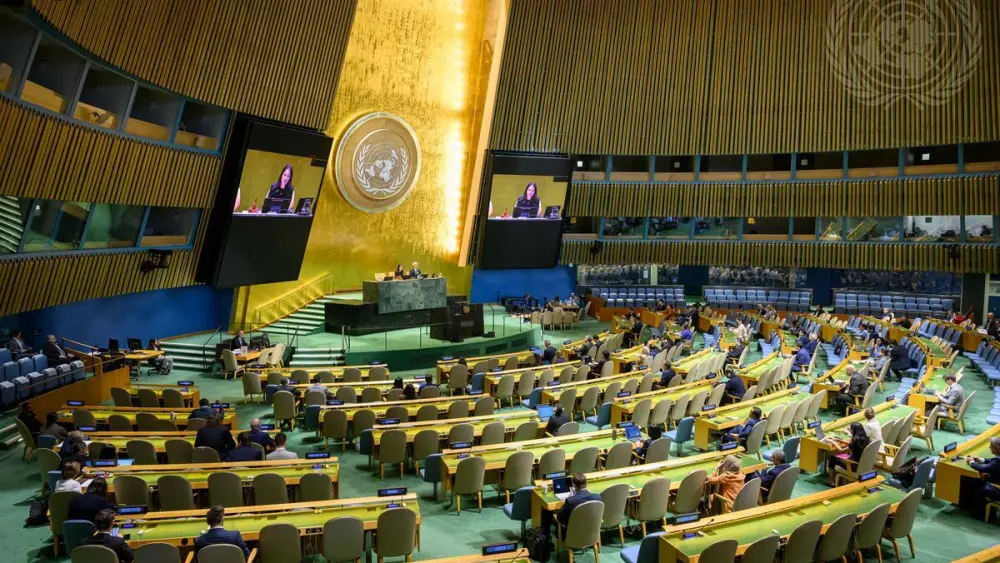
When at least one of the Security Council’s five permanent members vetoes a resolution, it triggers a General Assembly session automatically.
Al Banai said that the group will “continue coordinating closely with member states in preparation for submitting a new draft resolution” in “recognition of the seriousness of the current threats.”
Oil and gas prices have risen significantly after Iran effectively closed the strait during its war against Israel and the United States. Iranian threats to attack ships in the strait, through which nearly 20% of the world’s oil supply typically passes, have led to major disruptions of global supply chains.
Iran allowed certain vessels through at times charging hefty fees, before Washington recently announced its own blockade of the strait.
The Security Council’s failure to adopt the resolution “sends the wrong message to the world that threats to international waterways can occur without a firm collective response from the international body responsible for maintaining international peace and security,” Al Banai said.
Mike Waltz, U.S. ambassador to the United Nations, told the General Assembly that Washington stands with its Gulf allies “in this time of reckoning.”
The U.S. envoy said it was “truly unfortunate” that China and Russia vetoed the draft resolution. He also said Iran is trying “to take each of your economies hostage.”
Anna Evstigneeva, deputy Russian envoy to the global body, said that the Security Council was “effectively being asked to give a green light for the use of certain defensive measures under the pretext of ensuring maritime security.”
“This would have amounted to a carte blanche for continued aggressive actions and further escalation,” she said.
Russia supplies critical weaponry to Iran in violation of a U.N. Security Council resolution, and Iran supplies Russia with attack drones for use against Ukraine.
“What we are seeing right now in the Strait of Hormuz should concern every country,” Danny Danon, the Israeli ambassador to the United Nations, told reporters.
“Iran is trying to choke one of the world’s most important water waves and turn it into a weapon,” he said. “They block ships, they harvest them, then they name a price. Pay and you pass, refuse and you are stopped.”
“That is not trade,” Danon said. “That is economic terrorism.”
“After weeks of negotiations, even a stripped-down Security Council resolution was vetoed,” the envoy said. A “clear resolution” must address the Iranian regime’s efforts to produce nuclear weapons, its missile production and its terror proxies, he added.