



“Who’s controlling the media? Who’s controlling the strong machine?”
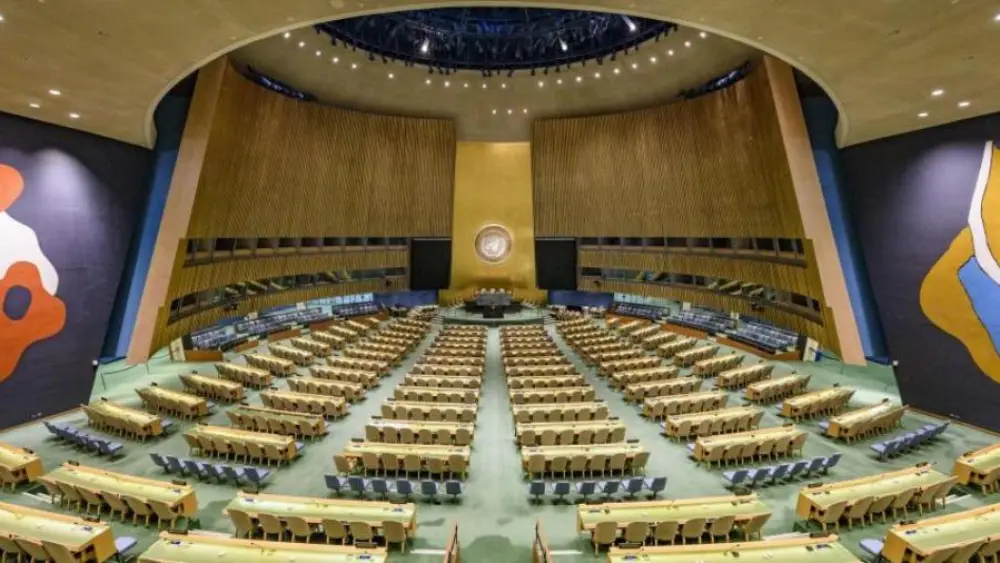
These were the questions asked by Montaser Marai, Al Jazeera‘s Manager for Media Development, at a Nov. 4 U.N. seminar, titled, “International Media Seminar on Peace in the Middle East.” The seminar, organized by the U.N. Department of Global Communications, was aimed at using “journalists, media experts, think tanks, diplomats, and members of academia” to “sensitize public opinion to the question of Palestine.”
For 40 years, the Committee for Accuracy in Middle East Reporting and Analysis (CAMERA) has worked to promote accuracy in media and fair treatment of the Jewish people and the Jewish state. By contrast, these values appear to be anathema to much of the U.N. apparatus, as the U.N. seminar demonstrated. Antisemitic conspiracy theories have become normalized, and journalism has been converted from a truth-seeking tool to a weapon for partisan activism.
So, who does control the media and the “strong machine,” according to Marai, a featured panelist at the U.N. seminar?
That would be the “Center of Powers,” declared Marai, who confided to the audience that it makes him “scared to say anything” because of unfair accusations of antisemitism the “Center” employs against people like him. The same Center also targets Palestinian journalists, “even out of Palestine,” he added.
Marai’s cited evidence for the existence of this monolithic media-controlling entity is the case of several Deutsche Welle journalists who lost their jobs after CAMERA exposed their promotion of anti-Jewish terrorism and tropes, including their claims of Jewish control and “fabricating” the Holocaust.
Conveniently omitting the journalists’ own objectionable rhetoric, Marai suggested they lost their jobs over unproven allegations of antisemitism and that this, in turn, is evidence of a shadowy “Center of Powers” that controls the media by weaponizing antisemitism for its own nefarious purposes.
The moderator of the panel, Director of the UN Information Service Alessandra Vellucci, did not challenge any of Marai’s conspiratorial and bigoted rantings. Rather, she expressed her gratitude towards Marai for his remarks, thus imitating earlier silent acquiescence by other U.N. officials to such claims of “Jewish lobby” control during the July 2022 anti-Israel U.N. Commission of Inquiry.
One might forgive Marai for conspiratorial thinking regarding media control, given that he works for an outlet controlled by the repressive Qatari government. However, many inside the United Nations seem all too comfortable with suggestions that a manipulative Jewish cabal controls the levers of power.
When people buy into such bigoted and delusional conspiracy theories, it is unsurprising that they would then also justify prejudice and bias against the Jewish collective, embodied today by the Jewish state of Israel.
That was, indeed, the other message of the seminar. In the words of Marai, “As a journalist, you have to be biased” against Israel. Fellow panelist Ali Ghaith, a U.N. Development Programme communications analyst, readily agreed, insisting that: “We can become activists and journalists... [T]his is who we are and this is our story and this is our narrative, and the people around the world, they would have to get used to that and listen to us....”
This is not new. Similar messages have been delivered in previous annual U.N. media seminars on the Middle East. For example, at the 2021 seminar, Palestinian journalist Daoud Kuttab promoted his method of inventing an “Israeli perspective” to debunk, rather than having to debate a real voice from Israel’s mainstream. Kuttab offered his method as a form of “solutions journalism,” but a more accurate name for this would be “straw man journalism.”
If left unchecked, bigotry and biased reporting can create a vicious, self-reinforcing cycle. And it is exactly such a cycle that these U.N. media seminars have been working to create. At a time when antisemitism is reaching disturbing levels, we must expose how such an influential institution as the United Nations is contributing to it. And if we are to stem the tide of hatred and restore accuracy in Middle East reporting, we must vigorously respond to such efforts.
David M. Litman is a media and education research analyst at the Committee for Accuracy in Middle East Reporting and Analysis (CAMERA).
This article was originally published by CAMERA.


