Newsletter
Newsletter Support JNS

Telephone service opens between Israel and the UAE

“Additional agreements will be reached with Gulf countries, like Bahrain and Oman,” Israeli Intelligence Minister Eli Cohen tells Army Radio.

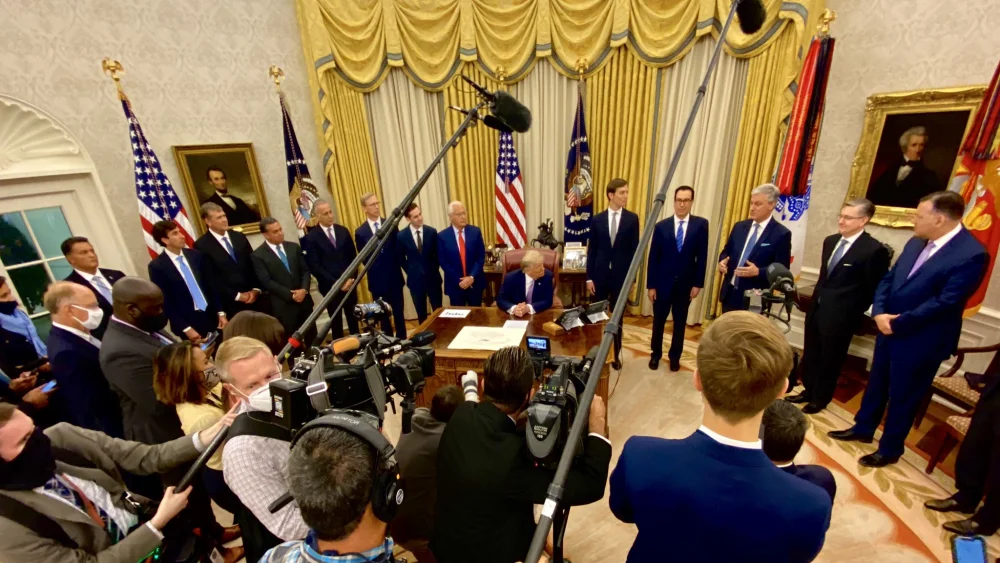
Members of U.S. President Donald Trump's Middle East peace team and foreign dignitaries from the United Arab Emirates gather at the White House on Aug. 13, 2020. Credit: White House Deputy Chief of Staff for Communications Dan Scavino Jr./Twitter.
Members of U.S. President Donald Trump’s Middle East peace team and foreign dignitaries from the United Arab Emirates gather at the White House on Aug. 13, 2020. Credit: White House Deputy Chief of Staff for Communications Dan Scavino Jr./Twitter.

The United Arab Emirates and Israel opened up telephone service on Sunday as part of the normalization deal between the two countries brokered by the Trump administration.

UAE Foreign Minister Sheikh Abdullah bin Zayed Al Nahyan called his Israeli counterpart Gabi Ashkenazi, and Israeli Communications Minister Yoaz Handel issued a statement “congratulating the United Arab Emirates on removing the blocks,” according to the AP.

Israeli news websites that had previously been blocked by the UAE government could also be accessed from the Gulf state, the report said.

Separately, Intelligence Minister Eli Cohen told Army Radio that more normalization deals were in the works.

“Additional agreements will be reached with Gulf countries, like Bahrain and Oman,” said Cohen, adding that in the coming year, there is a chance for additional agreements in Africa, especially with Sudan and Morroco.

“It looks as if the Genocide Caucus in Congress will continue to grow,” Dan Schnur, a political science lecturer, told JNS.
Ahead of the JNS Summit, the Bosnian Serb leader explains her strong support for the Jewish state and warns of Iranian influence in the Balkans.
A coalition of Jewish groups called the law “an important step forward, giving law enforcement and prosecutors additional tools to protect targeted communities and hold offenders accountable.”
The participation of campus-affiliated groups like CUNY for Palestine “openly encouraging and providing support for terrorism and extremist ideologies,” Jayne Zirkle of EndJewHatred told JNS, “represents a serious challenge that universities can no longer ignore.”
After 35 years working across the continent, entrepreneur Haim Taib tells JNS he sees it as the next frontier for Abraham Accords cooperation.
The Islamic Republic is seeking to recover economically and militarily through the memorandum of understanding with the U.S., while avoiding any relinquishment of long-term strategic assets.