
I was walking from the Denver Convention Center to the Hyatt Regency, the two locations for the Jewish National Fund-USA’s Global Conference for Israel, when a woman standing on a fence and wearing a keffiyeh around her face shouted at me: “Baby killer!” The protesters behind her shouted, “You have blood on your hands!”
Instead of shouting back, instead of fighting, I smiled and kept walking. I knew in my heart how absurd they were. I knew how mentally ill they were. And I wasn’t going to give them an inch.
Not only that, but I wasn’t going to give in to the negativity. I was going to turn this interaction into something positive. Since Shabbat was coming soon, Hashem handed me the perfect opportunity.
I’d flown into Denver the day before. I’d gone to the conference to speak about Israel in the media on a panel with JNS managing editor Carin M. Smilk and Ynet correspondent Daniel Edelson. I was also covering the conference for the Jewish Journal of Los Angeles, where I’m a community editor.
I had never been to a JNF conference for Israel, but leading up to it, I did think about canceling. I was scared: What if the protests turned violent? What if someone followed me back to my hotel and tried to assault me? What if terrorists were planning an attack?
Before I made my decision, I asked my rabbi, who had just gone on a rabbinical mission to Israel, if I should go. “Yes, you should go and show your support,” he said. “If I was safe in Israel, you’ll be safe there.”
That convinced me. I packed up my belongings, kissed my husband and daughters goodbye, and prayed that everything would be OK. As soon I landed in Denver, I headed over to the Eastside Kosher Deli to pick up a delicious lunch and everything I would need for Shabbat: grape juice, challah and food. Though there would be a Shabbat dinner at the conference, as a Jewish mother, I know you can never have enough food—just in case. Once I got everything ready, I thought, “I’m all set!”
And then the next day, after the protesters yelled those hateful things at me, I realized: I didn’t have any candles to light for Shabbat.
I quickly messaged one of the organizers of the conference and asked if there would be candle-lighting before dinner. Yes, they’d have electronic candles. I told her I’m Orthodox and need real candles. I learned that the fire marshal wouldn’t allow it in the convention center itself, but that we could light candles in our hotel room. The only problem? I wasn’t staying at that hotel. I didn’t want to leave tea lights burning in my room and miss Kabbalat Shabbat prayers, and possibly the dinner, too.
I messaged the organizer again: “What can I do?” I anxiously waited for her response while I called two local Chabad Houses, which told me I could come to them and pick up candles if I wanted to, but I wouldn’t have gotten there in time.
I then asked a fellow observant journalist I met if she was going to light.
“I don’t have any candles,” she told me. “I thought there would be candle-lighting before the dinner?”
Oh no, I thought. I couldn’t light and neither could my new friend. What were we going to do?
With the clock racing closer towards Shabbat, I was starting to panic. I prayed to calm myself down and thought, “It will work out. It has to.”
Then, in the afternoon, the organizer finally messaged me back.
“I have someone I can connect you with,” she wrote. “She said you can light candles in her room.”
She connected me to a woman I’d never met before. I texted this woman a thank you and asked, “Do you have extra candles?”
“Only two,” she said.
“OK, let me go search for more,” I said. “My friend also wants to light.”
I briskly walked around downtown Denver, dodging some sketchy, strung-out characters and snow that had accumulated on the ground the night before. I found a CVS and looked for tea-light candles, but to no avail.
“Oh, geez,” I thought.
I didn’t have time to drive anywhere else, so I went outside, dejected.
Then, I saw a Walgreens.
I rushed inside, circled and circled around the store until I found the candle section, and spotted a goldmine: a bag of 50 tea lights.
“Thank you, Hashem!” I said out loud, not caring who heard me.
I checked out and then headed back towards the convention center. I saw the protesters outside, so I turned on my camera and started to record myself in front of them.
“I’m at the Denver Convention Center, where they are protesting … let’s just say Jews. I scrambled to find Shabbat candles,” I said. “I forgot mine. Thank you, God. Thank you, Hashem for making me forget mine because I got a whole bunch.”
I uploaded the video to Instagram and X, and texted my Chabad rebbetzin: “Look, I’m a shaliach now!” In typical awesome Chabad fashion, she said, “All Jews are shaliachs!”
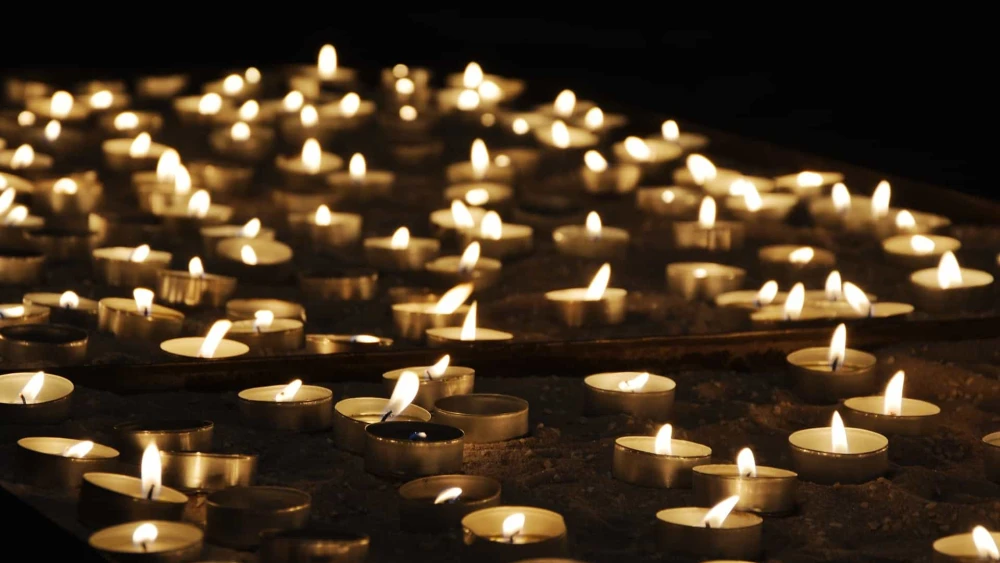
I got inside and handed out candles to random women I didn’t know, as well as some friends. And then, once candle-lighting came at 4:18, five of us from all different Jewish backgrounds came together and lit inside of a hotel room. The woman who was staying there, I learned, was also Chabad and lived in the Crown Heights neighborhood of Brooklyn, N.Y. She stayed with the candles until they went out.
As Jews, it’s our mission to be a light unto the nations—a mission I take very seriously since my name is Kylie Ora (Hebrew for light”).
I am an Orthodox Jewish convert and a proud member of the Jewish community. I didn’t fear these protesters; I only fear Hashem. And I love Hashem. I love being a Jew.
We cannot let antisemites or loudmouths get us down. We must keep spreading our light, especially during Chanukah. We can only destroy the darkness with the light.
Am Yisrael Chai, and Happy Chanukah!