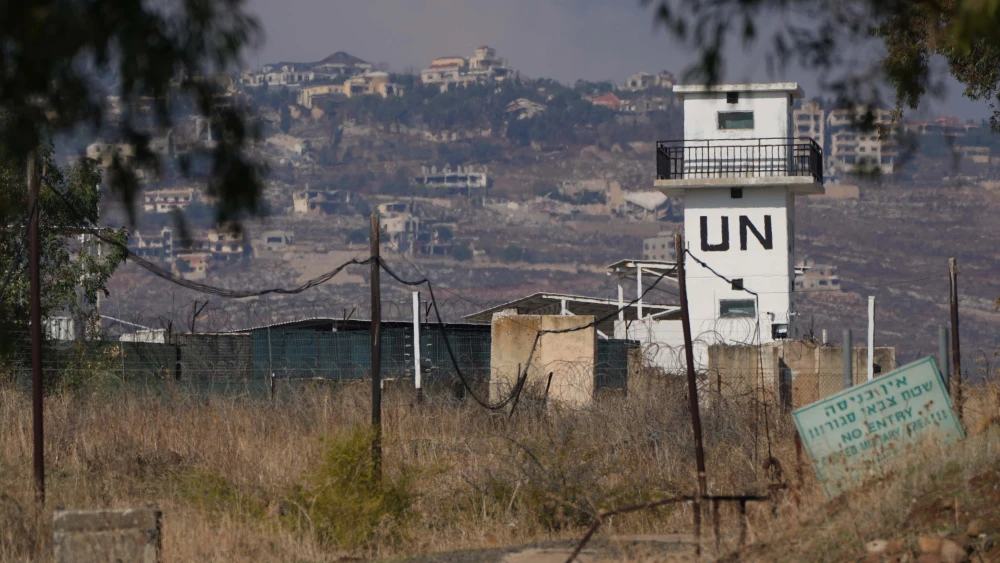
The U.N. Security Council voted unanimously on Thursday to extend the mandate of the U.N.’s peacekeeping mission in Lebanon one final time.
The U.N. Interim Force in Lebanon, or UNIFIL, monitors the Israel-Lebanon ceasefire and helps the Lebanese Armed Forces disarm Hezbollah and restore Lebanese government control to the south of the country. Its mandate was slated to expire on Sunday.
The council voted on Thursday to “extend for a final time the mandate of UNIFIL” until Dec. 31, 2026.
“For a change, we have some good news coming from the United Nations,” Danny Danon, the Israeli ambassador to the global body, said after the vote.
The envoy added that UNIFIL failed in its mission to stabilize the region.
The French-drafted resolution, which passed on Thursday, states that “an orderly and safe drawdown and withdrawal” must begin within a year of the mandate’s expiration and calls for Israel to withdraw forces north of the so-called Blue Line, the unofficial border between Israel and Lebanon.
“Today, the Lebanese government has a responsibility to take control of the area and to understand that they have to be there—not Hezbollah, or anyone else,” Danon stated.
Dorothy Shea, interim U.S. ambassador to the United Nations, told the council that “the first ‘I’ in UNIFIL stands for ‘Interim.’ The time has come for UNIFIL’s mission to end.”
Shea pointed to a “radically different” Lebanese security environment than what existed a year ago before Israel’s decapitation of Hezbollah’s leadership and infrastructure, and said the United States “will continue to work with the LAF to expand its capabilities as Lebanon carries out its critical work in disarming Hezbollah.”
Lebanese President Joseph Aoun stated that he hopes UNIFIL’s remaining time “will be an opportunity to rescue the Lebanese situation and stabilize the situation on our southern borders.”
Not everyone showed support for UNIFIL’s closure.
Even as China voted with the other 14 members of the council, Geng Shuang, Beijing’s deputy U.N. ambassador, lashed out at the “total disregard of the tensions on the ground,” of the “legitimate concerns of Lebanon as a host country, and in total disregard of the strong voices of the vast majority of the council members,” showed by Washington, which he named only as “a permanent member” of the council.
“This practice of imposing one’s will on others and taking ill-conceived and arbitrary actions is disappointing,” Geng said.