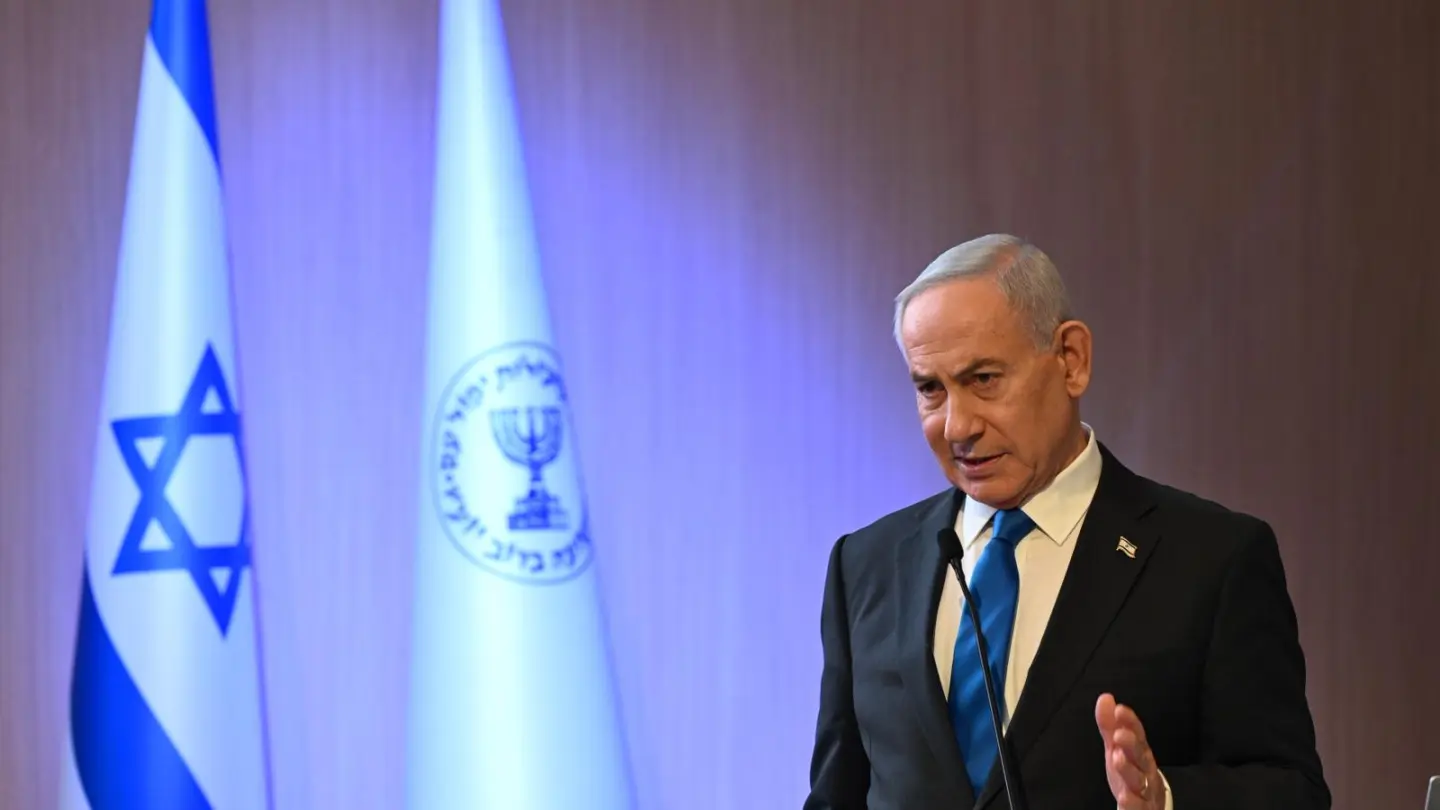
Israeli Prime Minister Benjamin Netanyahu stated on Feb. 22, in an address delivered at a security conference, that Israel seeks to construct “an axis of our own” composed of states that oppose both axes of radical Islam, the Shi’ite and the extremist Sunni ones.
“The purpose of this axis,” Netanyahu explained, “is to connect states that share a common understanding of regional realities and the threats they face.”
He described his vision as a form of “alliance system” or “network of partnerships” that would link not only Israel and India, but also Arab states, African countries, Greece, Cyprus and additional unspecified Asian partners.
Netanyahu emphasized the importance of deepening ties with India and called for the formation of a durable alliance to confront manifestations of radical Islam that threaten regional stability.
He praised India and characterized bilateral cooperation as vital in both economic and security domains, underscoring the aspiration to develop a partnership grounded in shared principles of moderation, mutual respect, and progress.
Within this framework, Netanyahu noted that Israel is interested in establishing a new regional “model of cooperation” that would connect states with converging interests in countering shared threats.
Senior diplomatic sources indicate that this approach reflects Netanyahu’s broader strategic conception of reshaping the region, not merely through a bilateral partnership between Israel and India, but through an expanded network of regional and Asian alliances designed to counter extremist Islamic forces.
According to these sources, the concept envisions a “hexagonal alliance” composed of six principal international partners: Israel, India, Greece, Cyprus, Ethiopia and the United Arab Emirates. This configuration would serve as a defensive arc against radical Islamic axes.
With the current regime in Iran collapsing and the rising likelihood of a new government forming, there is a possibility that the United States and Israel could seek to integrate a “new Iran” into the framework.
Senior security officials assess that Israel is now shifting its strategic focus—from primarily eliminating the Iranian-led Shi’ite axis toward preparing for the emergence of a new Sunni axis that may attempt to fill the vacuum left by a collapsing Iran.
This prospective Sunni alignment, reportedly including Turkey, Qatar, Egypt, Saudi Arabia and Pakistan, is viewed by some Israeli analysts as aspiring to challenge Israel’s regional influence and constrain its strategic maneuverability.
Turkey, regarded as one of the leading states within the Muslim Brotherhood camp, is increasingly perceived in Israel as a potential “new Iran.” Ankara has expanded its influence in Syria, Libya, Sudan and Somalia, and is seen as harboring regional ambitions reminiscent of Iran’s expansionist posture.
Saudi Arabia, meanwhile, is no longer publicly advancing normalization with Israel, largely due to disagreements surrounding the two-state solution and the establishment of an independent Palestinian state.
Riyadh has also entered into a defense understanding with Pakistan, a nuclear-armed state, a development that Israeli observers monitor closely.
Diplomatic sources further emphasize that Israel views the proposed axis not only through a security lens but also as a strategic-economic lever.
Jerusalem aspires to position itself as a central transit hub between Asia and Europe, relying in part on the India–Middle East–Europe Economic Corridor, which aims to connect India to Europe via the Gulf and Israel.
In parallel, Israel is investing in enhanced cooperation with Greece and Cyprus in the fields of energy, natural gas, and maritime transportation, with the objective of transforming the Eastern Mediterranean into a regional energy hub.
Senior diplomatic officials conclude that the envisioned “hexagonal alliance” is not merely a political or security arrangement, but a long-term strategic vision aimed at establishing Israel as a pivotal node in an emerging network of economic and geopolitical interests.
The success of this initiative, however, will depend on Israel’s ability to secure sustained American support in confronting the Iranian-led Shi’ite axis, while simultaneously navigating the evolving dynamics of a potential Sunni coalition in the region led by Turkey and Saudi Arabia.
Originally published by the Jerusalem Center for Security and Foreign Affairs.