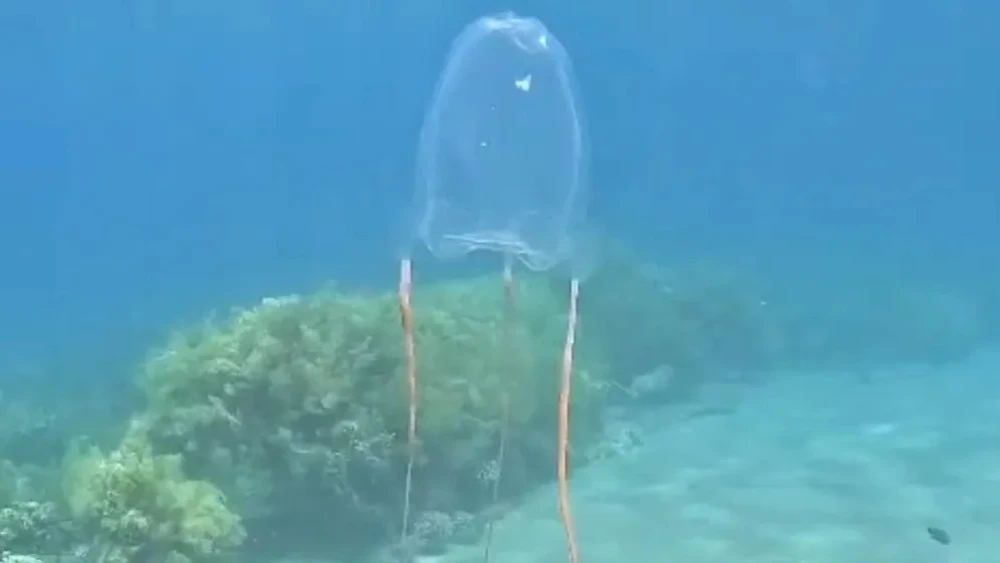
A rare species of box jellyfish has been spotted in the waters of the Gulf of Eilat, prompting the Israel Nature and Parks Authority to urge swimmers to remain alert while stressing there is no reason to avoid entering the sea.
Authorities said only a handful of Alatina grandis jellyfish have been observed, describing the appearance as an isolated event rather than the start of a jellyfish bloom. The species is rarely seen in the northern Red Sea and typically appears only under unusual current and wind conditions.
The jellyfish was identified by Dr. Tzafrir Koplik and Prof. Tamar Gia-Haim through DNA analysis and examination of its distinctive physical features, including its cube-shaped bell and characteristic tentacles.
“It is important to clarify that this is not a swarm of jellyfish, but only a few individuals,” said Dr. Assaf Zevuluni, the Nature and Parks Authority’s Gulf of Eilat ecologist. “The chance of encountering such a jellyfish in the sea is very low, and there is no reason to panic or avoid swimming. Along with enjoying the sea, it is simply important to be aware of the natural environment.”
Box jellyfish are among the world’s most venomous marine animals, with some species capable of delivering fatal stings. The best-known example is Australia’s Chironex fleckeri, commonly known as the sea wasp. However, officials emphasized that the species found in Eilat is different and significantly less dangerous.
According to the authority, the sting of Alatina grandis can be painful and, in some cases, may require medical attention, but it does not possess the highly potent venom associated with Australia’s deadly box jellyfish. The authority said swimmers should exercise normal caution if they encounter the animal but stressed that the likelihood of seeing one remains extremely low.
Marine scientists said changes in the distribution of sea life can occur for various reasons, including climate change and shifts in ocean currents and wind patterns. Such environmental changes can occasionally carry species beyond their usual range.
The authority said the appearance of Alatina grandis in the Gulf of Eilat is consistent with those processes but stressed there is no evidence that the species is establishing a permanent presence in the area.
One of the jellyfish specimens was collected and transferred to research laboratories for detailed analysis. Scientists hope the findings will improve understanding of the species’ distribution and contribute to broader research on the unique marine ecosystem of the Gulf of Eilat, one of Israel’s richest and most biologically diverse marine habitats.
The Nature and Parks Authority advised anyone encountering a jellyfish or other potentially dangerous marine animal to keep a safe distance, avoid contact, warn nearby swimmers and report the sighting to the authority’s hotline.