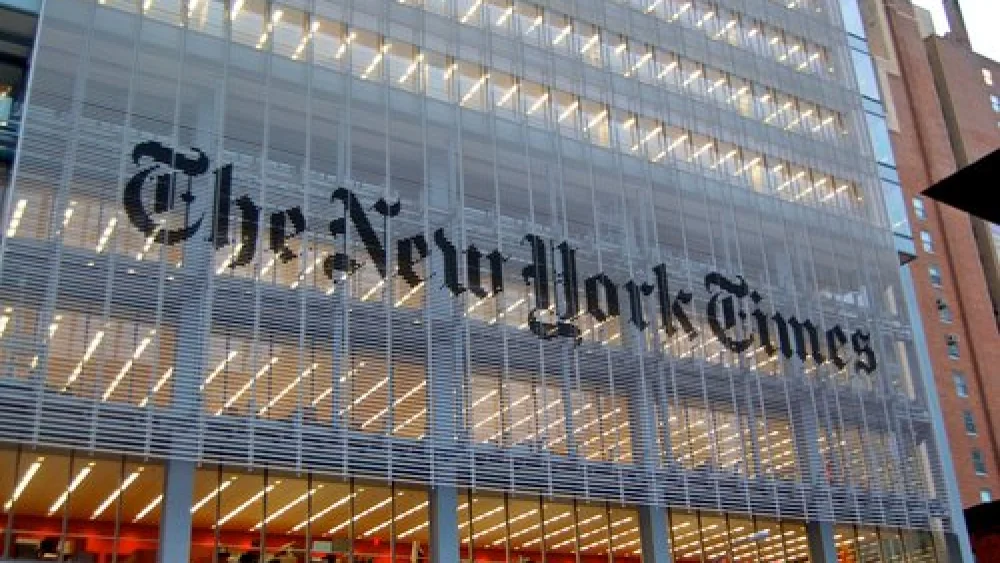

In response to the publication of an anti-Semitic cartoon in last Thursday’s International New York Times, protesters gathered outside the Manhattan office of the “Gray Lady” on Monday evening to demand that those responsible for the blatant display of Jew-hatred be fired.
Among the speakers at the rally were former New York Assemblyman Dov Hikind and eminent law professor Alan Dershowitz, both Jewish Democrats. Hikind led the crowd in chanting, “Shame on The New York Times.” Dershowitz decried the paper’s bias against Israel, and its practice of disguising slant as news coverage and analysis.
The demonstration followed viral social-media indignation over the cartoon, which depicts a blind, kippah-wearing U.S. President Donald Trump led by a seeing-eye dog (Israeli Prime Minister Benjamin Netanyahu) with a Star of David hanging from his collar.
Initially, the “paper of record” issued a clarification, claiming that the publication of the cartoon had been an “error of judgement.” When ridiculed for this pathetic excuse, the Times published a better semblance of an apology, expressing “deep regret,” yet blaming a single mid-level editor for the mishap.
Nevertheless, in the following weekend edition, the International New York Times published a second cartoon—this one of Netanyahu dressed as Moses holding the Ten Commandments in one hand and a selfie-stick in the other.
It is too early to tell how many Times readers will cancel their subscriptions in the wake of the debacle. It is also unclear how long it will take for the storm to blow over.
But one thing is certain: The only worry that the left-wing daily has at the moment is about loss of revenue and damage to its already dubious reputation.
Nobody at the paper or elsewhere is bracing for an armed Jewish onslaught. You know, like the slaughter in 2015 of 12 cartoonists and editors at the left-wing satirical French weekly, Charlie Hebdo, when it went after Islam. That the Paris-based paper regularly mocked Judaism and Christianity did not factor into the Islamist terrorists’ rampage, which continued on to the district’s Hyper Cacher kosher market, where shoppers were taken hostage and four Jews were murdered.
The Charlie Hebdo office was also fire-bombed in 2011, after publishing a cartoon of Muhammad in an issue whose cover was titled “Sharia Weekly.” This was five years after the paper was sued for running a series of controversial Muhammad-based cartoons that had appeared months earlier in the Danish daily, Jyllands-Posten, and caused a global Islamic assault.
Indeed, when Jyllands-Posten published a series of Muhammad cartoons in September 2005, the angry reaction on the part of local Muslims was swift. Although the paper’s editors explained that the purpose of the cartoons had been to spur debate in Denmark about ethnicity and free speech, what the satirical illustrations sparked was a worldwide frenzy.
Indeed, as word of the cartoon controversy gradually spread—in the days before Twitter was a household name—Muslims began to riot in Europe, North America, Australia, Africa and the Middle East.
At least 200 people were killed during or as a result of these demonstrations, which were also used as an excuse for radical Muslim groups to vent their rage against Christians. Churches and Western embassies were attacked, and Jyllands-Posten cartoonists, who were receiving credible death threats, went into hiding.
Meanwhile, publications—including one for which I worked—were warned not to reprint the cartoons, even to illustrate articles reporting on the controversy or opinion pieces sympathetic to offended Muslims.
It is debatable, though doubtful, whether cartoons considered by Muslims to be “blasphemous” are comparable to satire viewed by Jews as anti-Semitic. What is not a matter of dispute, however, is the fact that no cartoonist, editor or anyone else ridiculing Jews or Judaism need fear for his life. The same cannot be said of those making fun of Muslims or Islam. Just ask the staff of Jyllands-Posten and Charlie Hebdo.
If The New York Times editors are concerned today about the current uproar that their anti-Semitic cartoon has unleashed, it is not due to fear of death and destruction. It’s because the Jews complaining noisily outside their office yesterday made it difficult for them to concentrate while coming up with their next batch of Israel-bashing pieces.
Ruthie Blum is an Israel-based journalist and author of “To Hell in a Handbasket: Carter, Obama, and the ‘Arab Spring.’ ”