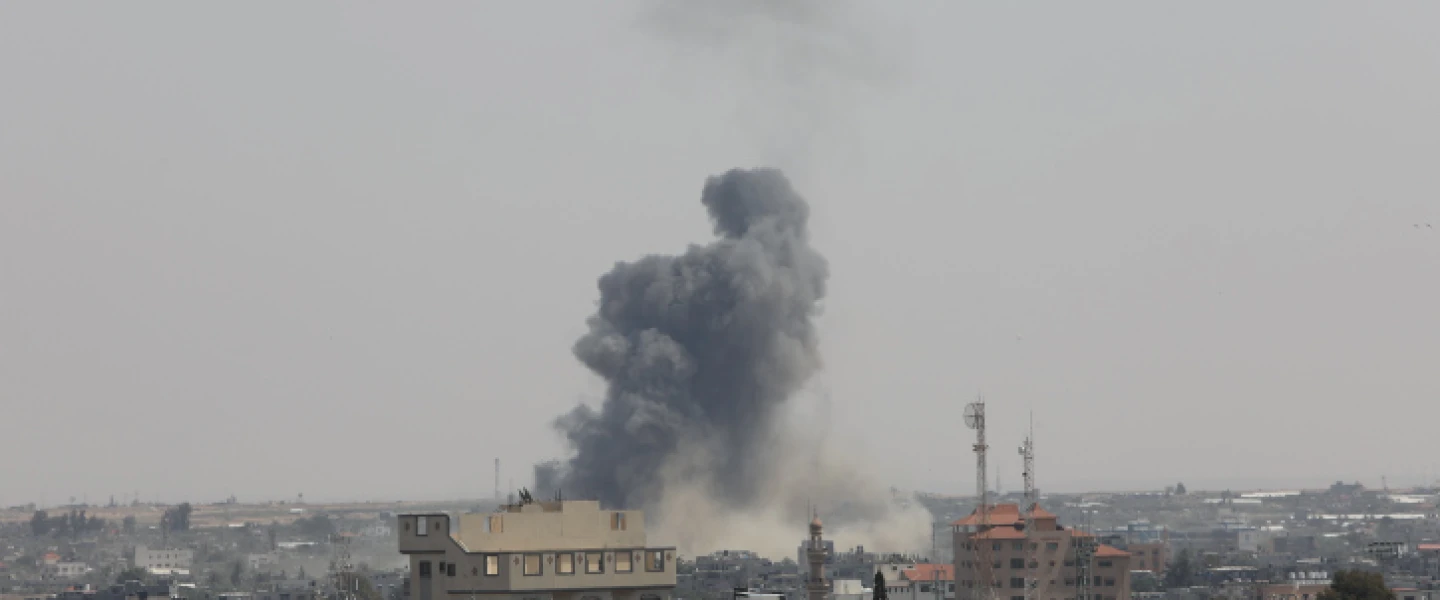
Palestinian Islamic Jihad launched hundreds of rockets at southern and central Israel on Wednesday from the Gaza Strip. Air-raid sirens sent millions of Israelis running for cover, including in Tel Aviv, and the Iron Dome air defense system began intercepting projectiles in mid-air.
The barrage came a day and a half after Israeli Air Force strikes that killed three senior PIJ commanders and destroyed ten of its bases and weapons storage facilities in Gaza.
According to Israel Defense Forces spokesperson Rear Admiral Daniel Hagari, the delayed response was significant.
First, it took PIJ some time to overcome the shock caused by Israel’s surprise attack on Tuesday, said Hagari. The terrorist group then understood that Israel had gone into defensive mode following the strikes, flooding Gaza’s skies with aircraft, both manned and unmanned, to detect and eliminate any retaliation attempt, he added.
In response, PIJ dispatched an anti-tank-missile squad to the border fence near Khan Younis in southern Gaza to carry out an attack against Israeli soldiers or civilians, said Hagari. The squad’s vehicle was detected by IDF intelligence and struck from the air, he added.
On Wednesday, the IDF began seeing signs of PIJ preparing rocket launchers for use. Terror squads were identified and eliminated as they set the timers on the launchers, he continued.
Nevertheless, heavy barrages were launched at Israel on Wednesday afternoon, with Iron Dome intercepting rockets as far north as Rishon Lezion and Tel Aviv.
No injuries and only minor damage was reported, with a house suffering a direct hit in Sderot and a kindergarten being hit in Kibbutz Nirim, according to Israeli media reports.
Despite declarations coming from the Gaza terror factions, according to Hagari Israel does not see Hamas actively firing rockets at this stage.
“Hamas is not reacting. We are dealing with actions. We will work against actions,” he said.
The IDF is currently focusing its firepower on PIJ cells actively attacking Israel or other “immediate threats,” he added.
However, he emphasized, Hamas was in control.
“This will end when Hamas tells PIJ to stop. Not when Hamas tells Israel [to stop],” he said.
On Tuesday, the IDF said one of the three PIJ commanders killed by Israel earlier in the day, Tarek az-Aldin, had directed PIJ operations in Judea and Samaria from Gaza. He had recently been working to introduce rocket launchers to Judea and Samaria for the purpose of attacking Israeli civilians, according to Israeli intelligence.
Khalil Bahitini, another of the senior PIJ figures killed, was responsible for rocket fire on Israel in the past month, according to the IDF. He was the commander of PIJ’s Northern Gaza Division, and approved all terrorist attacks from there, and was involved in planning further, imminent attacks. He ordered the heavy missile barrage on April 2 that saw over 100 rockets fired at southern Israel.
The third PIJ operative targeted in Tuesday’s strikes was Jahed Ahnam, PIJ’s Secretary of Cooperation. One of the most senior PIJ members, he was formerly secretary of its military council, and was in charge of coordinating weapons and money transfers between it and Hamas, according to the IDF.
The Israeli military had been gathering intelligence on the three terrorists’ movements since at least April, when upticks in rocket attacks from Gaza began. The terrorists were identified by the Israeli security establishment as posing a direct threat to regional stability, and their future planned actions would have led to an escalation, according to IDF assessments.
“They could have created a larger-scale dynamic of escalation, bringing Hamas into the picture,” said Hagari on Tuesday.
“PIJ as you know is funded 100% by Iran. But these [rocket] attacks were local initiatives. This operation [the air strikes]—we have been working on it since last Tuesday [May 2], since the rocket attacks. We wanted to conduct this on Tuesday but we didn’t have the operational environment, the conditions,” he said.
In the meantime, prior to Tuesday’s strikes, IDF planners gathered intelligence on the apartments and inner circles of the targets, preparing a simultaneous triple strike intended to stun the terror group.
The Israel Security Agency, IDF Military Intelligence and IDF Southern Command all played key roles in the planning.