Newsletter
Newsletter Support JNS

Five Iranian tankers sailing for Venezuela, defying US sanctions

Amid economic collapse, Venezuela has been relying on Iran to prop up its oil industry by giving the Islamic Republic tons of gold bars.

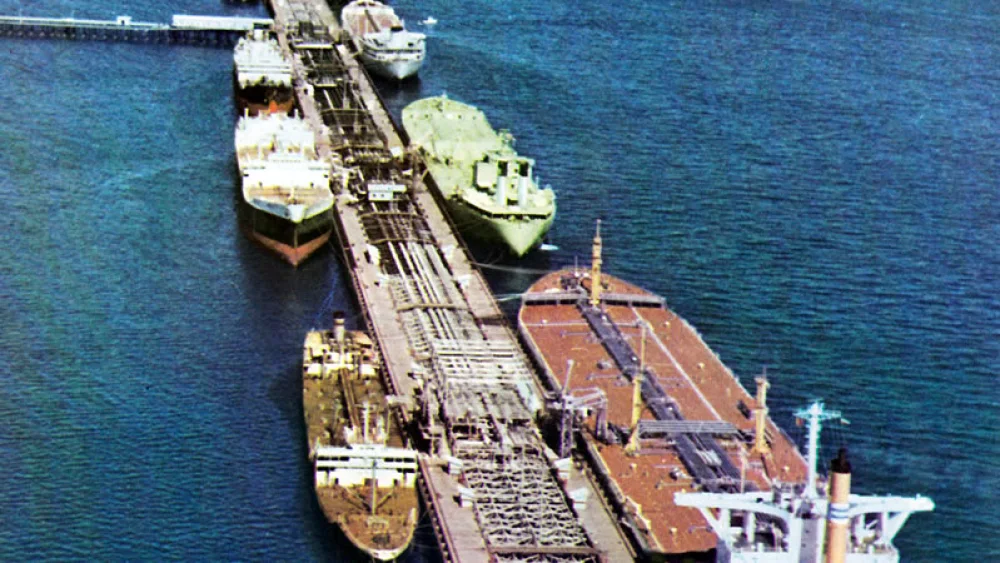
Large tankers loading at Kharg Island Terminal, offshore in the Persian Gulf. Credit: National Iranian Oil Company via Wikimedia Commons.

Five Iranian tankers apparently consisting of at least $45.5 million in value of gasoline and similar items are currently sailing to Venezuela in defiance of U.S. sanctions, reported The Associated Press on Sunday.

A senior U.S. official told Reuters on May 14 that the Trump administration is reviewing measures it could take in response to the shipment.

“It is not only unwelcome by the United States but it’s unwelcome by the region, and we’re looking at measures that can be taken,” the official told the outlet.

Amid economic collapse, Venezuela has been relying on Iran to prop up its oil industry by giving the Islamic Republic tons of gold bars, thereby depleting the South American country’s gold vaults, reported Bloomberg late last month, citing sources with direct knowledge of the matter.

What was once an oil-rich nation, Venezuela holds some 70 tons of gold in its vaults, according to Bloomberg.

In a letter to U.N. Secretary-General António Guterres, Iranian Foreign Minister Mohammad Javad Zarif said that the United States must “give up bullying on the world stage,” accusing the Trump administartion of “piracy” in threatening the “disruption of Iran’s fuel transmission to Venezuela.”

Iranian Deputy Foreign Minister Abbas Araqchi echoed Zarif and told Swiss Ambassador to Iran Markus Leitner that any U.S. action against the tankers would be met with an “immediate and firm response.”

Abdulkadir Al-Jelani, 58, is due in court on July 1 and faces charges of making the threats and three counts of assault with a weapon.
The designations include Hezbollah-linked institutions that “threaten regional stability, international security, mutual interests and global trade,” the U.S. Treasury Department stated.
Gerard Filitti, of the Lawfare Project, told JNS that “lax immigration policy” has always been the main driver of importing “terrorist ideology” into the United States.
“The teachers we have, we don’t respect and support in the way that they deserve,” Paul Bernstein told JNS. “If we’re successful and we grow enrollment, that problem only gets bigger.”
“The message being sent is that you can get away with attacking someone in broad daylight because you disagree with their opinions, especially if it involves feelings about Israel,” Joshua Burt, of the Anti-Defamation League, told JNS.
“Not identifying Hamas as a terrorist organization is, I think, a failure, Marc Miller told the Canadian Press. “And not clearly stating that, for example, Hamas intended to kill Jews is, I think, an unfortunate error in curation and should be rectified.”