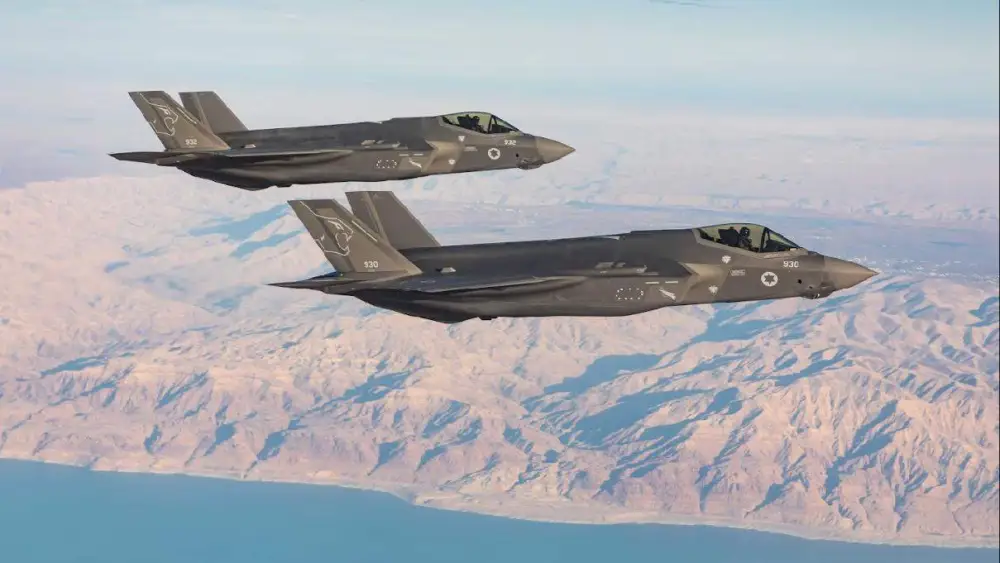
Israeli Air Force fighter jets launched renewed air raids on Hezbollah targets in the Syrian town of Al-Qusayr, near the border with Lebanon, on Tuesday, attacking munitions depots used by the terrorist group.
“Hezbollah’s Munitions Unit is responsible for storing weapons inside Lebanon and has recently expanded its activities into the area of Al-Qusayr, near the Syria-Lebanon border,” the military confirmed on X.
“This is another example of Hezbollah creating infrastructure for the transfer of weapons from Syria to Lebanon through border crossings,” added the IDF. “Hezbollah, with help from the Syrian regime, endangers the safety of civilians by establishing its infrastructure in civilian areas.”
The Syrian Observatory for Human Rights, a London-based war monitor affiliated with Syria’s opposition, said seven “violent explosions” were reported as a result of the Israeli strikes, which targeted warehouses in the industrial city of “Al-Qusayr and buildings on the outskirts Al-Qusayr in the Homs countryside near the Syrian-Lebanese border.”
The organization said it received “initial information about casualties.”
‘Prevented a future attack’
Israeli fighter jets struck terror-related targets in Al-Qusayr on Oct. 31, including arms-storage facilities, and command and control centers used by Hezbollah’s elite Radwan Force and its Munitions Unit.
Israel rarely admits to attacks in Syria, although in February, Jerusalem revealed that it had struck more than 50 targets belonging to Hezbollah and other Iran-backed terrorist organizations in Syria since Oct. 7, 2023.
On Monday night, IAF planes attacked Hezbollah’s Syrian intelligence headquarters, located about six miles south of the capital Damascus.
The site served as “Hezbollah’s central intelligence body, responsible for intelligence assessments, the direction of intelligence activities, and the intelligence gathering and detection capabilities,” the Israel Defense Forces stated.
Reports in Syrian media said the airstrikes in Sayyidah Zaynab—a major center of Iranian terrorist activity—caused several casualties.
On Sunday, the IDF revealed that special forces captured a pro-Iranian operative during a raid in Syria. The arrest was carried out in “recent months” by members of the Egoz commando unit, along with field interrogators of the Military Intelligence Directorate’s Unit 504.
The IDF said that Ali Soleiman al-Assi, a Syrian from Saida in the southern part of the country, was tasked by Tehran with “gathering intelligence on IDF troops in the border area for future terror activity of the network.
“The operation prevented a future attack and led to the exposure of the operational methods of Iranian terror networks located near the Golan Heights. Al-Assi was transferred for further investigation,” it added.