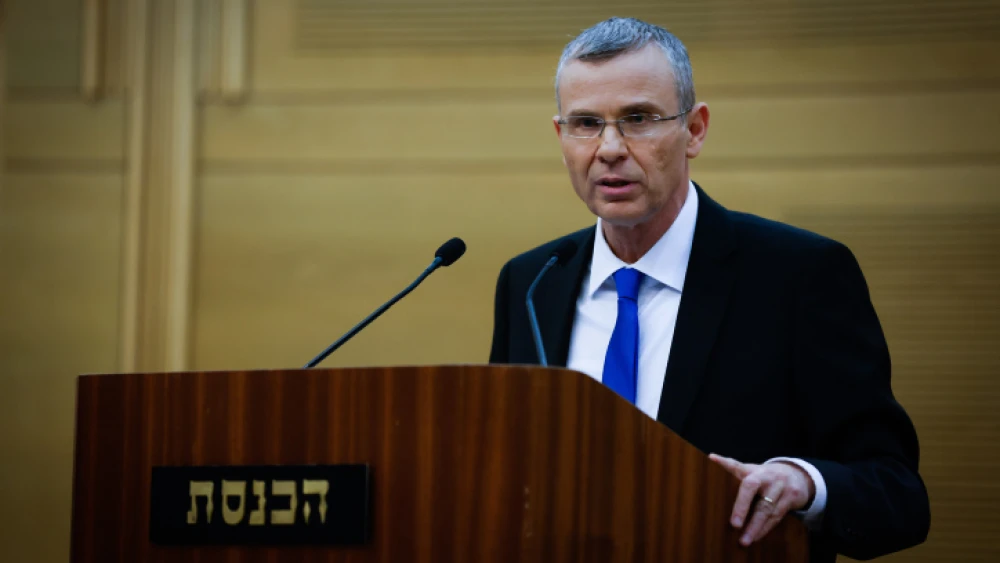
Israeli Justice Minister Yariv Levin is seeking to advance a bill that would criminalize calls by Israeli citizens for international sanctions against the Jewish state, the country’s Ynet news outlet reported over the weekend.
Under the proposed law, which is currently being considered by Attorney General Gali Baharav-Miara prior to being tabled in the Knesset, offenders could face up to 20 years in prison for public calls for sanctions against “Israel, its leaders, members of the security forces and Israeli citizens.”
The move came after Amos Schocken, the publisher of the Haaretz daily, called Hamas terrorists “freedom fighters” and called for a boycott as a pressure tactic to force the creation of a Palestinian state, in what Levin said was “not the first time that Israeli citizens have acted in this way.”
Several Israeli government ministries and agencies cut their ties with Haaretz following the remarks, vowing not to publish ads in the paper.
Currently, Israeli law allows for the deportation of foreigners who support boycotting the country and denying their entry, while calls for sanctions by citizens of the Jewish state are merely considered a civil offense.
Requesting a memo on the draft law from Baharav-Miara in a letter on Thursday, Levin noted that the Israel Defense Forces “has been at war on several fronts for more than a year, against murderous terrorism, including against the Hamas organization.
“A call to impose sanctions on Israel, its leaders, members of the security forces and Israeli citizens is a blatant violation of a citizen’s most basic duty of loyalty towards his country,” he wrote.
According to the justice minister, calls for boycotts are “tantamount to encouraging and promoting a move whose actual purpose is the denial of Israel’s right to self-defense. This act is all the more serious when committed during an existential war, and while our daughters and sons are being held in inhumane conditions by a murderous terrorist group.”
Levin said he seeks to punish those who “promote or encourage” the imposition of sanctions with ten years in jail, with the possibility of doubling the sentence if the offense was committed during wartime.
Last year, Levin vowed to criminalize the denial of Hamas’s Oct. 7, 2023 atrocities amid claims by an Arab Israeli lawmaker that the Palestinian terrorist organization didn’t murder Israeli children or rape women.
“I directed officials at the Justice Ministry to formulate a bill that would ban the denial of the massacre and institute severe punishment for those who do so,” the ruling Likud Party minister told local media at the time.
Thousands of Hamas-led terrorists invaded southern Israel from the Gaza Strip on Oct. 7, killing some 1,200 Israelis and wounding thousands more. Terrorists abducted 251 Israelis and foreigners to the Strip as hostages.