Newsletter
Newsletter Support JNS

Netanyahu: Israel and Russia will continue close defense coordination

Leaving for the U.N. General Assembly in New York, Israeli Prime Minister Benjamin Netanyahu says thanks to cooperation with Russia, Israel has had “great success” in curtailing Iran in Syria.

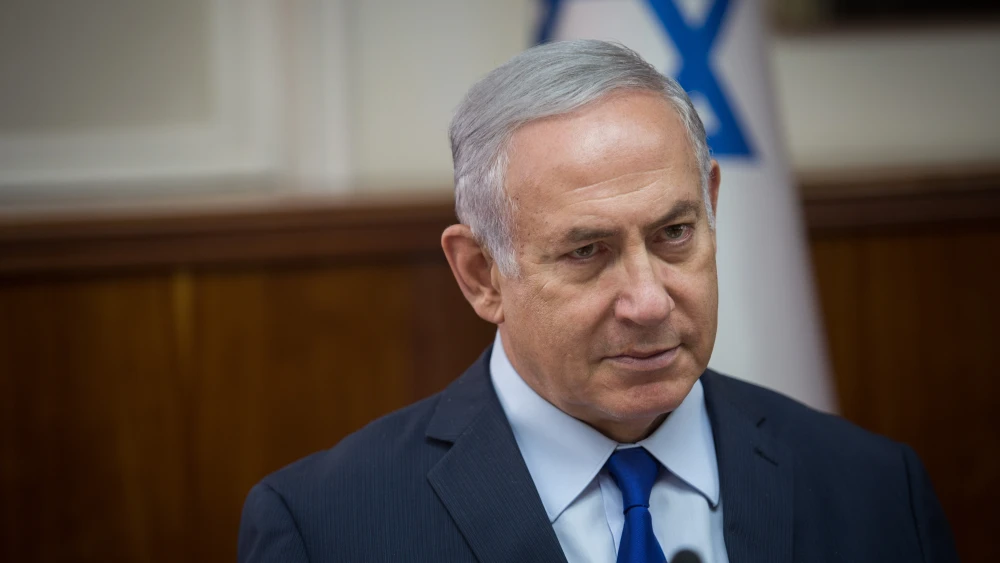
Israeli Prime Minister Benjamin Netanyahu leads the Ministers’ Committee meeting on Sept. 17, 2018. Photo by Hadas Parush/Flash90.

Israel and Russia will continue to maintain the close defense and security coordination between their two militaries, Israeli Prime Minister Benjamin Netanyahu said on Tuesday upon departing for New York to attend the U.N. General Assembly.

“I agreed with President Putin that IDF and Russian military working teams would meet soon. We will do what is necessary to defend the security of Israel,” he told the press at Ben-Gurion International Airport, commenting on his most recent conversation with the Russian leader.

Netanyahu said that for the past three years, Israel had been “very successful” in preventing the Iranian military from establishing a presence in Syria, as well as its attempts to transfer “lethal weapons” to Hezbollah in Lebanon.

“This is not to say that there haven’t been exceptions, but all in all, there has been a great success,” he said. “We did all this with maximum and successful security coordination with the Russian military.”

Touching on the Russian spy plane that was shot down by errant Syrian fire over Latakia last week, killing 15 crew members and sparking a crisis between Moscow and Jerusalem, the prime minister said that he had spoken with Putin twice since the “tragic events.”

“I expressed to him our deep regret over the loss of the crew of the Russian plane that was brought down by irresponsible Syrian anti-aircraft fire,” he said.

The launch pads were established under the cover of the ceasefire with Hamas, according to the Israeli military.
An all-women panel at the JNS International Policy Summit highlighted the voices of ordinary Iranians.
Ilana Gritzewsky, a former Hamas captive, told the U.N. Human Rights Council she is “living proof” of sexual violence, challenging rapporteur Reem Alsalem.
“There is an understanding here that Israel has a problem with Hezbollah and that something needs to be done about it,” said the Dutch defense chief.
The terror group “must be eradicated,” said Israeli security expert Amir Avivi.
The convoys will travel toward Prison 10 near Kfar Yona, where some yeshivah students are being held.
Benny Gantz, JNS editor-in-chief Jonathan S. Tobin, Gilad Erdan, Mosab Hassan Yousef, Nissim Black and leading voices in security, diplomacy, media, law and Jewish communal affairs headline the summit’s third day in Jerusalem.