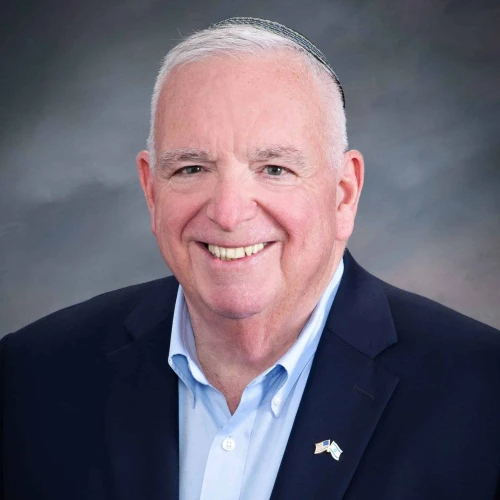
Yehuda Kaploun, a rabbi and U.S. State Department special envoy to monitor and combat antisemitism, was speaking at the Hudson Institute on Feb. 5 when his phone rang. He sent the call, which he told the audience was from Harmeet Dhillon, assistant U.S. attorney general for civil rights, to voicemail.
The call was a sign of “how the administration works together,” he said. Dhillon works “tirelessly” defending civil rights and supporting the Trump administration’s response to Jew-hatred on campuses, he said.
Kaploun’s conversation with Michael Doran, a senior fellow at Hudson and director of its Center for Peace and Security in the Middle East, covered a range of subjects, including the special envoy’s “quiet diplomacy” in his first months on the job, as he urges foreign governments to take steps to protect Jews.
“It’s easier to find a country that really doesn’t have antisemitism,” Kapolun said, in response to a question about trouble spots. “There’s a lot of difficulties in every country, even those that you would think would not have antisemitism.”
Kaploun said that he has used “gentle persuasion” and “maybe not so gentle persuasion” and has seen some early signs of progress.
Ararat Mirzoyan, foreign minister of Armenia, suggested recently that his country is open to joining the International Holocaust Remembrance Alliance, whose working definition of Jew-hatred is widely adopted.
Kaploun previously told JNS that he told Mirzoyan that Armenia should join the alliance, given his country’s suffering during World War I in the Armenian genocide. Shortly thereafter, Mirzoyan was indicating that Armenia might embrace IHRA.
The U.S. special envoy also told the audience at the Hudson event that Belgium restored synagogue and Jewish day school security funding, and that an Israel-boycott bill in Ireland, whose passage seemed assured, hit a wall.
Hungary, Romania and Albania are “making sincere efforts in dealing with antisemitism,” he said, attributing changes to the Trump administration’s stance on Jew-hatred.
“You can effect change, and you can get the victories,” he said.
The envoy told the audience at the event that his work fighting Jew-hatred and Holocaust denial relates to the sacrifices of American soldiers, who fought to liberate Europe during World War II.
Given Gen. Dwight Eisenhower’s extensive efforts to document the crimes, “so we could actually have the answers for these people who say the Holocaust didn’t occur,” Holocaust denial treads “on the memories of every American soldier who fought tyranny,” Kaploun said.
On Thursday, anti-Israel protesters interrupted the Hudson event several times.
The special envoy told the audience that a water company, which he used to lead, reached an agreement with Israel and Egypt to provide 150,000 gallons of water daily to Gaza through clear pipes, “so there could be no misunderstandings.”
“The people who said ‘No’ were Hamas and UNRWA,” he said. “Ironic, isn’t it?”