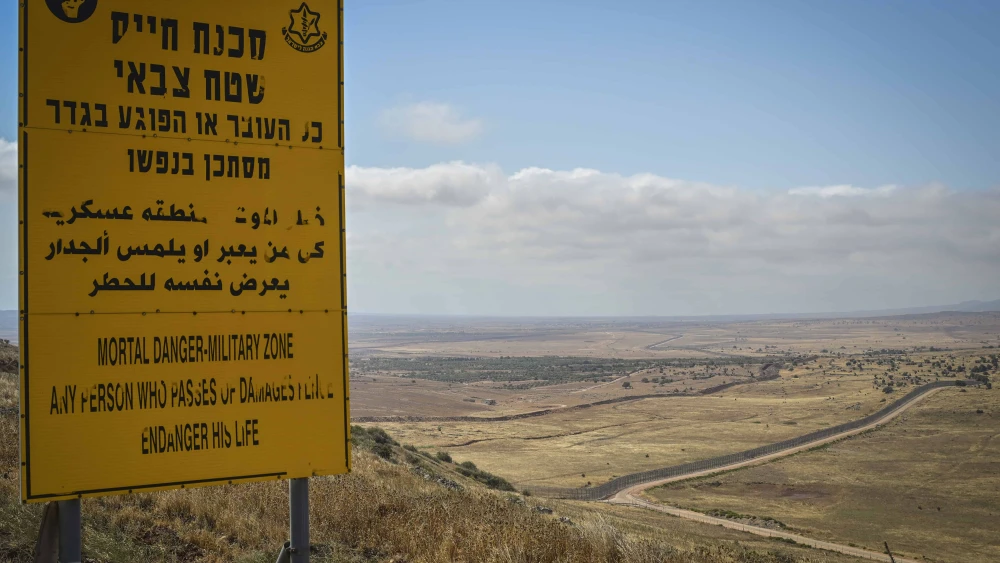
Israeli Prime Minister Benjamin Netanyahu on Sunday dismissed reports that Jerusalem was willing to give up the country’s buffer zone in Syria as part of a potential deal with the new government in Damascus.
The idea is a “joke,” the premier said in a recording on X.
“I’ll tell you what we’re discussing. We’re discussing with Syria something that wasn’t even imaginable before our great victory over Hezbollah. We’re discussing a security arrangement in which they demilitarize southwest Syria, and we ensure the security of our Druze allies in Jabal al-Druze,” said Netanyahu.
Last week, Syrian President Ahmed al-Sharaa said that ongoing security negotiations with Israel may soon yield a formal agreement.
During a briefing before his trip to the United Nations General Assembly in New York, the Syrian leader said talks could lead to results “in the coming days,” according to Reuters.
A Syrian Foreign Ministry official confirmed progress in talks, telling AFP that several security and military agreements are expected to be signed with Israel by the end of the year.
In an interview aired on Sunday, al-Sharaa told CBS News’ Margaret Brennan that U.S. President Donald Trump’s lifting of sanctions from his country was a “courageous and historic decision.”
Trump “recognized that Syria should be safe, stable and unified. This is in the greatest interest for all countries of the world, not just Syria,” he added.
When asked if he wants to meet with the American leader during the U.N. General Assembly conference in New York this month, the Syrian president answered affirmatively.
“We need to discuss a great many issues and mutual interests between Syria and the USA. We must restore relations in a good and direct way,” he said.
Brennan also asked al-Sharaa if he had undergone an ideological transformation, having led the Sunni terror group Hayat Tahrir al Sham (HTS), an offshoot of Al Qaeda, during Syria’s prolonged civil war.
The president replied: “Let’s look at what’s happening now, regardless of what was said in the media. Today, we have really saved the people from the oppression that was being thrust on them by the criminal [Bashar al-Assad] regime. And we have restored hope for the people who are refugees or internally displaced, so they can return to their homeland.
“We supported the people who were bombed with chemical weapons. We also confronted ISIS. We expelled the Iranian militias and Hezbollah from the region. All of these noble acts we took in Syria should have been the role of the international community. But the international community was unable to free a single prisoner or break the siege on a single town where people were starving to death,” he stressed.
He went on to say that he expects the world to assist in the reconstruction of his war-torn country. “Anybody who stands against the lifting of sanctions would be complicit in killing the Syrian people once again,” he said.