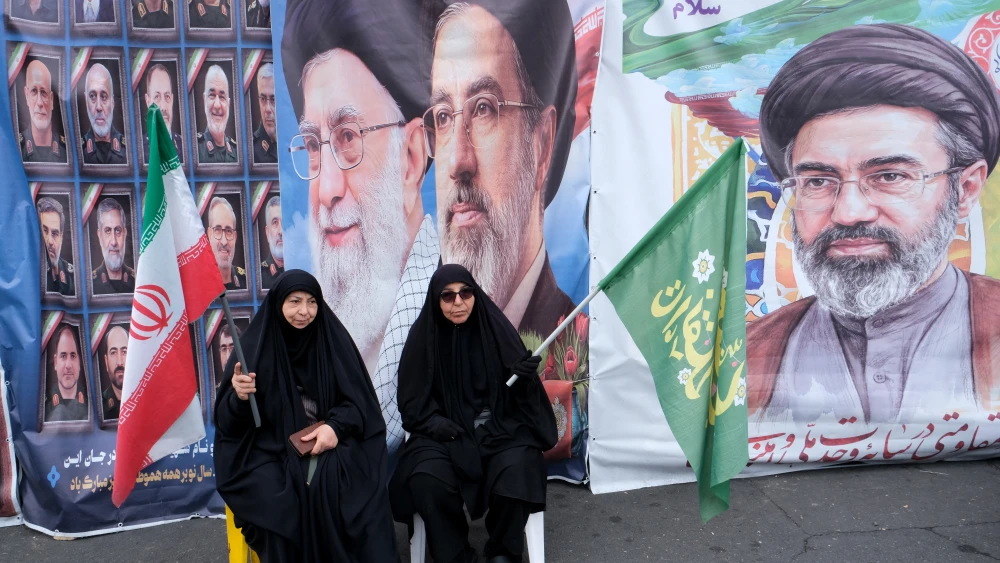
The U.S.-Israeli war on the Islamic Republic has fractured Iran’s leadership and hindered its ability to coordinate negotiations, officials familiar with U.S. and Western intelligence told The New York Times on Monday.
Several dozen top Iranian officials and their deputies have been eliminated in “Operation Epic Fury/Roaring Lion,” leaving surviving leaders struggling to communicate or meet in person out of fear of more targeted airstrikes, the report said.
Compromised communications have fueled confusion and mistrust among remaining officials, who are increasingly reluctant to use phones or other messaging systems, according to the intelligence briefings. The disruption was also said to have weakened coordination between the regime’s military and civilian leadership.
U.S. officials told the Times that hardliners within the Islamic Revolutionary Guard Corps have gained influence, sidelining Tehran’s clerical leadership.
The extent of control exercised by Iran’s new supreme leader, Mojtaba Khamenei, remains unclear. He has not appeared publicly, and U.S. and Israeli intelligence believe he may have been wounded during the fighting. Some intelligence officials believe he may serve primarily as a figurehead, with IRGC commanders making key decisions.
A senior U.S. military official said Iran’s command and control capabilities have been significantly degraded by the ongoing U.S. and Israeli aerial campaign. However, Tehran’s decentralized command structure allows regional commanders to launch missile and drone attacks independently, even without direct orders from Tehran.
The United States military has begun targeting those local commanders, the official said.
Officials briefed on intelligence assessments also noted that internal disarray has limited Iran’s ability to respond to U.S. ceasefire proposals, with Israeli officials comparing the communication breakdown to hostage negotiations with the largely decimated Hamas leadership during the war in the Gaza Strip.
U.S. President Donald Trump on Monday said that Washington was “in serious discussions with a new, and more reasonable, regime to end our military operations in Iran.”
“Great progress has been made but, if for any reason a deal is not shortly reached, which it probably will be, and if the Hormuz Strait is not immediately ‘open for business,’ we will conclude our lovely ‘stay’ in Iran by blowing up and completely obliterating all of their electric generating plants, oil wells and Kharg Island (and possibly all desalinization plants!), which we have purposefully not yet ‘touched,’” the president wrote on his Truth Social account.
The Iranian regime has received messages through intermediaries signaling Washington’s willingness to negotiate, but on Monday, Tehran responded negatively to the U.S. proposals, calling them “unrealistic, illogical and excessive,” Foreign Ministry spokesperson Esmaeil Baghaei said, according to the IRGC-affiliated semi-official Tasnim News Agency.
Baghaei’s remarks came a day after the foreign ministers of Pakistan, Egypt, Saudi Arabia and Turkey met in Islamabad for initial talks on proposals to reopen the Strait of Hormuz to commercial shipping. “Our position is clear. We are under military aggression. Therefore, all our efforts and strength are focused on defending ourselves,” said Baghaei.