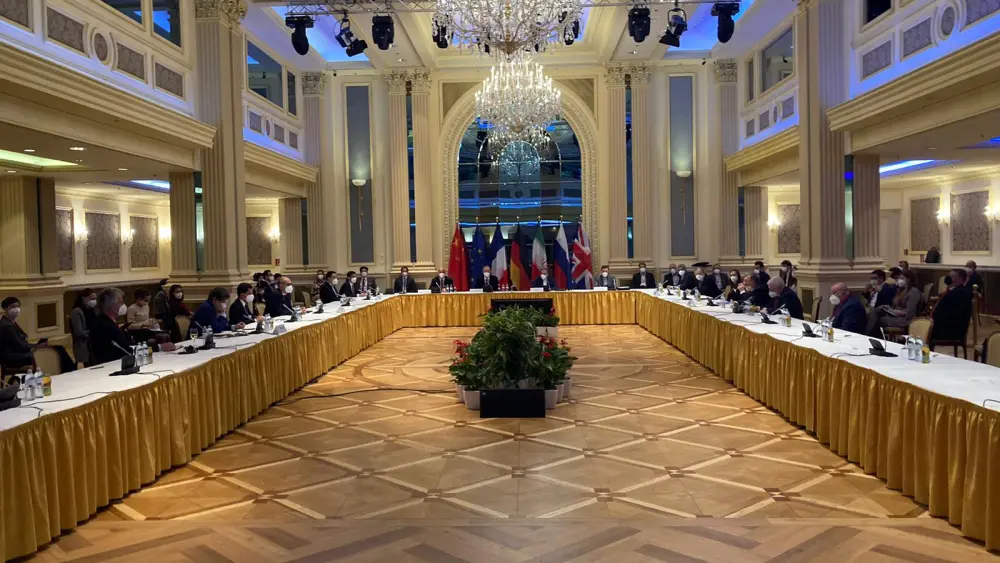
Negotiations in Vienna over a possible return to the 2015 Iran nuclear agreement are proceeding slowly despite signs of progress in late December, France’s foreign minister said on Tuesday.
“They are slow, too slow and that creates a gap that jeopardizes the chance of finding a solution that respects the interests of all sides,” said Jean-Yves le Drian, according to Reuters.
The eighth round of negotiations between Iran and world powers around a return to the Joint Comprehensive Plan of Action kicked off on Dec. 27. The talks had resumed in November after a five-month hiatus spurred by Iran’s general elections, but broke off shortly afterwards, amid reports of Western frustration at Tehran’s “unrealistic” demands. Since the United States unilaterally exited the JCPOA in 2018, the Islamic Republic has caused fellow signatories to accuse it of gradually moving away from its commitments under the agreement. Both U.S. and European officials have warned that as Iran’s nuclear program advances, a return to the 2015 deal may become impossible. In December, U.S. Special Envoy for Iran Robert Malley warned that given the pace of Iran’s nuclear program, there are only “weeks left, but not much more” to revive the JCPOA.
“At some point in the not-so-distant future, we will have to conclude that the JCPOA is no more, and we’d have to negotiate a wholly different deal, and of course we’d go through a period of escalating crisis,” Malley told CNN.
Israeli Foreign Minister Yair Lapid raised the subject of the talks during a discussion with French President Emmanuel Macron earlier this week. According to a statement from Lapid’s office, he reiterated Israel’s demand that pressure on Tehran be stepped up.
During a meeting with the French leader in November, Lapid stated that only a “credible military threat” would stop Iran from continuing its race to a nuclear weapon. Lapid also emphasized “the immediate need for the strengthening of international sanctions [against Iran], and ... the urgent need for a Plan B” should the talks collapse.