
U.S. President Donald Trump recently said of Iran’s current negotiators: “I really believe it’s a regime change because I find these people to be much more rational than the people that are no longer with us.” U.S. Vice President JD Vance has spoken of turning over “a new leaf” and “fundamentally transforming” relations if Iran’s leadership changes course.
This is the misunderstanding that has preceded every failed Iran strategy for more than four decades. It focuses on the men. It ignores the machine.
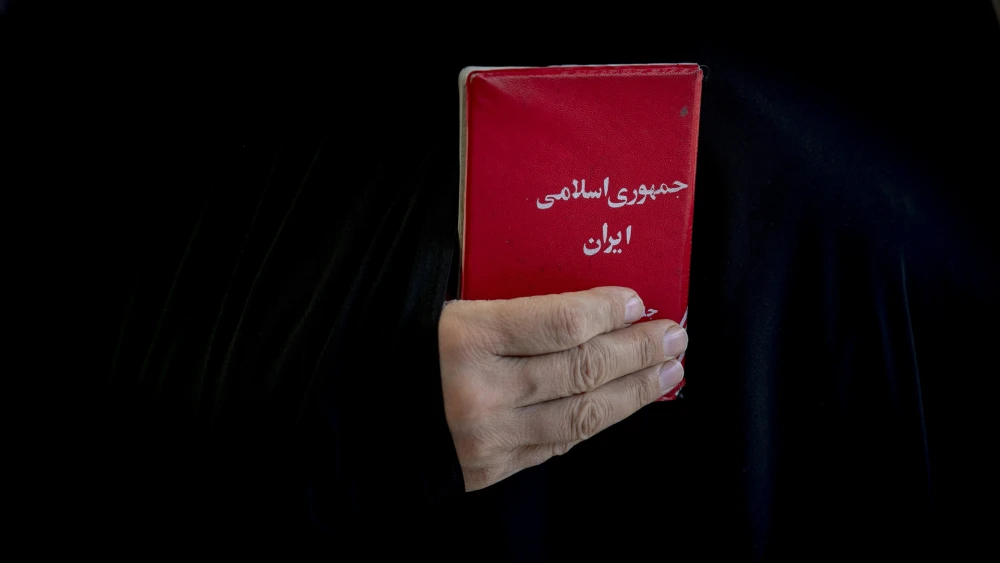
The Islamic Republic is not a mood. It is not a contest between moderates and hardliners that a rational negotiator might resolve. It is a constitutional architecture—designed, article by article, to make political Islam, Shi’ite jurisprudence and revolutionary guardianship structurally irreplaceable. You cannot negotiate your way past a constitution.
Start with Article 4. All civil, penal, financial, economic, administrative, cultural, military and political laws must be based on Islamic criteria, “absolutely and generally,” applying to every article of the constitution, and every law and regulation in the state. This is not a preamble aspiration. It is the supreme legal test against which every act of every Iranian institution is measured. Sharia does not influence the state. It governs it.
Article 5 supplies the Shi’ite theory of who rules. During the occultation of the Twelfth Imam, authority belongs to the just and pious Islamic jurist—velayat-e faqih, “guardianship of the Islamic jurist.” Article 57 places the legislative, executive and judicial branches under this absolute religious-political supervision. The Supreme Leader is not a head of state in any recognizable modern sense. He is the living constitutional embodiment of a doctrine of sacred succession.
From that summit, the architecture descends in interlocking layers. The Guardian Council—six Islamic jurists appointed by the Supreme Leader, six legal experts approved through the judiciary—reviews every piece of legislation for conformity with Islam and the constitution before it has legal standing.
Parliament is therefore not sovereign; it legislates inside a theological cage. The Assembly of Experts, which appoints and could theoretically dismiss the Supreme Leader, is itself elected through a process supervised by the Guardian Council—the body that chooses the leader is already filtered by the leader’s own constitutional organs. The Expediency Council, whose members are appointed by the Supreme Leader, resolves any deadlock between parliament and the Guardian Council.
The Islamic Revolutionary Guard Corps exists, by constitutional mandate in Article 150, not to defend Iran’s territory—that is the regular army’s function—but to guard “the Revolution and its achievements.” The judiciary operates under Article 167, which instructs judges that where codified law is silent, they must rule according to Islamic sources and valid fatwas.
Quranic text becomes legal doctrine; legal doctrine becomes penal code; penal code becomes indictment; indictment becomes a rope.
Every layer filters the one below it. Every organ answers, directly or indirectly, to the ideological apex. No election, no negotiation and no change of personnel can touch the architecture itself. This is what the machine is designed to ensure.
Ruhollah Khomeini saw it clearly. In Islamic Government, written before the 1979 Iranian Revolution, he argued that Islamic law did not merely require moral guidance from the state; it required the state itself to be Islamic. What he imagined, the constitution of 1979 codified. What the constitution codified, 45 years of institutional layering has made structural.
The clearest proof of what the machine actually produces is not in its constitutional text but in its courtrooms. Moharebeh—“waging war against God”—is defined in Article 279 of Iran’s Islamic Penal Code as drawing a weapon against people’s lives, property or security in a way that creates public fear. Its punishments under Article 282 include death, crucifixion, amputation and banishment. Its theological root is Quran 5:33, on those who wage war against Allah and spread corruption in the land.
Amnesty International reported in February that at least 30 people faced the death penalty in connection with the January protests, including children and young adults tried in expedited proceedings. In June, Iran executed Javad Zamani and Abolfazl Saedi on convictions that included moharebeh and corruption on earth.
This is the machine running as designed. Quranic text becomes legal doctrine; legal doctrine becomes penal code; penal code becomes indictment; indictment becomes a rope.
So when Washington speaks of “rational” interlocutors, the right question is not whether the men across the table are rational. It is what institution they represent and what they are constitutionally capable of changing.
A rational negotiator does not repeal Article 4. A new president does not dissolve the Guardian Council. A diplomatic breakthrough does not disband the IRGC or rewrite Article 167. The men may be reasonable. The machine is not.
Israel and the West can degrade the regime’s capabilities through sanctions, covert pressure, cyber operations and military containment. These things matter. But degradation is not transformation. You can damage a machine without replacing it.
True regime change has one meaning: the collapse of the institutional order that makes political Islam the constitutional law of the Iranian state. That requires rupture inside the regime itself—genuine defections from its coercive organs, not softer rhetoric from its diplomats—and an organized Iranian political alternative capable of replacing a revolutionary state with a national one. Nothing short of that qualifies.
Everything short of that is management. And the Islamic Republic has been managed, contained, sanctioned and negotiated with for nearly 50 years. The men have changed many times. The machine has not changed once.
Washington can negotiate. But it should negotiate with clear eyes about what it is negotiating with—not a mood, not a faction, but a constitutional order that has embedded its own permanence into every institution it controls. Acknowledging that is not pessimism. It is the beginning of a strategy serious enough to matter.