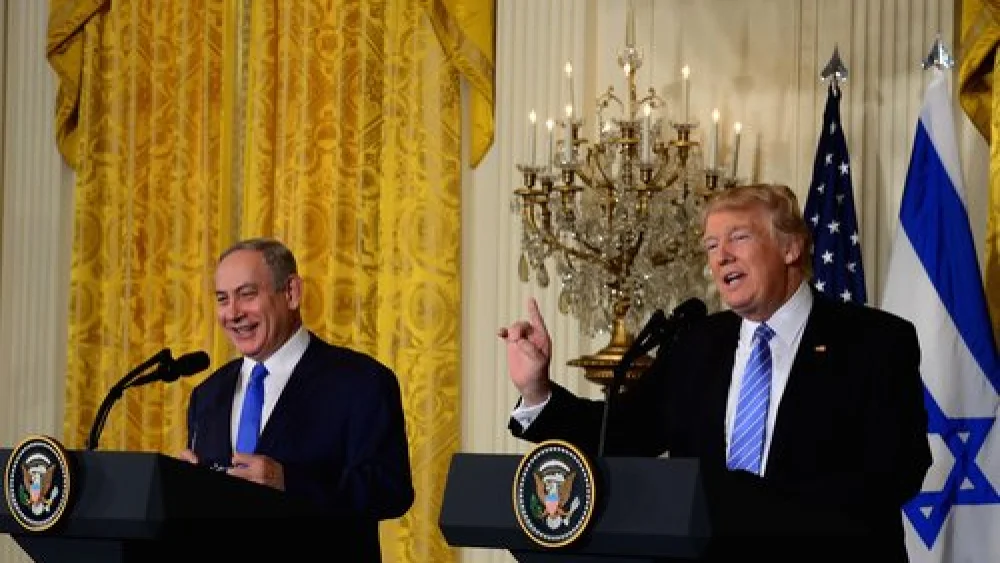
The United States’ historical recognition of Jerusalem as the capital of Israel and of Israeli sovereignty over the Golan Heights weren’t the only pro-Israel decisions made by U.S. President Donald Trump since entering office.
Just as the U.S. embassy was moved to Jerusalem amid Palestinian threats and warnings from the State Department that “the Middle East would burn,” in other areas as well Trump’s administration has supported Israel fully despite objections at home and abroad.
On May 8, 2018, mere days before the United States officially inaugurated its new embassy in Jerusalem, the Trump administration withdrew from the 2015 Iran nuclear deal. Since then, the United States has continued to impose harsh economic sanctions on the regime in Tehran, decimated its economy, forced corporations to cut business ties with it, rebuffed intensive European efforts to save the Iranian economy, compelled China and India to partake in sanctions, and just last week deployed the U.S. Navy’s largest aircraft carrier to the Persian Gulf.
And while Trump and officials in his administration have stressed that these measures were implemented to uphold American interests, and not necessarily on behalf of Israel, in their view Israel’s and America’s security are one and the same—and this is the crux of the matter.
Not only has the administration completely backed all Israeli military activity in Syria, Gaza and Judea and Samaria, but U.S. officials have also made clear that in their view anti-Zionism, Jew-hatred and calls for boycotting Israel all stem from the same phenomenon.
In the words of U.S. Ambassador to Israel David Friedman: “There are places in Manhattan, where I worked for 35 years, where you could attend a cocktail party and if you said, ‘I hate Jews,’ you would be politely escorted to the door. But if you said ‘isn’t it a shame that after the Jews survived the Holocaust they turned into Nazis themselves against the Palestinians,’ you might be ordered another drink and invited to hold court on your interesting point of view. Unlike other nations, unlike other peoples, there is no political correctness when it comes to Israel and the Jewish people.”
The Trump administration refuses to accept this double standard.
On April 12, for the first time, the U.S. embassy announced visa exemptions for Israeli investors, while on March 26 President Trump made history by recognizing Israel’s sovereignty over the Golan. Consequently, the administration and Congress are now including the Golan in joint trade and cooperation initiatives.
On March 4, U.S. Central Command declared it was deploying the Terminal High Altitude Area Defense (THAAD) anti-ballistic missile defense system in Israel—the most advanced such system in the American arsenal. A day earlier, the State Department said it was shutting down the independent “Palestinian consulate” on Agron Street in Jerusalem and making it a regular department of the embassy located in the city’s Arnona neighborhood.
On Feb. 21, for the second time, Friedman attended and spoke at the Israeli-Palestinian International Economic Forum sponsored by the Judea and Samaria Chamber of Commerce and Industry—yet another step signaling U.S. recognition of the permanence of Israel’s presence in there.
A week prior, on Feb. 13-14, the United States convened, in large part on Israel’s behalf, the 2019 Warsaw Summit, in an effort to highlight and curb Iran’s activities in the region. At the conference, Israeli Prime Minister Benjamin Netanyahu sat alongside Arab leaders.
U.S. Vice President Mike Pence spoke at the conference and declared: “Tonight, I believe we are beginning a new era, with Prime Minister Netanyahu from the State of Israel, with leaders from Bahrain, Saudi Arabia and the UAE, all breaking bread together, and later in this conference sharing honest perspectives on the challenges facing the area.”
On Sept. 1, 2018, the Trump administration announced the complete cessation of American financial support for the United Nations Relief and Works Agency for Palestine Refugees (UNRWA), which perpetuates and exaggerates the Palestinian refugee issue. Ten days later, the administration shuttered the PLO’s offices in Washington, and on June 20, 2018, the United States withdrew from the U.N. Human Rights Council. The move was spearheaded by then-U.S. Ambassador to the United Nations Nikki Haley, as an objection to the body’s discrimination against Israel.
Ariel Kahana is a diplomatic correspondent for Israel Hayom.
This column first appeared on Israel Hayom.