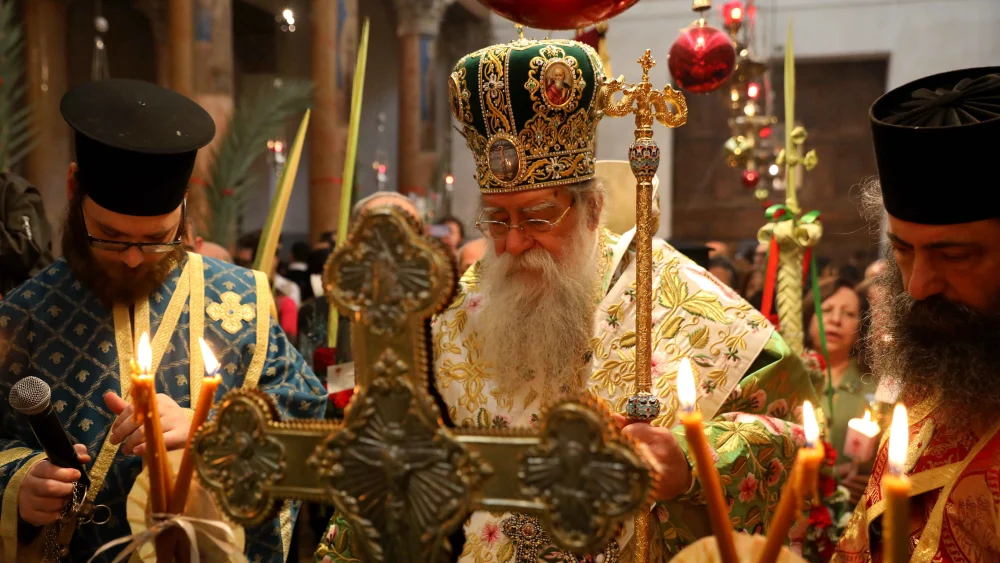

Bethlehem is emptying. Tehran is filling.
That is not a poetic contrast. It is a demographic fact unfolding in real time, and almost no one is reading both sides of it together.
In Bethlehem, the city where Christianity was born, according to tradition, Christians made up 86% of the population in 1950. Today, they are around 10%. Since the Hamas-led terrorist attacks in southern Israel on Oct. 7, 2023, at least 142 more families have left, according to the Jerusalem Center for Applied Policy.
The community that still carries Christianity’s birthplace is receding quietly—not through massacre or decree, but through the slow exit of people who no longer see a future there.
In Tehran, by contrast, Iranian courts sentenced 96 Christians to a combined 280 years in prison in 2025, according to Article 18, the U.K.-based rights organization that monitors Christian persecution in Iran. All of them were arrested for belonging to house churches. Most were born Muslim.
These are not separate stories. Historic Christianity is fleeing the same order from which a new Christianity is now emerging in secret. Both are responses to the same failure: states that have turned religion into an instrument of control and left no room for anyone to be different without paying a price.
In Iraq, a Christian population of roughly 1.5 million in 2003 has fallen to fewer than 250,000. In Syria, the Christian population fell from roughly 2 million before 2011 to between 300,000 and 600,000 today. In June 2025, a suicide bomber entered the Mar Elias Church in Damascus during morning prayers; about 350 worshippers were inside. Twenty-five were killed.
In January 2026, Open Doors moved Syria from No. 18 to No. 6 on its World Watch List of countries most dangerous for Christians, the largest single-year jump in the ranking’s history.
This is not a string of isolated incidents but a pattern.
What makes this moment particularly dangerous is that the pattern continues even when apparent opportunities arise. The fall of the Bashar Assad regime in Syria in December 2024 generated the usual promises. Within months, Syria’s interim constitution defined Islam as “the main source of legislation” and barred a Christian from serving as president. In the October 2025 elections, one Christian was elected out of 119 members of parliament. The promises were made. The structure did not change.
The historical template is next door. In 1914, Christians made up between 20% and 25% of Anatolia’s population. Today, they are 0.2%. Benny Morris and Dror Ze’evi, in The Thirty-Year Genocide, showed that this did not happen in one blow, but in recurring waves of expulsion and erasure. Turkey is now the dominant outside power in post-Assad Syria. Human Rights Watch documented in 2024 that Turkish-backed forces engaged in arbitrary detention, property seizure and deliberate demographic engineering in northern Syria. The pattern has a precedent. The precedent has a name.
Then there is Iran, where something very different, and equally revealing, is taking place.
The Islamic Republic treats conversion from Islam to Christianity as a security offense. Running a house church can mean prison. And yet, rights monitors estimate the number of Muslim-background Christians in Iran at between 300,000 and 1 million. Missionary organizations place the figure considerably higher. Independent verification is structurally impossible because these communities cannot be counted openly. But what is not in dispute is the direction: Iran is experiencing a conversion wave unlike anything in its modern history.
In 2025 alone, 254 Iranian Christians were arrested—nearly double the previous year, according to Article 18. Nearly 90% of charges were brought under a law criminalizing “propaganda contrary to the holy religion of Islam.” A regime that presents itself as the guardian of Islam is responding with a severity that reveals fear, not confidence.
What drives this wave? Not mainly Western missionary activity but exhaustion with a state-enforced religious order. Operation World has named Iran as having the fastest-growing evangelical movement in the world. It is happening inside the very country that declared it would prove the supremacy of Islam.
Miners once carried canaries into the shaft. When the canary stopped singing, the air had already turned. Christians in the Middle East have long served that function—not because their suffering matters more than others, but because they are reliably among the first to leave when a society stops tolerating difference.
When they go, they are rarely the only ones going. Their exit coincides with the departure of professionals, minorities and dissenters, anyone who no longer trusts the state to offer equal protection. And when converts in Iran are forced underground, the issue is not only freedom of worship. It is freedom of conscience itself.
Three things follow from this:
The United States lifted sanctions on Syria in 2025 without demanding a single benchmark on minority rights. That leverage is gone. But every future engagement with Damascus—reconstruction funds, diplomatic normalization, security cooperation—should be conditioned on measurable protections, not assurances. Minority representation in government and security forces is a testable standard. Apply it.
Iran’s underground converts are prisoners of conscience by any serious definition of the term. Western asylum systems do not consistently recognize Muslim-background Christians as a persecuted class. They should. This is not a theological position. It is a straightforward application of refugee law.
And Bethlehem deserves more than pilgrimage. The city that symbolizes the birth of Christianity is losing its Christian population to economic strangulation and political limbo. If Western governments are serious about preserving Christian presence in the Holy Land, then they need policies that give their residents a reason to stay, not museums that commemorate the ones who left.
Bethlehem is emptying. Tehran is filling. The difference is only the direction of escape.