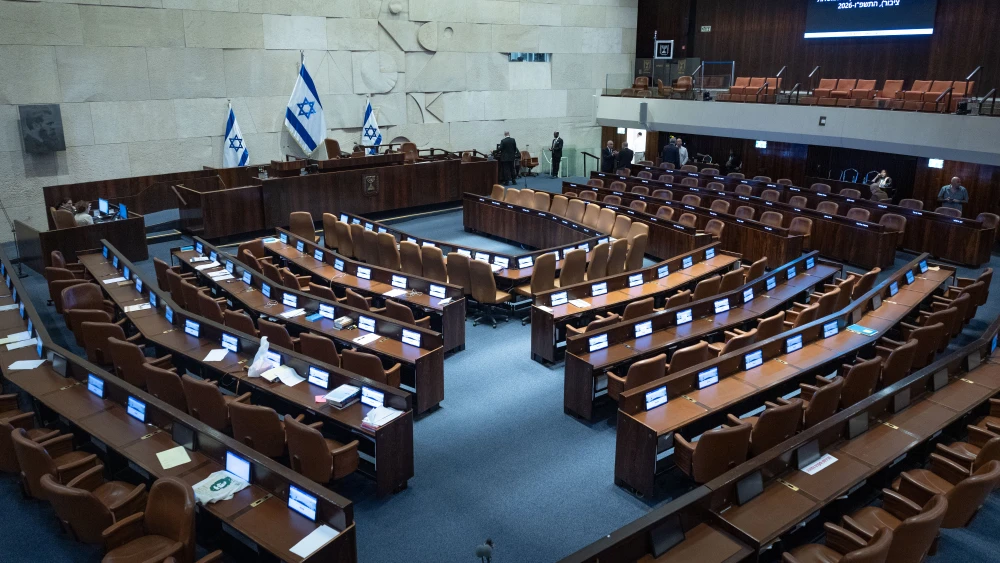

The public storm surrounding the proposed Knesset legislation “Basic Law: Torah Study” is no longer just a religious or social debate; it is a resounding indictment of the Israeli political system.
The law seeks to establish—at the highest constitutional level—that Torah study is a supreme value equivalent to military service. In practice, it is legal cover for anchoring a complete Haredi exemption from conscription directly into the basic laws with the aim of bypassing the Supreme Court’s rulings and thwarting any chance of equal burden-sharing.
Israelis are trapped in a loop in which the judicial system displays determined activism on one hand, while a government dependent on the Haredi parties is completely paralyzed on the other.
This deadlock does not stem from malice or a lack of leadership.
I am completely convinced that, under a presidential system, Prime Minister Benjamin Netanyahu would never have countenanced such a law. I am equally certain that even he does not believe it is a correct, just or fitting law for the State of Israel. But under the current parliamentary system, the prime minister’s judgment is inevitably distorted by his desperate desire for coalition survival. Whoever needs the swing parties to remain in power will yield to them at any cost; otherwise, his government will fall. In this case, moreover, Netanyahu could well lose his strategic partnership with the Haredi parties to the opposition.
This kind of extortion is a demographic and economic time bomb.
Basic Law: Torah Study is not just a sectoral achievement for the Haredi parties. It is also a strategic advance payment meant to entrench the Haredi parties’ standing ahead of the formation of the next government. By fixing their draft exemption at the level of a basic law, they completely change the starting line for future negotiations. They ensure that any potential prime minister, from the right or from the left, will be forced to accept this extortion as a fait accompli. The entire country will pay the price.
I have nothing against Torah study, quite the opposite. I recognize that the Torah has preserved the Jewish people for thousands of years and is the foundation of our existence. I support making the Haredi public a full partner in determining the types of service we will need, which need not necessarily be military, and the same goes for Arab citizens.
But this bill cannot be defined as anything other than extortion. And this kind of extortion is a demographic and economic time bomb: As of 2025, only 40% of Israeli first-grade students study in the state’s secular education system. According to forecasts, the Haredi sector is expected to make up 41% of young people of conscription age by 2050. Giving a constitutional blank check to “Torah is his craft” on such a scale means the complete collapse of the economy.
The structural threat is even more severe: As the Haredi share of the population grows, so, too, will their political power and the number of Knesset seats they hold. If we wait, the future Knesset will be completely locked in. No coalition will have the political majority required to change the status quo, and the sectoral parties will hold a permanent veto over the country’s future. The secular dread of this long-term future has real grounding in reality.
We need to state a simple truth: Our system simply isn’t a good one. The existing parliamentary structure has exhausted itself and become a dysfunctional mechanism that grants minority groups disproportionate power. Even opposition parties may end up paying enormous prices to the Haredi or other swing parties through laws that cost Israeli society dearly.
Our system shackles the hands of leadership, thwarts the will of the majority and forces the entire country to serve narrow sectoral interests at the expense of our existential future. As long as we keep playing by these same broken rules, we will keep going around in the same loop and leading Israel towards a predetermined end.