


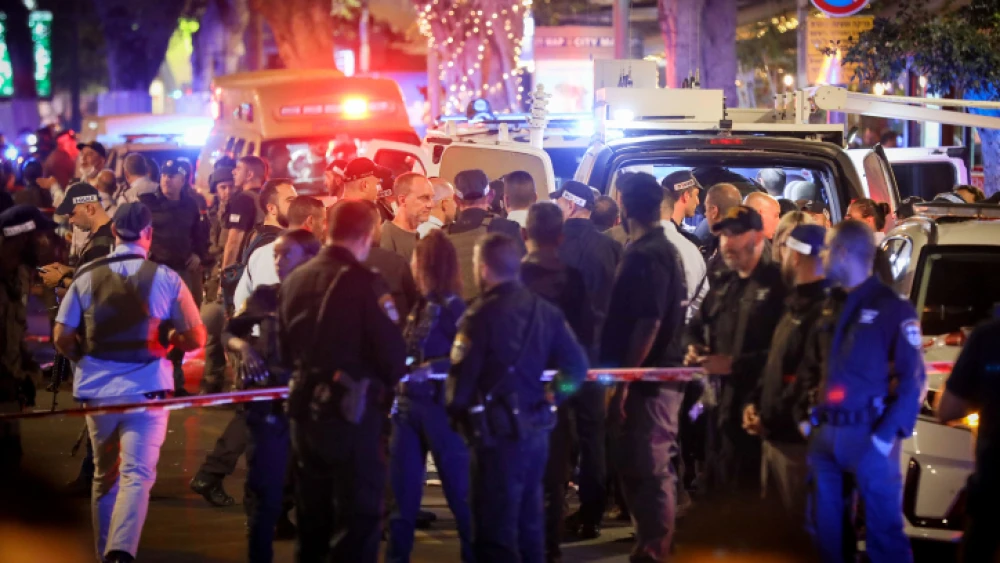

Reporters rushed to Tel Aviv on Thursday night to cover the shooting at the Ilka pub on Dizengoff Street. Less than half an hour after the deadly spree, cameras and microphones flooded the vicinity, and the whole country tuned in to watch.
The hunger for information surrounding the event, coupled with a touch of voyeurism, was unavoidable. The gunning down of young people enjoying a night out at a bar would be cause for fear and curiosity under any circumstances. But the fact that this was the fourth such act of “lone wolf” carnage carried out in the Jewish state in little more than two weeks—following fatal assaults in Bnei Brak on March 29, Hadera on March 27 and Beersheva on March 22—made the entire episode even worse.
As if the incident in itself weren’t horrifying enough—particularly as Tel Aviv residents were instructed to hole up in their homes and the city’s public transportation was halted—the terrorist was on the loose. In fact, he would remain at large until early the next morning, when he was finally located in Jaffa and eliminated during a battle with Israeli forces.
This was what set apart the Tel Aviv attack from the other three. In each previous case, the terrorist was neutralized while in the process of murdering his victims. Here, the perpetrator, 28-year-old Ra’ad Hazem from Jenin, managed to slip away among the throngs of diners and passersby, some busy administering first aid to the wounded and others fleeing for dear life.
The pandemonium was palpable as various units of the Israel Police, Israel Defense Forces and Israel Security Agency (Shin Bet) arrived en masse to scour the area for the terrorist. This was compounded by the presence of the press.
Until the TV channels ended their special broadcasts at 2 a.m., they all had reporters on the scene, who were interfering with the men and women in uniform. One correspondent went as far as to tail soldiers on a door-to-door search for the terrorist, with a camera rolling on their faces and weapons.
Another actually stepped over police tape with her cameraman, so that he could zoom in on the broken glass and bloodstains on the pavement outside the pub. As a police officer grabbed her arm and pulled her away, she continued her breathless babbling.
Nobody needed expertise in national security to realize that showing this kind of footage for all to see—including the terrorist, who was probably watching on his cellphone—constituted the crossing of a serious red line.
Meanwhile, viewers were witnessing hundreds of police officers and soldiers run to and fro in a seemingly disorganized fashion, as though the operation had no central commander. It was definitely not a good look and shouldn’t have been shown.
The security forces agreed. The next day, the spokespersons’ units of the police, IDF and Shin Bet released a rare letter of complaint to “all of the media outlets,” admonishing them for turning an emergency situation into a “reality TV” show and failing to engage in a modicum of self-censorship.
The letter noted the exposure of the faces, equipment and tactics of special forces soldiers and the danger that this posed to troops and TV crews alike. It also warned against spreading fake news and sowing panic.
Channel 12’s Danny Kushmaro and Rina Matzliah argued that the military censor had not prohibited the coverage and that none of the above spokespeople were available for comment during the event. Matzliah attributed their disgruntlement to embarrassment at the bedlam that was revealed.
Walla News and Axios correspondent Barak Ravid blasted the letter. “With all due respect to the IDF, Shin Bet and police spokespeople,” he tweeted, “in a democratic country, it is the media that covers and criticizes the defense establishment and not the other way around. There is no place for the letter issued by these three bodies, and it should never have been [written].”
Though the spokespeople should have been doing their jobs on Thursday night, their incompetence is no excuse for the press to actively hinder a real-time hunt for an armed and dangerous mass murderer. Nor is the media’s role in a democracy to “criticize the defense establishment” while its agents are engaged in a tricky, risky urban-combat undertaking.
Every outlet should have instructed its staff in the field to remain outside the perimeter of the operation. In their haste to scoop one another and the competition on social media, however, they were simply unable to control themselves. The end result was pure snuff and everybody knows it.
Ruthie Blum is an Israel-based journalist and author of “To Hell in a Handbasket: Carter, Obama, and the ‘Arab Spring.’ ”


