Holocaust

Much of the criticism stems from the original subhead: “To exonerate the nation of the murders of three million Jews, the Polish government will go as far as to prosecute scholars for defamation.”

The 81-year-old Holocaust survivor will engage in a cross-racial, intergenerational conversation via the social-media platform with thousands in honor of Yom Hashoah.

“This is not just about putting things right, it is about apologizing in profound shame,” said Germany’s Interior Minister Horst Seehofer.

The new Holocaust Survivor Vaccine Assistance Program is a one-time initiative to offer COVID-19 protection for survivors worldwide.
A recently completed two-year project discovered some 4,000 previously unknown identities and information about 26,000 others.

Every document and interview I discover as part of family research reminds me of how the Israelites in Egypt did not want to leave their comfort zone, despite the difficulties. Even after escaping Egypt, many wanted to turn back.

An unidentified person drew a swastika about a meter tall and two “SS” signs near a staircase.

It mandates that schools teach students about the Holocaust and other genocides at least once each during middle and high school.
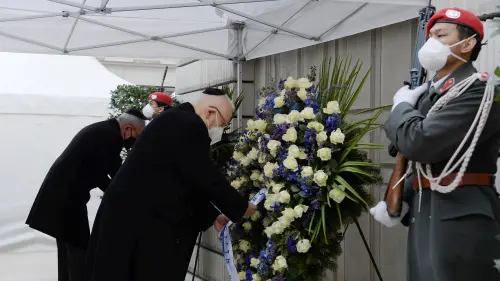
Israeli President Reuven Rivlin thanked Austrian Chancellor Sebastian Kurtz for Austria’s commitment to fighting anti-Semitism and support for Israel with regard to the International Criminal Court.

The Hungarian Jewish community is the largest in East-Central Europe with an estimated 100,000 members.

The painting has been hanging in the Musée d’Orsay in Paris as part of the national collection since 1980, when it was acquired by the state via auction from a gallery in Zurich.

Michael Spence, president of University College London, acknowledged free speech but seemed to draw a limit when it comes to some subjects.