Newsletter
Newsletter Support JNS

Israel, Greece and Cyprus officials work to expand energy cooperation

The European Union wants to decrease its reliance on Russian gas.

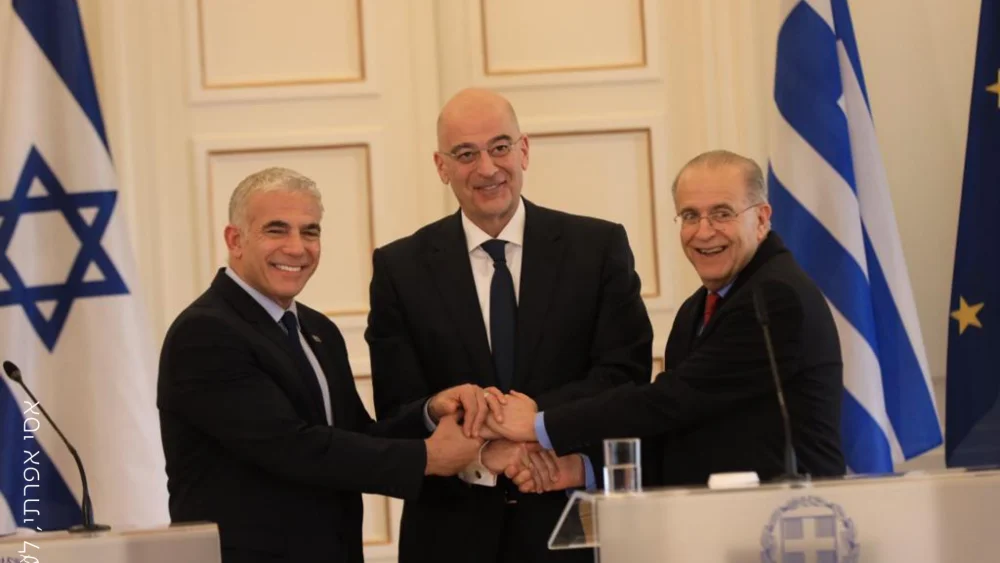
Greek Foreign Minister Nikos Dendias, Israel's Foreign Minister Yair Lapid and Cypriot Minister of Foreign Affairs Ioannis E. Kasoulidis at a news conference at the Ministry of Foreign Affairs in Athens, Greece, on April 5, 2022. Source: Asi, Efrati/Twitter.
Greek Foreign Minister Nikos Dendias, Israel’s Foreign Minister Yair Lapid and Cypriot Minister of Foreign Affairs Ioannis E. Kasoulidis at a news conference at the Ministry of Foreign Affairs in Athens, Greece, on April 5, 2022. Source: Asi, Efrati/Twitter.

Officials from Israel, Greece and Cyprus met in Athens on Tuesday to expand their energy cooperation on natural-gas pipeline projects in light of the ongoing war in Ukraine.

Israeli Foreign Minister Yair Lapid tweeted that the war loomed over the meeting, where those gathered noted that “first and foremost, in regional security.”

The European Union wants to decrease its reliance on Russian gas due to the war.

Foreign Minister of Cyprus Ioannis Kasoulides said“we are proceeding with projects such as the EuroAsia Interconnector and the EastMed pipeline ... and we are confident that when materialized, they will have another practical and geostrategic value for the Eastern Mediterranean and the European Union,” reported Reuters.

Cyprus, Greece and Israel agreed to build the world’s longest and deepest underwater cable to link their electricity grids in the EuroAsia Interconnector project, which is expected to be finished in 2024.

The EastMed subsea pipeline is in the planning stages and involves transferring natural gas to Europe.
As NATO leaders meet in Ankara, JNS spoke with former U.S. envoy James Jeffrey and JINSA’s Blaise Misztal about why U.S. and Israeli officials disagree about Turkey.
“Iran’s demonstrated aggression was unwarranted, dangerous and a clear violation of the ceasefire,” CENTCOM said.
The organization asked the court to reconsider, arguing that it could be forced to suspend operations in the state and nationwide if the designation takes effect.
The 19-year-old waived trial after prosecutors said that he conspired to join ISIS and communicated about “violence against Jewish people,” per a federal filing.
Rabbi Aaron Starr, rabbi of Shaarey Zedek and president of the Michigan Board of Rabbis, declined to comment directly on Dr. Abdul El-Sayed but told JNS, “look at what he says about ‘genocide’ and who his funders are.”
“Contemporary Antisemitism 2026" explores ways that can influence how cultures identify, understand, and confront anti-Jewish and anti-Israel sentiment.