Newsletter
Newsletter Support JNS

Indian military chief tours Israel, receives briefing on security threats

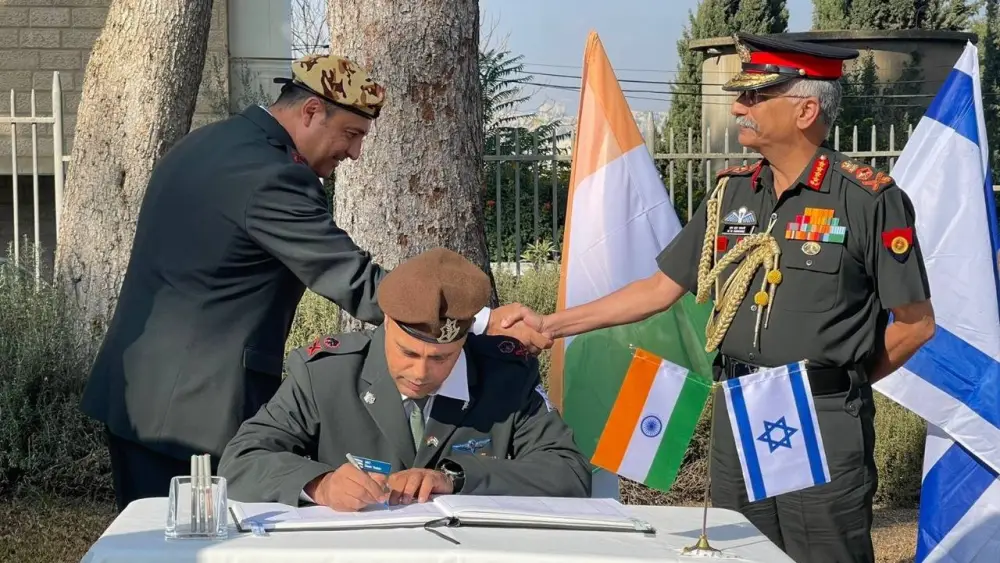
Gen. Manoj Mukund Naravane (“MM”) Navarne observed Israel’s northern borders and also paid tribute to Indian army casualties that fell during World War I.

Indian Chief of Army Staff, Gen. Manoj Mukund Naravane (“MM”) Navarne, at a wreath-laying ceremony in Israel honoring Indian soldiers who died during World War I, Nov. 17, 2021. Source: Twitter.

The Indian Chief of Army Staff, Gen. Manoj Mukund Naravane (“MM”) Navarne, is in Israel for a five-day visit, reported the Indian website NDTV.

Upon arrival on Wednesday, Navarne visited the main headquarters of the Israel Defense Forces in Tel Aviv.

The next day, he stopped at the Indian Soldiers War Memorial in Jerusalem, where he laid a wreath and paid tribute to Indian army casualties that fell during World War I.

Also on Thursday, Navarne was greeted by the IDF Guard of Honor before observing an IDF special operations unit, “where he was briefed on aspects of the conduct of counter-terrorism operations,” according to the report.

He also spent time on Israel’s northern borders, receiving a briefing there by IDF officers.

Last month, Indian fighter jet pilots took part in the Israeli Air Force’s international Blue Flag drill in southern Israel. The pilots described receiving high training value from the exercise, adding that they would take home the experience of combined fourth and fifth-generation aircraft combat exercises.


“I’ll be surprised if that ends up being the smart political move down the road, because it’s really just the unions that are against it,” Colleen Hroncich, of the Cato Institute, told JNS.
“The far-left blames Zionists, the Islamists blame Israel, and the ‘blind right’ blames the Jews,” Ambassador George Deek told JNS. “It’s three different stories with the same hate.”
Descendants of publisher Samuel Fischer say the painting’s 1936 sale resulted from Nazi persecution.
Samir Mahmoud Hassan Abu Younis had led the brigade for approximately two months following the slaying of his predecessor.