


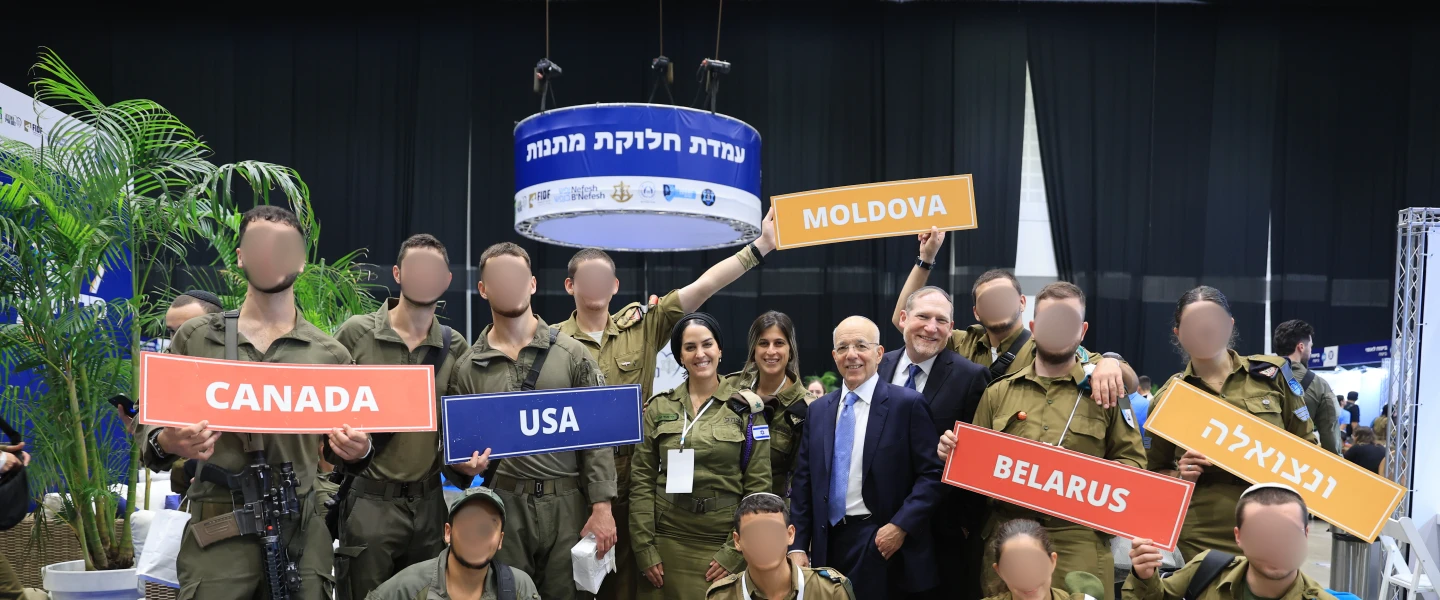
For one lone soldier from the United States, a bureaucratic problem that could have taken months was resolved in a single day.
The soldier, identified only as C.W. for security reasons, had been serving in a technology unit in the IDF’s Gaza Division when she attended Yom Siddurim, an annual event designed to help lone soldiers deal with the practical demands of life in Israel.
“I really needed to get my degree recognized by Israel,” she told JNS. “They let me do the whole process all in one day that otherwise could have taken me another couple of months.”
That is precisely the kind of problem Nefesh B’Nefesh is trying to eliminate for young people who make aliyah and are then required to serve in the IDF, often far from their families.
The organization’s work with young olim (immigrants) extends beyond helping them arrive in Israel. Through its Lone Soldiers Program, in partnership with Friends of the IDF (FIDF), Nefesh B’Nefesh provides ongoing assistance to young immigrants from around the world who are required to serve or volunteer in the IDF, helping them navigate the bureaucracy, logistics and personal challenges that can accompany military service without immediate family support in Israel.

Turning bureaucracy into one day
On Oct. 22, thousands of lone soldiers are expected at Expo Tel Aviv for the 2026 Yom Siddurim, which brings more than 750 government offices, organizations and service providers together under one roof.
Instead of spending days traveling between government offices, soldiers can handle multiple tasks in one location, including obtaining biometric passports and identity documents, dealing with driver’s-license matters, securing recognition of foreign degrees, receiving legal advice and housing and employment assistance, and resolving National Insurance-related issues.
The Nefesh B’Nefesh-FIDF Lone Soldiers Program, the IDF Human Resources Department and other organizations serving lone soldiers coordinate the event.
But the program’s support does not begin—or end—with a large annual event.
Shraga Weissmann, who has headed the Nefesh B’Nefesh-FIDF Lone Soldiers Program for the past two years, came to Israel from Baltimore to study in 2001 and made aliyah in 2004. One of 10 children, he served in the Mahal Hesder program in the Golani Brigade, learning Hebrew during his army service.
Along with the challenge of 500 days of reserve duty, he now works with young people experiencing many of the same difficulties he once faced.
“On a personal level, it’s really special to do this job,” Weissmann told JNS. “Every lone soldier has difficulties, and being able to help any of them make the journey a little easier is an amazing experience.”
The challenges can be practical—housing, employment, licenses or paperwork—but they can also involve language, navigating the military system and simply knowing whom to call.
The Nefesh B’Nefesh-FIDF Lone Soldiers Program works with lone soldiers from around the world, with advisers able to assist in multiple languages. It also helps lone soldiers before they enter the army, including with questions about aliyah, bureaucracy and ulpan, and continues to provide support throughout their service.
The goal is not simply to help a lone soldier complete a form. It is to make it possible for a young person who arrived from another country to function successfully in Israeli society before, during and after military service.

A home for young women serving Israel
The same philosophy now extends to young women choosing a different form of service: Sherut Leumi (National Service), an alternative framework in which Israelis who do not serve in the military perform civilian service in hospitals, schools, welfare organizations and other public institutions.
For young women who choose National Service, the needs can look different, but the importance of having a support system is similar.
Nefesh B’Nefesh established its Lone Bnot Sherut program to provide community and practical support for bnot sherut—young women performing National Service—who come to Israel from abroad without their immediate families. The program works with various National Service organizations and is open to participants from around the world.
Last year, that commitment took physical form with the opening of the Nefesh B’Nefesh Lone Bnot Sherut Residence in Jerusalem.
Dafna Emmer, who came to Israel from New York with her family 12 years ago and has hosted numerous gap-year students in her home, heads the Bnot Sherut program.
She describes the residence as much more than housing.
The first cohort included 95 young women from eight countries. They served in hospitals, schools, national organizations and heritage institutions throughout Jerusalem.
For some of the young women, Sherut Leumi is also a way to experience life in Israel before deciding whether to make aliyah. Some arrive as olim; others come on volunteer visas and leave Israel afterward.
For those who stay, a year or two of service can become a bridge into Israeli life.
The residence provides furnished apartments with single, double and triple occupancy, kitchens, common areas, a gym, laundry facilities and a beit midrash, and is open for Shabbat and all holidays. There are also Torah-learning and social programs, Shabbat arrangements and opportunities to build a community with other young women who have made the unusual decision to leave their families and home countries to spend a year or two serving Israeli society.
There are three resident assistants, all of whom made aliyah, completed Sherut Leumi and continued to university. They are available to residents, including at night, providing a familiar face when a young woman needs advice or simply someone to talk to.
Resident assistant Gila Stepetofsky knows firsthand what that transition can look like.
Originally from Staten Island, N.Y., Stepetofsky studied at Sha’alvim for Women for a gap year before making aliyah. She completed Sherut Leumi at Midreshet Darkaynu, a program serving girls with special needs, then attended Hebrew University’s Mechina program to strengthen her academic Hebrew before beginning her studies in social work at Hadassah College.
Now she helps other young women navigate the transition she experienced herself.
“It’s an amazing program,” Stepetofsky told JNS. “The building has a great vibe; I wish I had this when I was on a similar track.”
The women arrive from very different backgrounds, she said, but quickly form a community.
“They come together like family in an English-speaking environment that provides a ‘soft landing,’” she said. “I’m happy to be there for these girls for whatever they need.”

A year that can change what comes next
Molly Litvak, from Los Angeles, arrived in Israel at the end of August on a volunteer visa. She works as an elderly companion, including at a dementia center and in private homes.
She arrived without knowing many people in Israel. The residence changed that.
“I have zero complaints,” Litvak told JNS. “The housing is near everything, walking distance and near bus lines.”
But the location was only part of the appeal. The social environment gave her an immediate community at a time when she was beginning a new experience far from home.
“It has been a meaningful time,” she said, describing the experience as “exactly what I wanted.”
Litvak has not yet made aliyah. For her, National Service is part of discovering whether Israel could eventually become home.
That possibility is one reason Nefesh B’Nefesh views support for service as part of its broader aliyah mission.
The organization describes its role in IDF and National Service as helping young people navigate a unique period in their lives, whether they are required to perform military service or choose Sherut Leumi.
For a lone soldier, that can mean turning months of bureaucracy into a single afternoon.
For a young woman doing Sherut Leumi, it can mean having a place to come home to, people who understand what it means to be far from family and the confidence to learn how to manage life independently.
And for both, it means that choosing to serve Israel does not have to mean navigating the experience alone.
Nefesh B’Nefesh’s support begins with aliyah, but for these young olim and volunteers, it continues through the much more complicated task of building a life in Israel.
