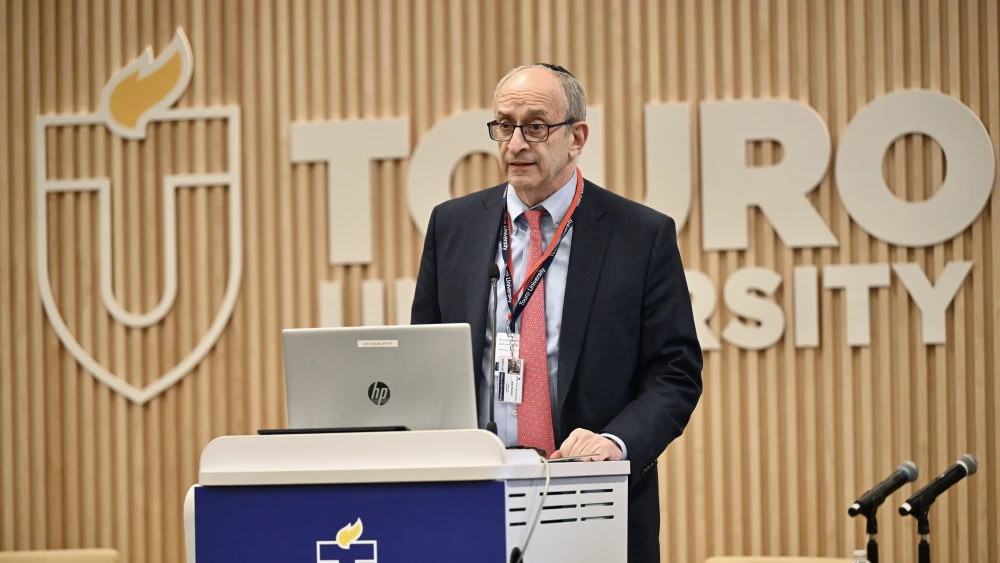
Dr. Alan Kadish, president of Touro University and a physician, hopes that the private school, which operates under Jewish auspices, doesn’t have to turn its recent symposium on antisemitism into an annual event.
“I’m hoping we never have to do it again,” he told JNS at the conference, which drew about 300 people, on Monday. “But the reality is we’ll probably end up doing it every year.”
The event drew elected officials, including Julie Menin, the New York City Council’s first Jewish speaker, as well as scholars, Jewish leaders and entertainers. Ido Aharoni, former Israeli consul general in New York, and Morton Klein, president of the Zionist Organization of America, also participated, as did singer Gloria Gaynor and social media activist Montana Tucker.
Kadish told attendees at the event, in Midtown Manhattan, that “words are not enough.”
“Statements of outrage aren’t enough,” he said. “When overt antisemitism infects society and the world, action is required.”
Menin and fellow Jewish City Council members Simcha Felder and Inna Vernikov and Simcha Eichenstein, a Jewish state Assembly member, received “courage in leadership” awards at the event.

Eichenstein, who represents a largely Orthodox Jewish district in Brooklyn, told JNS that antisemitism has become an increasingly tangible concern in his daily life, including decisions as routine as whether to take the train into Manhattan.
“I think twice about taking the New York City subway in 2026,” he said. “It’s very, very real. We have all experienced it.”
Protests outside the symposium underscored the urgency of addressing Jew-hatred, particularly when educators, legal scholars and advocates were gathered inside to discuss the issue, according to the state Assembly member. (JNS saw about a dozen protesters.)
“This is not just a wave. This is not just the effect of Oct. 7,” Eichenstein told JNS. “This was actually happening before Oct. 7. Unfortunately, what follows is the normalization of it.”
“If we do not fight this, it’s only going to get worse and worse and worse,” he said.
Kadish told JNS that physical attacks against Jewish students and antisemitic symbols on campus are serious concerns but that ostracism has been particularly damaging.
“The part that’s really been more insidious is social isolation,” he said.
Jewish students have found themselves cut off from former friends or treated differently due to their identity, he told JNS.
As a school with Jewish heritage, Touro has a particular responsibility to respond to antisemitism, according to its president. But Kadish told JNS that Jew-hatred undermines society broadly and isn’t only a Jewish issue.

Several months before the event, Touro created an Antisemitism Institute, which brings together faculty and professionals who work in research, education and legal advocacy. Its work includes an Antisemitism Law Clinic, a teaching fellowship for professors, and research into the spread and effects of antisemitism online.
The university is studying ways to help social-media users recognize antisemitic content and the psychological effects of online Jew-hatred on students, according to Kadish.
Menin, the City Council speaker, told attendees that she saw protesters waving Hamas flags outside City Hall last month, on the third anniversary of Oct. 7.
She said that it was shocking that such scenes have become part of the city’s reality. The United States has designated Hamas as a terrorist organization since 1997.
Mark Goldfeder, director of Touro’s Antisemitism Law Clinic, told attendees that the distinction between protected speech and unlawful conduct is central to addressing Jew-hatred through the legal system.
He described the clinic’s work training law students and allies to respond to discrimination and harassment. “The classroom is where the West learns to think about itself,” he told JNS.
Aharoni, the former Israeli consul general in New York and a Touro professor, told attendees that social media algorithms encourage people to view complicated conflicts through simplistic decisions between “oppressors” and “oppressed.”

“We are being ushered by technology into a new age of stupidity,” he told JNS.
He called the fight against antisemitism “a generational effort” that requires teaching students to think critically and engage with complexity.
Klein, of the ZOA, called on Jewish communal leaders, rabbis and elected officials to take a more forceful public stance against antisemitism and false accusations against Israel.
“This is the most dangerous time in my lifetime as an American Jew,” he told JNS. “We have to condemn the lies. We have to have rallies against the lies. We have to get public officials to publicly condemn the lies about genocide, apartheid, famine and colonization.”