Audrey Glickman, who survived the mass shooting during Oct. 27, 2018, Shabbat services at Tree of Life*Or L’Simcha Synagogue in Pittsburgh, thinks that people should watch testimonies from terror survivors.
“I would hope that they would watch all of us just in case one of the things would be appropriate,” the 69-year-old told JNS.
She allowed that “it’s never going to happen the same way again,” but that someone might see something that would help them escape a dangerous situation in the future. There is a “big opportunity to have something good come from it,” she said.
Glickman told JNS that “the day started as every Saturday did.”
“I picked up my friend Joe. It was cold and raining, and we had our winter coats on and got in my car instead of walking,” she said. “We walked in together.”

Her first sense that it wasn’t a normal day was when she heard a noise “like something was falling.”
She thought it was a coat rack but then understood it was “unmistakable automatic weapon gunfire echoing down the hallway.”
Glickman had received security training while working at another synagogue, where she was a rabbi’s assistant. She started running.
“I thought, this is what we do. There’s an emergency. We’ve got to save as many people as we can,” she told JNS.
David Rosenthal, who was helping her lead the prayer service, ran with her at first but then decided not to hide with her. He and his brother Cecil were killed in the attack.
Glickman and her late partner, Joe Charny, ran up the stairs and hid. When she used Charny’s phone to call 911, she was worried that it would make too much noise and draw the shooter’s attention. (She asked JNS not to name the shooter for fear of inspiring copycats.)
The 911 operators “wanted to keep me on the phone,” she told JNS. “I couldn’t do it. I could not stay on with them.”
“We made the decision to stay there until we could hear what was happening, because it seemed to be a safe place,” she said. “In due course, we decided to make our way out in the direction where there hadn’t been any praying going on, so hopefully there was no shooting going on.”
Her experience left her with a practical takeaway: have pockets big enough to carry a phone. Her phone was on a pew when the gunfire began.
“If somebody listens to our stories and gets themselves the training, then go for it, because that’s what we need,” she told JNS.

“If you’re prepared for the worst, then you can go on and live your life and find happiness and joy and laughter and know that when you need it, it will be there,” she said.
Glickman told JNS that recording her story was a chance to preserve memories. “It lets you tell your story as if you’re putting it down in a diary,” she said. “You can just download your brain.”
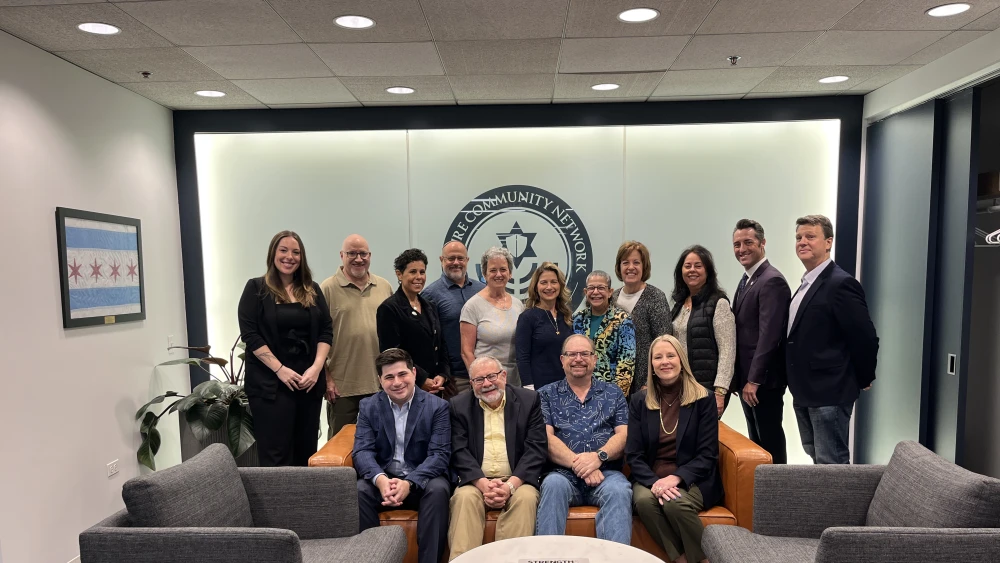
The Secure Community Network, a nonprofit that serves as the North American Jewish community’s official safety organization, launched a project called “standing with strength” on Oct. 1 to preserve accounts from 10 survivors, witnesses and family members who experienced fatal antisemitic attacks in Pittsburgh, Poway, Calif., and Overland Park, Kan., a hostage situation in Colleyville, Texas, and a deadly building collapse in Surfside, Fla.
Glickman’s story is part of the project, which is modeled on Steven Spielberg’s effort to preserve Holocaust survivor testimonies. The network says that it plans to incorporate the testimonies into its security training programs.
The network brought the participants together in September 2025 to record their experiences with Craig Turk, a screenwriter and producer whose television work includes “Private Practice” and “The Good Wife.”
Turk, 55, told JNS that Spielberg’s Holocaust survival testimony project inspired his work. “While written testimonies are essential to the historical record, being able to see these faces and hear these voices will help people connect to these experiences in the most profound way possible,” he said.
Both of Turk’s parents lost family in the Holocaust. He grew up in Orange County, Calif., meeting survivors. He said that recordings preserve the experiences for people who may never meet survivors.
“The simple fact of preserving them is really incredibly important,” he told JNS.

Growing up, Turk “understood clearly the trauma of that generation” but “felt so fortunate that I lived in a generation after that.”
“For my kids’ generation, that’s not the case, and it never occurred to me that my generation would be special in the sense of having had a break from this,” he said. “It’s been an unbelievable challenge for this generation, even before Oct. 7, but certainly since Oct. 7.”
Turk said that his daughter’s bat mitzvah took place on the morning of the Tree of Life massacre. His family was outside its synagogue on Hollywood Boulevard in Los Angeles taking photographs of grandparents, parents and children. Then police told them it was unsafe to remain outside.
He told JNS that listening to survivors tell their stories has changed how he approaches his safety. “I feel sad that we have to be conscious of this, but that’s the world we live in,” he said.
“It’s better to feel sad and prepared than to be indignant about the fact that you have to do it,” he told JNS.
Michael Masters, national director and CEO of the network, told JNS that hearing survivors describe their experiences convinced him it was “very critical” for SCN to “record their stories for posterity.”
The stories give viewers specific things to consider, like knowing where the exits are in every room and identifying ways to secure a door, he said.
“If I asked you to close your eyes in any room that you were in, would you know where the exits are?” he told JNS. “Would you know how to get to them?”
Masters said during the Colleyville hostage crisis, a hostage called 911 and put the phone down so the dispatcher could hear what was happening. Hostages positioned chairs to create a barrier between themselves and the attacker.
Though many Jews do not carry phones on Shabbat, Masters told JNS that some rabbis are “permitting identified individuals in the shul to be able to have a cell phone.”
Survivors belong to “a club that they never wanted to be a part of,” but they share their experiences to spare others what they endured, he told JNS.