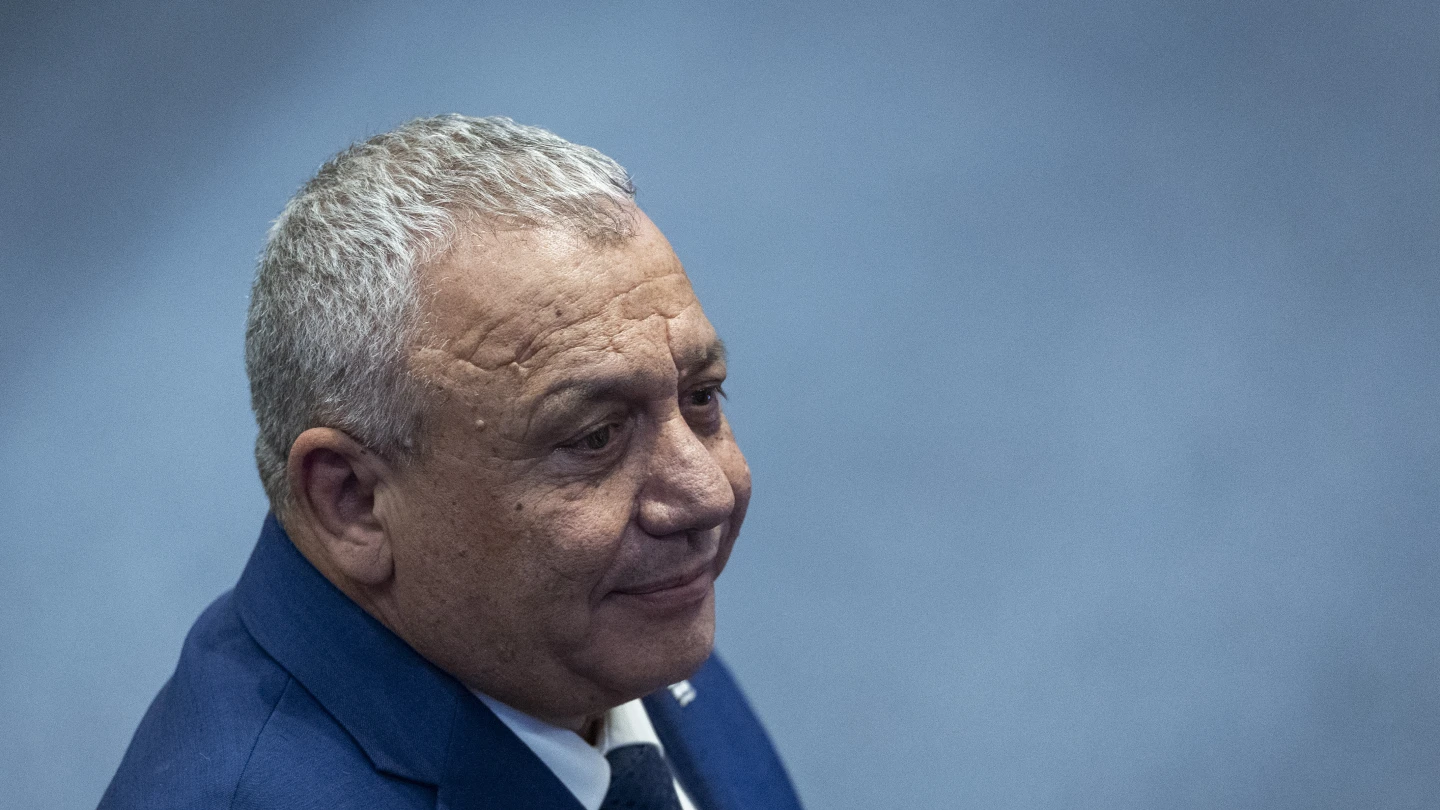

Gadi Eisenkot, the former IDF chief of staff and current chairman of the Yashar Party, which won 21 seats in the recent Knesset elections, has received a mandate from Israeli President Isaac Herzog to form a government. He was given a maximum of 42 days to do so.
Eisenkot’s most logical option would be to forge a coalition with Benjamin Netanyahu’s Likud Party (27 seats), Naftali Bennett’s and Yair Lapid’s B’Yachad (12), and Bezalel Smotrich’s Religious Zionism (6) for a total of 66 seats in the 120-seat Knesset.
This arrangement would exclude the Haredi parties of United Torah Judaism (7) and Shas (6), who insist on preventing the enlistment of yeshivah students in the IDF. It would also exclude the Arab parties, especially the Joint List (11), which is hostile to the idea of a Jewish state and unlikely to consider Hamas a terrorist organization—one of Eisenkot’s conditions for joining his government.
Mansour Abbas, chairman of the Arab-Islamic Ra’am Party (8), was part of the Bennett-Lapid government in 2021. Abbas has told members of the anti-Netanyahu bloc that he is prepared to explicitly recognize Hamas as a terrorist organization in exchange for a “genuine partnership.”
While Abbas’s declaration is a step in the right direction, should Eisenkot decide, as he promised, to finish the job against Hamas in Gaza, it is doubtful that Ra’am would stay in the coalition.
Under such circumstances, an Eisenkot government would lose its majority, even if it were able to recruit UTJ and Shas. Moreover, it is unlikely that Shas would join Eisenkot’s coalition, which would leave such a government with 55 seats—not enough to govern.
The anti-Netanyahu bloc parties are afflicted with Netanyahu Derangement Syndrome. They have pledged not to sit with Netanyahu in a government, regardless of the circumstances. Avigdor Liberman’s Yisrael Beitenu (7) has tried to convince Eisenkot to seek an arrangement with the Haredi parties, despite his campaign pledges to exclude them along with the Arab parties.
It is doubtful that the Haredi parties will end up joining Eisenkot’s coalition, although miracles can happen in Israel, especially when incentivized by financial rewards and power-sharing.
It would be difficult for UTJ chairman Yaakov Asher and Shas’s Aryeh Deri to find common ground with the far-left chairman of HaDemokratim (8), Yair Golan, who would rather have the Arab parties provide cover for a minority Eisenkot coalition from outside than include the Haredim.
Israeli Prime Minister Benjamin Netanyahu has called on the parties of the so-called change bloc to form a national unity government with the parties of his outgoing coalition. He has issued dire warnings that a government formed with the Arab parties, which he labels “terror supporters,” would destroy the country.
A fresh face might mitigate the negative attitudes toward Israel among the Democrats, though it could also come at the price of a two-state solution.
For Israel’s sake, the Zionist parties must find compromise and form a unity government. Such a coalition, which could hold 81 seats, would have the power to enact a solid draft bill and cut subsidies for yeshivah students who do not intend to become rabbis or teachers, thus bringing thousands of young men into the IDF.
The problem for Netanyahu is that he would have to forgo his alliance with Itamar Ben-Gvir’s Otzma Yehudit Party (seven) and the Haredi parties with which he has long been allied.
The anti-Netanyahu bloc must end its boycott of Netanyahu and realize that Israel is in a critical situation vis-à-vis its enemies and friends. The Islamic Republic of Iran will maximize its efforts to obtain a nuclear bomb, and the Trump administration might decide to focus on economic pressure rather than a military campaign. More seriously, the Trump administration could distance itself from Israel, and the Democrat-led U.S. Congress might be hostile and uncooperative.
Therefore, Israel must be united and resolute.
While Netanyahu has the experience and charisma to lead Israel during the difficult times ahead, he is hated by the U.S. Democratic Party and increasingly disliked by some in the Trump administration—including Vice President JD Vance and others in the MAGA movement.
A fresh face like Eisenkot’s might mitigate the negative attitudes toward Israel among the Democrats, though it could come at the price of a two-state solution, which most Israelis reject as too dangerous in the aftermath of the Oct. 7, 2023, Hamas massacre.
In any case, if democratic elections were to be held by the Palestinian Authority after a hiatus of 21 years, Hamas would win easily, as the inept and corrupt administration of Fatah leader Mahmoud Abbas is highly unpopular.
Israel must take advantage of Trump’s next two years in office. Trump endorsed Netanyahu and has a close working relationship with him.
It is therefore essential that a rotation of prime ministers take place with solid guarantees that Netanyahu will not play a dirty trick on Eisenkot as he did on Benny Gantz. If he goes second in a two-year rotation agreement, Eisenkot would serve as prime minister, having gained experience under Netanyahu’s tutelage.
Eisenkot must consider patriotic obligations rather than dwell on his ego. The above arrangement would provide relative political peace and unity in the face of critical challenges to the Jewish state.