“Seven times did the wolf tell the lamb stop. And only then devoured.” — Natan Zach, “Failure”
A few days ago, on Dec. 14, a bipartisan group of some 50 people, all former high-ranking security and foreign affairs officials in previous U.S. administrations, publicly called upon President-elect Joe Biden to act swiftly in the matter of Iran: “On day one, [President Biden] could announce his intention to re-enter the [2015 Joint Comprehensive Plan of Action] agreement, suggesting a step-by-step process for full sanctions relief that is synchronized with Iran’s return to full compliance.”
While acknowledging that “the conventional arms race, including ballistic and cruise missiles and drones, raises tensions and instability in the region and undermines deterrence,” the group argued that “with the JCPOA reinvigorated by Iran and the U.S., the hard work can begin on regional arms limitations and provide a foundation from which to resolve regional differences and explore regional cooperation.”
This bold call for action came against the backdrop of the growing European distrust of Iran and awareness of the JCPOA’s dangerous omission of the issues of Iran’s aggressive activity across the Middle East, including by arming its proxies with rockets and missiles. This activity cannot be separated from Iran’s quest for nuclear weapons because a nuclear bomb needs a delivery system. The recent success of the Iranian space launch vehicle has proven that Iran is capable of building rockets with a very long range.
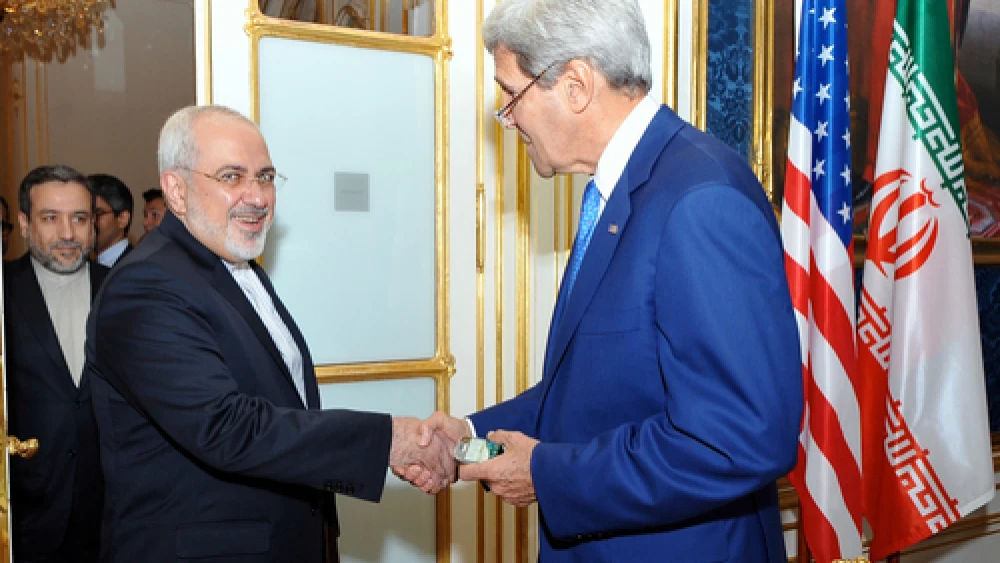
The proposal to first lift sanctions on Iran and then expect it to limit its missile industry may be an attractive topic at a foreign relations seminar, but for a dose of reality it is advisable to first listen to Iranian Foreign Minister Mohammad Javad Zarif, who in a Dec. 9 interview was very clear:
“Mr. Biden’s government officials know that the subjects that do not appear in the JCPOA are not absent by accident, but rather by decision. This means that we have debated the subject of the missiles. When they raised the issue of our missiles, we said: ‘What do you have to say about the weapons that Israel or Saudi Arabia possess? Are you saying that Iran should be denied its defensive capabilities? Do you have the right to do that?’ When they raised the issue of our regional [involvement], we said: ‘What do you have to say about Israel?’ And they responded: ‘We want to repair your relations with the region.’ We said: ‘Repair your own relations with the region.’”
And more: “America is in no position to set conditions for its return [to the JCPOA], or for the restoration of its rights when it comes to the JCPOA’s implementation. ... So, if the [missiles and regional intervention] do not appear in the JCPOA, it’s because they compromised on these issues. They failed to put them in the JCPOA. They do not have that option. They are the ones who owe us, because of their policies of arming [others] and their policies in the region.”
The game is always the same—the aggressor persuades the threatened party it has the higher moral ground. Iran’s blatantly expansionist ideology—its leaders proclaim that Iran is now in “the second phase of the Islamic Revolution"—has been replaced by these leaders’ claim that Iran is actually the Middle East lamb that must act in self-defense.
Zarif’s recent exposure of the Western democracies’ moral weakness in the negotiations for the JCPOA is a timely wake-up call. For the United States to take this group’s advice and lift the sanctions on Iran while disregarding Iran’s regional aggression and missile development would be dangerously reckless.
Ayelet Savyon is director of the MEMRI Iran Media Project; Yigal Carmon is MEMRI president and founder; Ze’ev B. Begin is a MEMRI Senior Fellow.