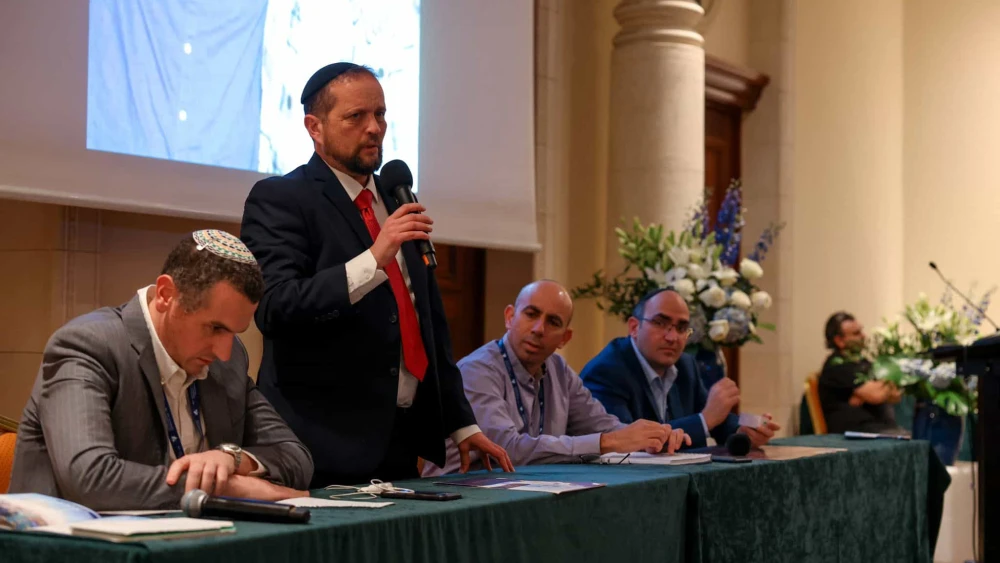
“The good news is that artificial intelligence is quite new; for those who aren’t using it yet, you can learn. However, this baby’s growth is exponential,” Chani Marzel told audience members at the Yael Foundation International Conference in Paphos, Cyprus, on Feb. 21.
Marzel, a consultant based in Lod, in central Israel, was giving a talk on the use of artificial intelligence in Jewish education.
In the wake of the Hamas onslaught on Israel on Oct. 7, dozens of educators at this week’s four-day conference were excited about the opportunity to reconnect with Jewish youth and boost Jewish education.
“Technology is important. We conducted competitive analysis and realized that we need to implement technology to offer excellent academic learning in Judaism and regular school subjects,” Chaya Yosovich, CEO of the Yael Foundation, told JNS.
“This is a time of opportunity in the Jewish world. We hear from a lot of the communities that they have members who weren’t involved in the past turn to them—either they come to synagogue or inquire about putting their children in a Jewish school,” she said.
The Yael Foundation supports 65 projects involving 10,000 children in 31 countries across six continents. In 2024, the foundation will be allocating €20 million ($21.6 million) to democratize Jewish education.
Marzel, the founder of the Creative Intelligence project, believes Jewish education can be greatly enhanced via the use of artificial intelligence.
“My dream is for every teacher to know how to use AI and be one step ahead or at least at the same level as the students,” she said.

She said the use of AI is crucial for children to learn independently. Technologies such as ChatGPT—a chatbot developed by OpenAI and launched in November 2022—should not be regarded as quick fixes, but rather as tools to help children develop their thoughts, she added.
“If we frame their use in a positive, healthy and productive manner, children will not use these tools for unintended purposes,” Marzel said.
She regards AI as a way to efficiently summarize information, conduct analysis and create informative illustrations. To her, AI works as a personal assistant that allows both teachers and students to achieve more in a shorter time.
After Oct. 7, Marzel recorded two Canva (an online graphic design app for creating social-media graphics and presentations) training videos for children to learn how to create illustrations and movies using AI. At the request of parents, she built a course for children ages 10 to 14.
“We must give children the tools and the opportunity to be whoever they dream to be and show them that we believe in them,” she said.
Regarding the issue of AI being used for antisemitic purposes, Marzel said: “Our enemies use AI for nefarious purposes, we must call on the Jewish people to use it to our advantage and to advance our agenda.”
During a visit to the United States last September, Israeli Prime Minister Benjamin Netanyahu discussed the benefits and dangers of AI during a 45-minute discussion with tech tycoon Elon Musk.
Musk said that artificial intelligence is “potentially the biggest civilization threat,” while Netanyahu discussed AI in biblical terms, noting that Moses laid out paths for the Israelites that led to blessings or curses. “The blessings of AI are amazing,” the prime minister said. However, he noted that artificial intelligence can also be harmful.
For example, last month, Gab, a far-right social-networking service, announced plans to release AI chatbots that will deny the Holocaust.
A digital escape room
At the conference, Ramy Avigdor, co-founder of Class-E, an Israel-based company aimed at realizing teachers’ and students’ potential by using digital tools, and director of Centro Kehila, an organization that supports Jewish education in Spanish-speaking countries, showed educators practical examples of techno-learning.
Avigdor presented a digital escape room that uses AI to teach students about Purim interactively with questions and clues. Students learn independently at their own pace for 25 minutes before diving deeper with their teacher.
“The computer is not a substitute for a teacher; it will never replace the spark in the eyes of the teacher and will never give love and encouragement the way a teacher does,” Avigdor said.
He also described how AI enables teachers to measure participation and monitor students. “It is possible to see in real-time which student needs help with what question and who is stuck at a certain level in the escape room,” Avigdor said.
AI creates automatic grade reports and skill reports where aggregated data is presented comprehensively. “I can see who failed vocabulary questions, who forgot to answer a question, and who is hesitating. I know in real-time where my class stands and where I need to focus my efforts,” he said.