Typhoid. Cholera. Yellow fever. Poverty. Life in America was tough in 1801. The health epidemics touched everyone, including Jewish communities. In the early 19th century, benevolent societies emerged to help families in crisis.
The Hebrew Orphan Society is the oldest of those organizations, and it is still operating, albeit with a slightly different focus. This year the Charleston, S.C.-based nonprofit commemorates its 225th anniversary of continuous operation.
The society was created by 23 members from Congregation Beth Elohim. The current-day membership is 36—double chai. Members reflect a broad range of the Charleston community. Eileen Chepenik, treasurer of the society, has been a member for 18 years. She is also board president of Jewish Family Services.
“It has always been a very honorary role, and members are voted in based on a lifetime of service to the Jewish community,” Chepenik told JNS. “We have two pots of money, and annually we give grants to Jewish organizations. There is an application process and a review of what the funds will be used for.”
Although the word “orphans” remains in the name, the mission has evolved, according to society president Dennis Feinberg.
“Obviously, the needs have changed quite significantly over 225 years,” Feinberg, a retired veterinarian, told JNS. “The original charter was to take care of widows and orphans after the Revolutionary War. Now, funds go to Jewish Family Services, the kosher-food pantry, the Jewish day school, youth organizations, synagogue programs and college scholarships.”

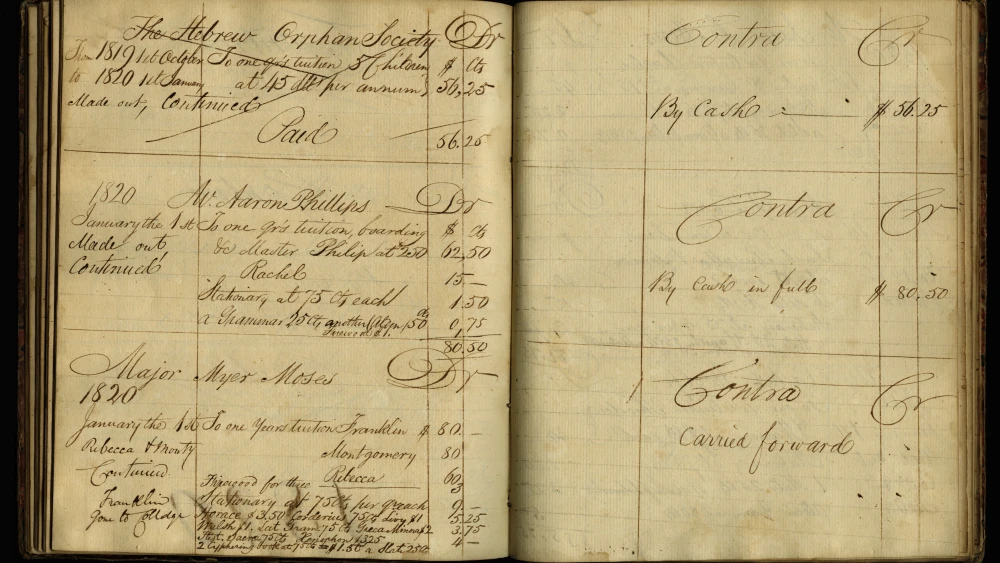
A society ledger entry from 1820 shows a payment of $80.50 to Aaron Roberts for tuition and boarding. Adjusted for inflation, that amount in 2026 would be about $2,000. That also happens to be the average amount the Hebrew Orphan Society now allocates for college scholarships. Over two centuries, the organization has continued its mission of financial assistance to families. It also bore witness to the passage of time, said society member Mark Pinofsky.
“When you look through the archives, it’s absolutely fascinating that history is played through the minutes, like in 1861, when Confederate forces fired on Fort Sumter,” Pinofsky said. “This was the beginning of the Civil War.”

‘More action, more activity, more commitment’
In 1800, Charleston had a Jewish population of about 600. They included some of the city’s wealthiest residents who had the means to fund a benevolent organization to aid struggling Jewish families. The society purchased a building at 88 Broad St. in Charleston in 1833, which functioned as a meeting space, a Hebrew school, and temporarily, a congregation. The property was sold in 1931 and now houses a fine-dining Italian restaurant.
Every year, society members meet to approve allocations, which total about $80,000. Donors continue to add funds, but most of the grants and scholarships are covered by endowments, Feinberg said.

“One was created by Edgar Miles, an ophthalmologist from Birmingham, Ala., who went to school at the University of South Carolina,” Feinberg said. “He created the Edgar Miles Fund. We also have the Zipporah M. Solomon Fund and a general fund.”
Recent recipients of society funding include Chabad, the Sherman House, an affordable living facility, BBYO, the Addlestone Hebrew Academy and several Charleston congregations. A couple of years ago, Feinberg, who calls himself an “Alabama rabble-rouser,” began questioning his colleagues whether the society’s mission was still relevant.
“Would our forefathers really want us to be doing the same thing, or can we make more of an impact in another way, particularly since Oct. 7, 2023. We have seen a lot of open antisemitism since then. I convened a retreat where we narrowed our scope, and the majority of our funds will still go towards youth. I feel good for the organization.”
Society members supported the idea of forming a strategic plan. With extremely low overhead and operating expenses of nearly zero, they can continue to support Jewish families with an emphasis on youth and education. After all, that directive has worked well for two centuries.
“We’re supporting the foundations of Jewish life to help perpetuate and grow it into the future,” said Eileen Chepenik. “When you think that 225 years ago, this small group of men got together and made this commitment to ensure Jewish life, and now we’re reinvigorating that commitment with more action, more activity and more intentional commitment to make sure that we continue the foundation and strengthen it for the future.”