



If you find yourself in the northern Negev during the summer, you will see a scorched landscape of yellow and brown. But each winter, the poppy anemone—the national flower of Israel—returns. You will witness a sea of lush, vibrant, red kalaniyot, a name derived from the Hebrew word for “bride.” Well over 400,000 Israelis make an annual pilgrimage to the area to immerse themselves in its spectacular beauty.
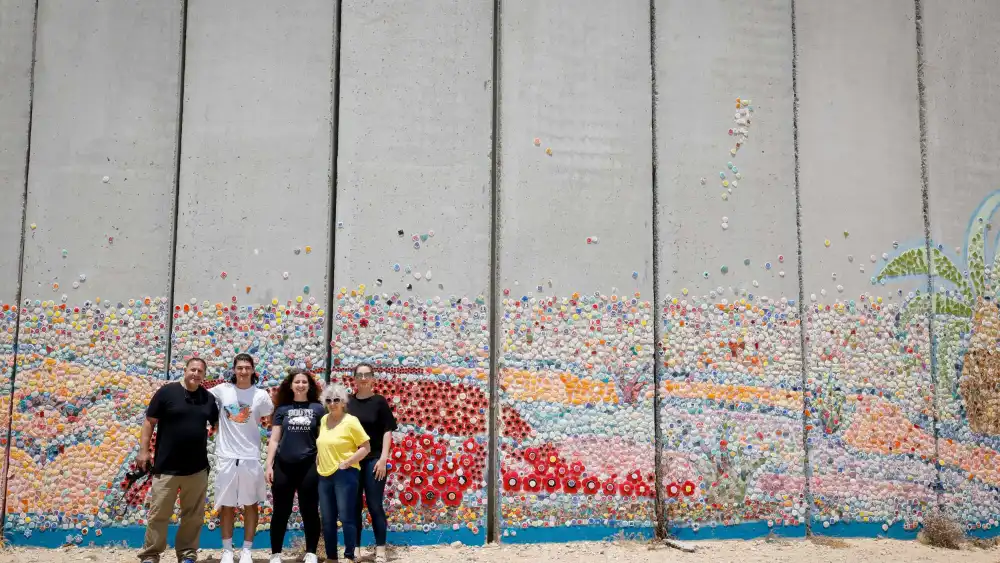
In 2019, I brought a group of student leaders to Israel on a tightly scheduled trip that left no time to see the blooming flowers. We did squeeze in a meaningful stop at the Negev village of Netiv HaAsara. After a moving presentation, we stopped to affix painted ceramic pieces on the “peace wall” that shielded the village from Palestinian sniper fire. The project’s initiators called it a “joint mosaic creation, by thousands of people, towards hope, love and happiness among all people.”
I was shocked that this stop scored lowest on the post-trip survey. I understood why when students shared that they felt unsafe visiting a village so close to Gaza. I thought they were overly anxious.
During the early hours of Oct. 7, Netiv HaAsara had a population of over 900 people. Today, like many villages in the area, the population is zero. The surviving residents are part of the over 200,000 Israelis who have fled their communities following the Oct. 7 massacre, the largest displacement of Jews since the Holocaust.
For some, it wasn’t the first time they were expelled from their homes. Netiv HaAsara was originally in the Sinai, but the 1978 peace treaty with Egypt required their removal. My grandfather covered the event as a journalist. His 1982 article in the Israeli newspaper Davar included a poem by Nativ HaAsara resident David Shemenovitz on the rebuilding of the village.
Translated by Nati Gabbay, it reads:
When we came here for the first time,
We felt at home,
Almost.
The sand is the same sand.
The sea the same sea.
The people are the same people,
And the beginning the same beginning.
Almost.
Less young.
Less innocent.
More polite,
And again we make the desert beautiful.
Anew, fields are sown,
Houses are built,
We try for grass.
With determination, we repeat it all from the beginning,
The daily struggle to succeed,
To profit, like the first time.
This time the beginning is not exactly a beginning,
And not exactly a continuation,
This time Netiv HaAsara is a revival.
After 2005, the residents of Netiv HaAsara were joined by Jews removed from the Gaza Strip.
Just two miles north of Netiv HaAsara is Kibbutz Yad Mordechai, named after the leader of the Warsaw Ghetto Revolt. In 1948, the kibbutz residents found themselves the only obstacle between the terrifying Egyptian army and poorly defended Tel Aviv. Just over 100 male and female Jewish defenders, including Holocaust survivors, armed with little more than World War I rifles, faced thousands of well-armed Egyptians with artillery and tanks. That the situation appeared hopeless is an understatement.
Yet the defenders miraculously held out against the Egyptian army for nearly a week, providing the young Jewish state invaluable time to organize a successful defense line outside Tel Aviv, preventing Egypt from fulfilling its vow to “throw the Jews into the sea.” Yad Mordechai was rebuilt soon after the war. The story of its valiant defenders is told in the page-turner The Six Days of Yad Mordechai.
On Oct. 7, Yad Mordechai not only managed to repel the invaders but did so without a single life lost. At the moment, it too has no residents. Some have found themselves exiled from their homes for the second time in their lives. Among the extensive damage in the attack was a symbol of Jewish resistance to another genocide: A rocket hit the kibbutz’s Holocaust museum, destroying a model of Mila 18, the headquarters of the Warsaw Ghetto fighters.
Residents throughout the Negev use art as a way to cope with the stress of Palestinian terrorism. The region’s music scene has thrived, as shown in the outstanding documentary “Rock in the Red Zone.” Yaron Bob had close calls with multiple rocket attacks, followed by an assault on his village on Oct. 7. He now describes himself as a refugee in his own country. His response was to turn rocket shards into sculptures of flowers. The artists of Netiv HaAsara are still selling the ceramics created to adorn their peace wall. They long to return home.
Like the anemone, I do not doubt that the inhabitants will return. Until then, we must continue to help them, whether through philanthropy, traveling to Israel or buying directly from Israeli artists through various means—including this Facebook group and the JNF.
In the same trenches of Yad Mordechai where Jews once fought the Egyptian army, soldiers are stationed once again. The kibbutz’s apiary remains undamaged. Its bees happily feast on the nectar of the anemones covering the surrounding hills, producing honey that can be delivered to your doorstep, providing the sweet taste of resilience.


