


Staff Sgt. Gal Hershko, 20, was among four soldiers from the 7th Armored Brigade who were killed in the southern Gaza Strip on Dec. 23, 2023, when an anti-tank missile struck their vehicle.
Hershko, a squad commander, was from Kibbutz Yiftah in the Naftali Mountains of the Upper Galilee, near Israel’s border with Lebanon.
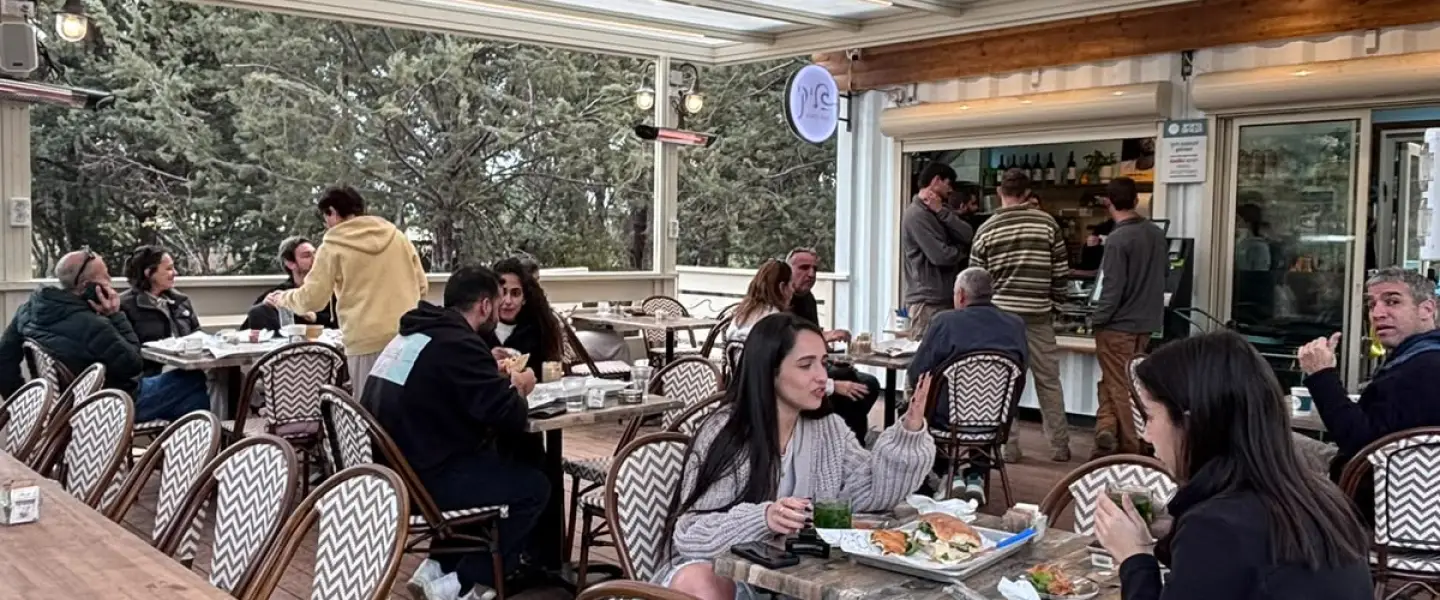
Almost two years later, in October 2025, Hershko’s aunt Carmel Zohar, with the help of extended family members and the local community, opened a coffee cart named Galiki—the affectionate nickname his mother, Racheli, called him.
Galiki, run primarily by Zohar, Racheli’s sister, serves as an outdoor community cafe, selling fresh pastries, sandwiches, salads and hot and cold drinks.
Patrons have praised the food, welcoming atmosphere, picturesque surroundings and support for IDF soldiers.
“The idea for the cart was Racheli’s,” Zohar told JNS. “Basically, she wanted it to be a place that celebrated life rather than something like a stone monument.”
The food itself is not what would have inspired Hershko, she explained. Rather, he loved nature, and the beautiful wooded surroundings on the outskirts of the kibbutz are what would have resonated with him.
The cafe also serves as a gathering place for the community.
“A cafe itself doesn’t say anything about Gal, but he loved meeting up with friends and spending time with them. He had several circles of friends,” Zohar said.
Ducks had a special significance for Gal, tied to his distinctive sense of humor and inside jokes he shared with friends. As a tribute, his family has hidden small toy ducks around the coffee cart for visitors to discover, a playful nod to something that brought him joy.
The kibbutz members have all been very supportive, Zohar said. Last March, during the war with Iran, northern Israel was under fire, “but we decided to remain open so that the community could have some breathing room,” she said. The site has an accessible protected space.
The baked goods are prepared by a baker who lives on the kibbutz, and the vegetables for the salads are grown locally.
“It’s important for us to support local businesses on Yiftah and in the Galilee,” she said.
When Hershko was killed, his family and community were among the approximately 65,000 residents of northern Israel who had been temporarily evacuated because of attacks by Hezbollah in Lebanon. They stayed in a hotel at Kibbutz Ginosar, just north of Tiberias, and returned home on March 24, 2024.

‘I knew before the family that something had happened’
Annat Zisovich-Charitt is the head of the kibbutz’s Community Emergency and Resilience Team.
In that capacity, “when Gal was killed, I was the person who got the phone call from the army. I knew before the family that something had happened to him,” she told JNS.
“That day, the rain didn’t stop, and there was a lot of flooding in northern Israel and several road closures. So, I had to wait for the army, and I couldn’t tell anyone about it.”
No one had told Zisovich-Charitt whether Gal had been killed or wounded, “but when you get a call like this, you know. I had to take them and show them the room where they would knock on the door.
“So, I was there. Sometimes, in life, you have a bond with another person that no one can break. At that moment, that knock on the door was a knock on my heart, and I felt connected to the family in ways that cannot be described.
“I was there when Gal’s mother heard about her son. I was the one to enter the room where his mother and sister were. So, now we are close friends, and we can speak freely about anything. It’s a forever connection.”
Gal’s sister, Michal, was 16 when he was killed. Now 18, she is set to be drafted into the IDF and has chosen to serve in the Combat Engineering Corps, like her brother.
Gal’s father, Noach, was at Kibbutz Yiftah when the news arrived. A team of soldiers went there to give him the terrible news, and he immediately returned to his family.
A couple of months later, Zisovich-Charitt wrote a poem about Gal and the family’s loss, which Israeli singer and musician Shiri Golan set to music.
“The whole idea of the cafe was very interesting because, in most cases, people erect a lookout or a structure in memory of a fallen soldier. But in this case, people sit down, see his picture and hear about him. It’s a very smart idea,” said Oded (Odi) Arbel, a friend of Gal’s grandparents on the kibbutz.
“I’m very connected to the family, although I didn’t know Gal that well,” he said. “It’s a different generation. But I got to know him much better after he was killed—from the eulogies and the stories told about him by family and friends.
“His aunt, who runs the cafe, is a good friend of our daughter. So, I try to help in any way I can and to be supportive.”
According to Arbel, it is a wonderful cafe and an important contribution to the region.
“It’s not a library or a stone. It’s a place with life,” he said.
“An expert on gardening and landscaping from the kibbutz took the entire area surrounding the cafe and made it beautiful. It’s right at the entrance to Yiftah and very attractive,” Arbel added.
“It’s also possible to have work meetings there. Some people who work from home bring their computers if it’s not too crowded. It’s very lively.”
Many soldiers frequent Galiki, he added, describing it as a “beautiful project.”
Customers can pay for an extra coffee and pastry and leave a note in a box indicating that the items are for a soldier. A soldier can then take the note and enjoy the treat.
“Many soldiers come,” Arbel said. “There are several army bases in the area. It’s one of several projects here aimed at supporting soldiers.”
Living with grief
One might wonder whether it was difficult for Racheli to return home from Ginosar three months after losing her son and, for the first time since his death, face his room and belongings—particularly since she had been away from home when she received the news.
Racheli chose not to be interviewed, preferring instead to have her sister speak.
“I can’t say whether my sister would have reacted differently had they been at home when Gal was killed,” Zohar said. “Nothing in Ginosar had any connection to Gal; he had visited only once. Perhaps it was easier that way. She knew it would be difficult to return, so she visited half an hour a day while still living in the hotel.”
“I think the coffee cart helps my sister very much to deal with the grief,” Zohar said.
“And it helps me as well—to take all this grief to a place with activity and to remind people of Gal every day. People see his picture and ask about him. Also, the parents have a place to go to that’s connected to Gal, and they leave the house every day and talk to people instead of staying at home with the pain.”
“Gal was my first nephew,” she continued. “I was 15 when he was born, and I loved going to visit them. I loved babies. They lived in Kiryat Tivon at the time. I would go there by bus after school.”
“Gal was special,” she said. “He never, ever looked for a fight. He was competitive in sports—soccer and basketball—and he would be disappointed if he lost, but he would never do anything to hurt another person.
“He always tried to do good. He was always looking for ways to help others, including in the army. He loved his soldiers like family.”


