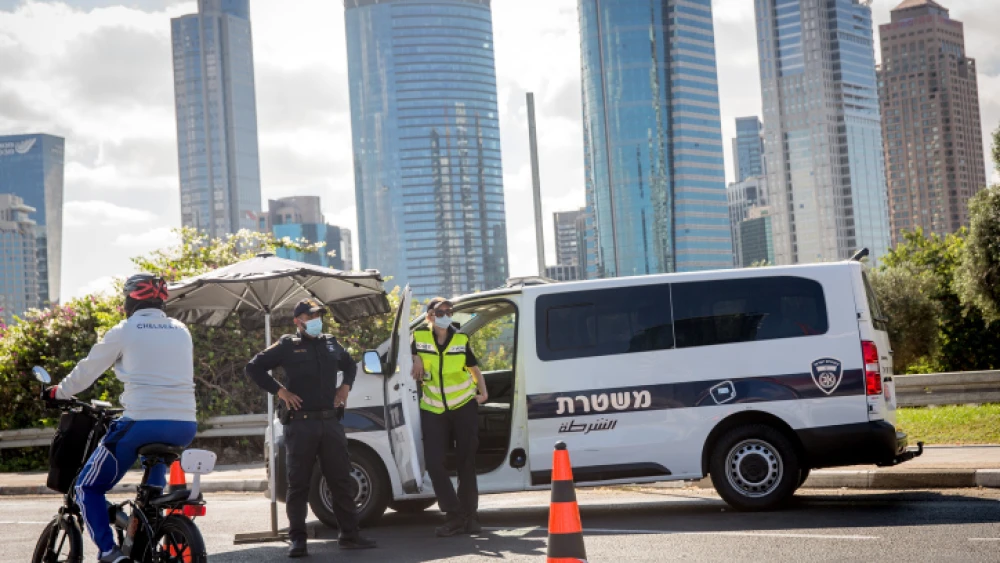
Israel’s coronavirus Cabinet on Tuesday voted to extend the country’s COVID-19 lockdown until midnight on Sunday and agreed to hold a preliminary discussion on a phased exit plan on Thursday.
The ministers will discuss the possibility, contingent on morbidity data, of lifting some lockdown restrictions next week, including the opening of some small businesses, as well as kindergartens and take-out restaurant service, according to a joint statement by the Israeli Health Ministry and the Prime Minister’s Office.
The Cabinet extended air-travel restrictions until Thursday, with further discussion on the issue slated for Wednesday, and lifted travel restrictions for the attendance of close family members at small weddings. Professional athletes were also allowed to resume training.
Israeli Health Ministry Public Health Services head Sharon Elroi presented the ministry’s outline for a phased exit, and Israeli National Security Council head Meir Ben-Shabbat presented the main goals for its various stages.
The outline, first released by the ministry on Saturday, consists of a gradual, eight-stage plan over a four-month period with each stage being contingent on morbidity data. According to the outline, before the first stage of the plan can be implemented the number of daily cases must drop to 2,000. This will allow the opening of preschools, as well as small businesses that do not receive customers.
According to the ministry, of the 41,628 COVID-19 tests conducted on Tuesday, 5.4 percent were positive, down from 8 percent on Thursday and a peak in recent weeks of more than 15 percent. The number of daily cases stood at 2,264 on Wednesday—approaching the 2,000 daily cases required before the phased exit plan can be initiated.
Despite the data showing a decrease in morbidity, however, experts present at Tuesday’s Cabinet meeting said that more time was required to establish the kind of clear-cut, definite and continual decline necessary before a decision could be made to begin easing the lockdown.
Since the onset of the pandemic, there have been 297,501 confirmed COVID-19 cases in Israel, although serological testing carried out by the ministry suggests that the true number of infections is about double that figure. Of the 46,491 cases currently active, 780 are considered to be serious, down from a peak of 883 on Monday, and 244 COVID-19 patients are currently on ventilators. To date, 2,067 people have died of the disease.