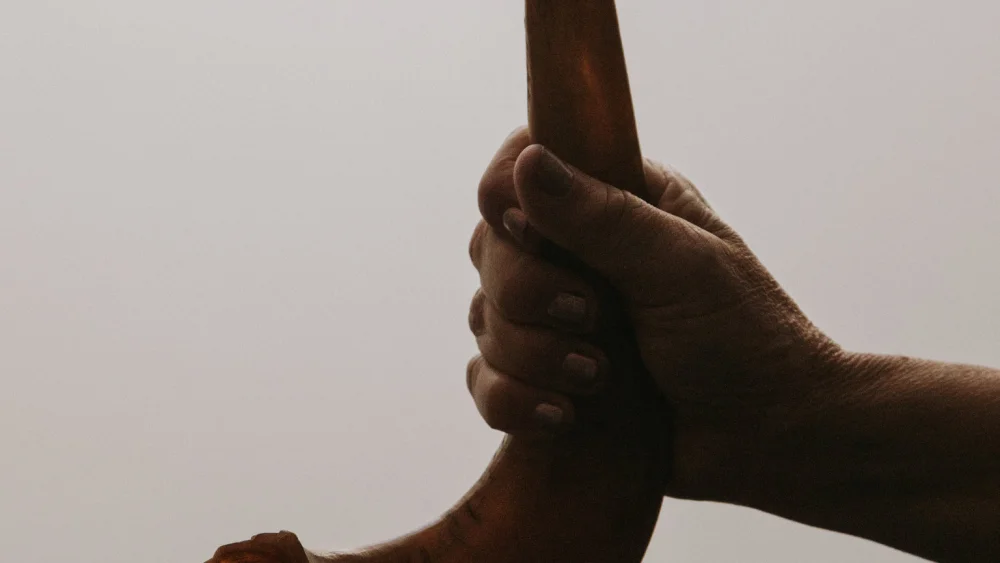
The Museum of Jewish Heritage: A Living Memorial to the Holocaust in New York City revealed on Monday a shofar that was hidden and blown in the Auschwitz concentration camp 75 years ago and never shown to the public before.
The ram’s horn, which is blown during Jewish High Holiday services, will be on display as part of the museum’s traveling exhibit, “Auschwitz. Not long ago. Not far away.”
According to the museum, Chaskel Tydor, a longtime prisoner at Auschwitz responsible for organizing work details at one of the more than 40 Auschwitz subcamps, arranged for a group of prisoners to work far from the center of the camp during Rosh Hashanah in 1944 so they could pray privately, and so that the sound of the shofar would be heard without attracting unwanted attention.
In January 1945, the Germans forced prisoners on the infamous death march, and a fellow prisoner asked Tydor to safeguard the shofar, saying, “I’m going to die on this march. If you live, take this shofar. Tell them we blew the shofar at Auschwitz.”
Tydor survived the Holocaust and took the shofar with him to Israel and then America.
His daughter, Judith Tydor Baumel-Schwartz, who directs Holocaust research at Bar-Ilan University in Ramat Gan, Israel, spoke at the artifact’s unveiling, saying she was loaning the shofar to show the great lengths that imprisoned Jews went to practice their religion during the Holocaust.
“One thing I know from all the thousands of survivors I interviewed, it’s that the impossible was possible, both the bad and the good,” she said.
The exhibit “Auschwitz. Not long ago. Not far away” is on view until Jan. 3, 2020.