
Africa’s muted response to the U.S.-Israel war with Iran exposes a hard truth. Their stance on Israel and the Palestinian question is driven less by events than by narrative: the African Union’s entrenched framing of Israel as a colonial actor, a view that is both inaccurate and strategically distorting.
Across Africa, responses to the Iran conflict have been cautious and neutral, with governments emphasizing de-escalation, economic risks and dialogue over choosing sides. Few governments expressed measured sympathy for Iran or voiced concern over Iranian strikes on Gulf states.
A similar pattern has appeared during Russia’s war with Ukraine, where many African states abstained or avoided firm alignment in U.N. votes, reflecting a pragmatic focus on stability, economic ties and diplomatic flexibility rather than ideological commitment.
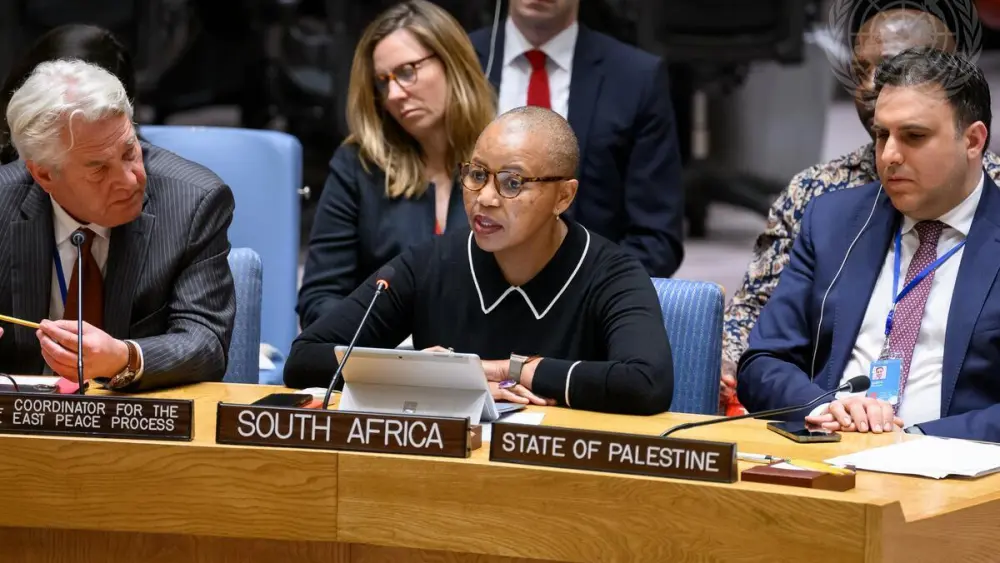
This pattern stands in sharp contrast to African countries’ strong and often unified stance on Palestine. Israel is widely condemned, while Palestinians are broadly supported. The framing of Israel as a colonial power by the African Union sets the tone for continental consensus, even when public opinion varies. The U.N. voting record and recognition of Palestinian statehood show a strong continental consensus in favor of Palestine and against Israel’s position.
On Israel, African states speak—and vote—with one voice. A total of 52 out of 54 members of the African Union have formally recognized the State of Palestine and have supported U.N. resolutions backing Palestinian rights and statehood, consistently voting against Israel’s stance in key General Assembly votes on Palestine.
The only exceptions, which do not recognize Palestinian statehood, are Cameroon, which is aligned closely with Israel, and Eritrea, despite the fact that its dictator is pro-Iran and hostile to Israel. That country’s stance is shaped by the Tigrinya nation, which forms the overwhelming majority in Eritrea, and maintains deep cultural and historical ties to the Jewish people.
In recent years, Israeli Prime Minister Benjamin Netanyahu sought to revive Israel’s engagement with Africa through high-level diplomatic outreach. His visits to Uganda, Kenya, Rwanda and Ethiopia were aimed at promoting ties in security, technology, water and agriculture. In Kenya, Israel’s Netafim introduced drip irrigation for smallholder farmers, increasing crop yields and reducing water use by up to 30% to 50%, as well as enabling farming in arid and semi-arid regions.
Even countries that benefit from Israeli assistance in technology, water and agriculture consistently vote against Israel at the United Nations, highlighting the disconnect between Israel’s tangible contributions and Africa’s narrative-driven alignment.
According to the UN Watch Database, Ethiopia, Ghana, Kenya, Uganda and Rwanda all record 0% in favor of Israel, overwhelmingly vote against and register the remainder as abstentions.
African states have actively restricted Israel’s diplomatic participation: An Israeli delegation was expelled from the African Union summit, and the ambassador was removed from a conference, culminating in Africa’s decision to suspend Israel’s observer status.
The Palestinian issue in Africa is significantly shaped by institutional framing, particularly through the African Union, which has consistently cast it in the language of anti-colonial struggle. This viewpoint helps standardize how many African states interpret the conflict, reinforcing a shared diplomatic position.
Israel’s recognition of Somaliland is in line with this approach, affirming its right to self-determination based on colonial-era borders—a principle that underpinned the creation of almost all African states.
The current U.S.-Israeli joint military action against Iran, by contrast, lacks the institutional and historical framing that shapes African diplomacy on Palestine, which is embedded in the African Union’s European anti-colonial perspective. Iran and Ukraine are treated as distant great-power conflicts with no connection to Africa’s liberation history. Without that historical and emotional anchor, African states default to pragmatism—prioritizing economic risks, energy prices, trade disruptions and regional stability.
The pattern is clear: African countries’ responses are narrative-driven when colonial framing is activated and interest-driven when it is not. Most of their positions vis-à-vis Israel are not determined solely by strategy, security cooperation or economic engagement.
Rather, it is shaped by how Israel is perceived within the African Union’s historical narrative framework. As long as the dominant framing places Israel within an anti-colonial paradigm, responses by this bloc of countries, especially during moments like the Gaza war, will remain politically and morally constrained.
At the same time, most African nations’ neutrality on Iran and its pragmatism on Ukraine demonstrate something equally important: This alignment is not fixed. When narrative pressure is absent, most African countries behave as pragmatic actors. They protect their interests, maintain diplomatic flexibility and avoid entanglement in external conflicts.
Israel should directly challenge the dominant narrative shaping its perception in Africa. First, Jerusalem should more actively articulate its historical narrative, emphasizing its indigenous roots and the continuity of Jewish presence in the land. Hebrew and Judaism are indigenous to the land of Israel, and the Jewish people’s right to self-determination in that land is rooted in that historical continuity.
Second, Israel should engage African partners to challenge the narrow colonial narrative that dominates institutions like the African Union. European colonialism has long been center stage, while centuries of Arab and Ottoman expansion, slavery and domination in Africa are largely ignored. Correcting this blind spot not only honors Africans who suffered but also reshapes Israel’s image.
Historically, Israel reached its high point in relations with African countries through structured, state-backed outreach via institutions like MASHAV, particularly in the 1950s through the 1970s, focusing on agricultural training, nation-building partnerships and solidarity with newly independent African states. That era combined a clear ideological vision with dedicated resources. Today, Israel should revive this approach, rebuilding its programs with the same strategic focus and commitment.
Israel must reposition itself in three ways: from a “helper” to a partner in sovereignty—enabling independence in water, food and development; from a Middle Eastern conflict actor to a model of state resilience—a post-colonial state that built capacity under pressure and offers relevant security and development lessons; and from a tech provider to a civilizational ally, engaging Africa through shared narratives of history, identity and dignity rather than purely transactional cooperation.
Israel’s recognition of Somaliland is in line with this approach, affirming its right to self-determination based on colonial-era borders—a principle that underpinned the creation of almost all African states.
As African countries’ responses to Iran shows, alignment is not automatic. Their unified stance on Israel is driven by narrative, and Israel must actively work to change it.