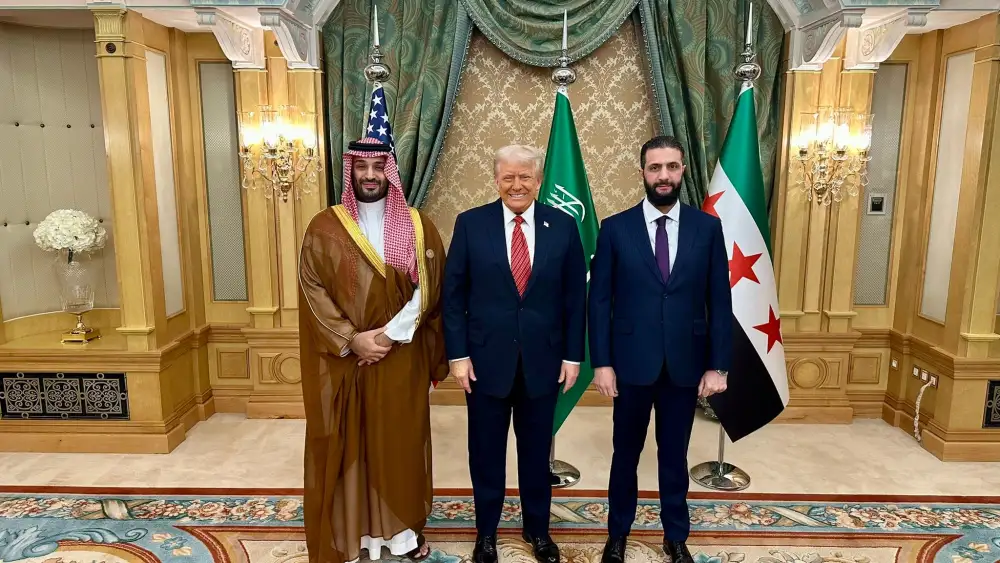
U.S. President Donald Trump met with Syrian President Ahmed al-Sharaa in Riyadh on Tuesday ahead of the Gulf Cooperation Council (GCC) summit, a day after announcing the lifting of all U.S. sanctions on Damascus.
The meeting marked the first direct encounter between American and Syrian leaders in a quarter century.
Turkish President Recep Tayyip Erdoğan joined the 33-minute conversation via video call, alongside Saudi Crown Prince Mohammed bin Salman, the Turkish Anadolu news agency reported. Erdoğan praised Trump’s sanctions decision as “historic,” highlighting it as a key Turkish foreign policy objective.
White House Press Secretary Karoline Leavitt posted a photo of the meeting on X, saying Trump had thanked both Erdoğan and the crown prince for their friendship, and had told al-Sharaa that he has “a tremendous opportunity to do something historic” in Syria.
According to Leavitt, Trump encouraged al-Sharaa to sign onto the Abraham Accords with Israel, expel all foreign terrorists from Syria, deport Palestinian terrorists, assist the United States in preventing an ISIS resurgence and take full responsibility for ISIS detention centers in northeast Syria.
Speaking to reporters on board Air Force One following the talks, Trump said: “I think they have to get themselves straightened up. I told him [al-Sharaa], ‘I hope you’re going to join when it’s straightened out.’ He said, ‘Yes.’ But they have a lot of work to do.”
Today, President Trump, at the invitation of Crown Prince Mohammed bin Salman, met with Syrian President Ahmad al-Sharaa. President Erdogan of Turkey joined by phone. President Erdogan praised President Trump for lifting sanctions on Syria and committed to working alongside Saudi… pic.twitter.com/0yhyZbQ1o0
— Karoline Leavitt (@PressSec) May 14, 2025
Al-Sharaa, formerly known as Abu Mohammad al-Jolani, thanked the leaders for facilitating the meeting and acknowledged the strategic opportunity created by Iran’s retreat from Syria. He affirmed Syria’s commitment to the 1974 disengagement agreement with Israel, expressed support for U.S.-Syrian cooperation against terrorism and chemical weapons, and invited American companies to invest in Syrian oil and gas. He also proposed turning Syria into a trade corridor between East and West.
Following the trilateral discussions, Trump said the United States is “looking at normalization with Syria,” signaling a potential shift in decades of U.S. policy toward the country. The president also reportedly discussed economic incentives offered by al-Sharaa, including opening Syrian oil fields to American companies and proposing a Trump Tower in Damascus to encourage U.S. investment in post-war reconstruction.
The Russia-Ukraine war and the ongoing conflict in Gaza were also discussed, according to Leavitt.
Jerusalem reportedly views the normalization push with deep concern, citing al-Sharaa’s past and the potential legitimization of a figure long tied to terrorism. Israeli Foreign Minister Gideon Sa’ar has previously called the new Syrian government “jihadists in suits.”