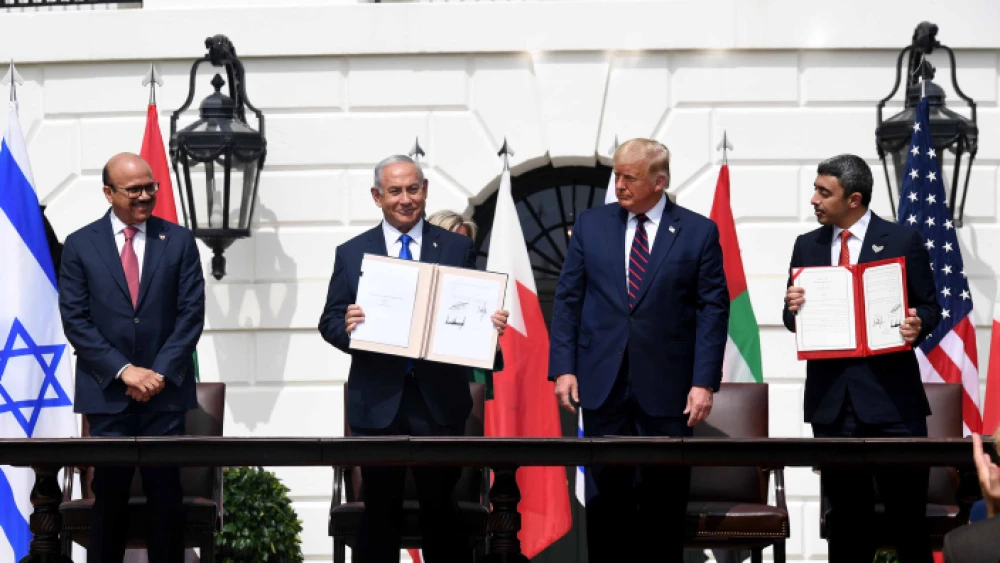
A bipartisan group of U.S. lawmakers is currently touring Abraham Accords signatory countries, having already visited Morocco and Bahrain ahead of stops in the United Arab Emirates and Israel.
The Trump administration-brokered agreements normalized relations between the Jewish state and those three Arab countries, in addition to Sudan.
The delegation, led by Sens. Jacky Rosen (D-Nev.) and James Lankford (R-Okla.), also includes Sen. Kirsten Gillibrand (D-N.Y.), Michael Bennet (D-Colo.), Dan Sullivan (R-Ark.), Mark Kelly (D-Ariz.), and Ted Budd (R-N.C.).
In Bahrain on Sunday, the senators met with U.S. Navy Vice Adm. Brad Cooper, the commander of the U.S. 5th Fleet, which is headquartered in Manama.
Bahraini King Hamad bin Isa Al Khalifa also welcomed the delegation at Al-Safriya Palace.
On Friday, King Mohammed VI of Morocco hosted the senators at a dinner at the royal palace in Rabat. Andre Azoulay, a senior advisor to the king, and Serge Berdugo, the Secretary General of the Council of Jewish Communities of Morocco, were also in attendance, according to Moroccan media.
The day prior, the American lawmakers held talks with senior Moroccan government officials, including Foreign Minister Nasser Bourita.
The senators are seeing firsthand how the Abraham Accords have led to unprecedented regional integration and cooperation, and are discussing ways in which the agreements can be strengthened and expanded to bring in other countries, according to a statement released ahead of the trip.
“The historic Abraham Accords have transformed the Middle East—paving the way for unprecedented cooperation and normalization between Israel and Arab partners,” said Sen. Rosen. “The Accords are already contributing to all four countries’ economies and helping them work together to combat Iranian aggression. My colleagues and I look forward to meeting with senior government officials, business leaders and civil society organizations to discuss how we can strengthen the relationships fostered by the Accords and expand them to new countries.”
Said Sen. Lankford: “This time will be invaluable for members of the Senate Abraham Accords Caucus as we continue to strengthen relationships throughout the region through reconciliation and common goals. In the days ahead, we will continue to bring nations together for the future of U.S. national interest and for our allies.”
Last year, Sens. Rosen and Lankford, along with Sens. Joni Ernst (R-Iowa) and Cory Booker (D-N.J.), launched the Senate Abraham Accords Caucus to build on the success of the deals.