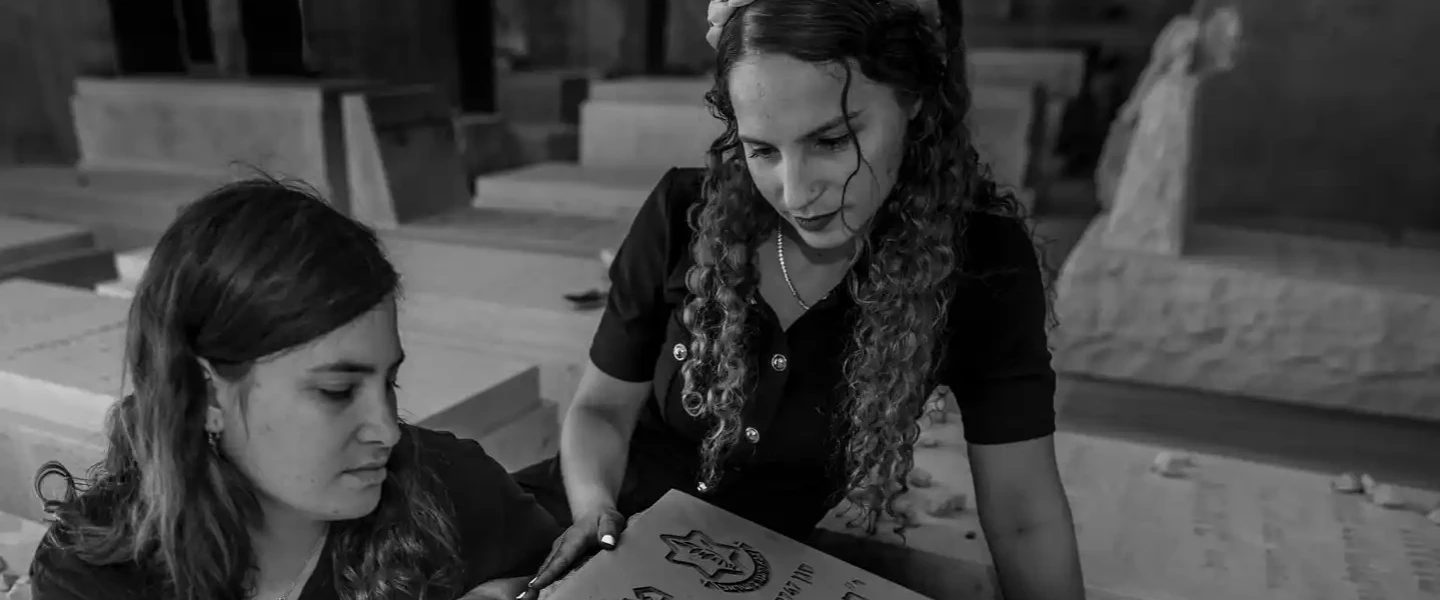
First, the father of the Israeli family was killed in a drive-by Palestinian shooting attack a decade ago, while two of his children were sitting in the back of the car.
Then, several years later, one of his sons was killed in a traffic accident on the way to work.
Next, a cousin was killed fighting off Hamas during the invasion of southern Israel on Oct. 7, 2023.
The final blow came just weeks after the massacre, when a teenage survivor of the first attack, Israel Defense Forces Lt. Pedayah Mark, 22, was himself killed fighting Hamas in Gaza.
“We were the survivors,” Tehila Mark, 24, told JNS, referring to the first attack where she and her brother saw their father gunned down. “It is simply unfathomable what we have gone through.”
“It’s inexplicable pain,” her 27-year-old sister, Orit Mark-Ettinger, said. “We couldn’t believe that this happened to us again.”

Teens lose a father
On the first day of summer in 2016, the Mark siblings were in the back of the car with their parents, driving to Jerusalem on a Friday afternoon to send Shabbat with their grandmother.
Just minutes after they left their home in the Israeli community of Otniel in the Hebron Hills, two Palestinian gunmen opened fire, riddling the car with 29 bullets, killing the driver, Rabbi Michael Mark, 46, a father of 10, and seriously injuring his wife, Chava, and daughter Tehila in the back seat.
The vehicle overturned on the side of the road, flipping over on its roof.
“I took off my seatbelt and started looking for a cellphone to call for assistance,” Tehila Mark recounted, as the terrorists began circling back to the car.
An unexpected hero
A Palestinian motorist who was driving with his wife had stopped his car at the side of the road by the overturned vehicle and approached the children, deterring the attackers from returning.
“We thought he was a terrorist because we did not realize what had happened, but when he said I will help you, then I had a feeling that he was not,” Mark recounted.
After using a car jack to pry open the door, the Palestinian driver put the Israeli children in the car with his wife, who is a nurse, and together they called the community’s Israeli security hotline from the number that the 14-year-old girl had memorized.
“In my heart, I didn’t think twice,” recounted the Palestinian, identified only by his first initial, A, in an interview with JNS this week. A decade later, both Tehila and he still vividly remember the digits of the security hotline.
As the Arab couple waited with the children for the army and ambulance to come, local Palestinians began stoning the vehicle and threatening the motorist for assisting Jews.
“Lock the doors,” he remembers his newlywed wife telling him, afraid that the children would be lynched.
When rescue workers arrived, the teenage girl’s last memory was her father being placed in white sheets that quickly became stained with blood.
During the Jewish mourning period for her father, the Palestinian man who helped save them came to pay his respects to the family, who warmly embraced him.
He would later be relocated to central Israel and granted temporary residency after his life was threatened for his heroic actions. A year and a half later, he was given a permanent residency permit in 2021, which allowed his wife and child to join him in Israel.
A former guard for a bank run by the son of Palestinian leader Mahmoud Abbas, he went on to help Israeli security officials capture wanted terror suspects, and is currently seeking Israeli citizenship and is interested in enlisting in the Israeli security services.
Tragedy strikes again and again and again
Meanwhile, as the Mark siblings tried to move on from the attack, tragedy struck anew when their brother, Shlomi, was killed in a traffic accident on the way to work in Jerusalem in 2019.
Four years later, disaster visited them yet again when Hamas attacked on Oct. 7. A cousin, Capt. Elhanan Kalmanson, was killed the next day in the fighting in Kibbutz Be’eri, the hard-hit agricultural community near the border with Gaza.

Lt. Pedayah Mark, who served as a platoon commander in the Tsabar battalion in the Givati Brigade, said he did not want to leave his soldiers when he was informed of his cousin’s death.
Weeks later, he and 10 of his own soldiers were killed in the fighting in Gaza.
“I was very afraid when he went into Gaza,” Tehila Mark recounted. “We as a family paid, and we paid, and we paid.”
“But when he died, he did not die hopeless as we were in the attack,” she said. “But fighting with his soldiers as an officer and fighting for the country we loved.”
The 37-year-old Palestinian who had saved the children seven years earlier and had kept in touch with the family over the years said he broke down in tears when he heard about the death of the child he had helped rescue.
He took his own boy and again went to the mourning period to pay his respects, where Mark’s mother told him that he had given her son seven more years of life.
“I cried the whole way there,” he recounted. “I was in shock. I remember him as a child, and this is the image I always have of him: a child.”

‘Time does not heal, but I have to live for him’
Tehila Mark, the young 20-something with trauma beyond her young years who still suffers from PTSD, said people don’t realize how terrorism stays with you, despite the passing of time.
“What people do not understand is they think ten years have passed since the attack and then you move on, but the attack stays with you forever,” she recounted.
“When I think of my father, I think of his overturned dead body,” she said.
“Life after a terror attack is life with a terror attack,” she continued.
“It does not pass. Time does not heal.”
Then, after the loss of her brother, who survived the attack with her, she said: “But I have to live for him.”