
After the Oct. 27 election, executive power remained with Israeli Prime Minister Benjamin Netanyahu’s caretaker cabinet, while the Knesset passed to his opponents, united in a change bloc led by former military chief of staff Gadi Eisenkot. The Supreme Court, sitting as the High Court of Justice, and the government’s attorney general ended up on the same side as the change bloc, leaving no neutral arbiter in the dispute they would normally settle. With Eisenkot’s mandate expiring on Dec. 6, that deadlock has drawn in the army, the security services and the rabbis—putting civil peace at risk.
On Nov. 18, without waiting to form a coalition, the new majority began a fast-track repeal of the judicial overhaul. A week later, on Nov. 25, the Jerusalem District Court suggested that Attorney General Gali Baharav-Miara consider dropping Case 4000 and reconsider Case 2000, two of the three corruption cases against the prime minister.
Meanwhile, much of the right rejects the High Court’s rulings altogether.
The new majority targeted the laws defining the powers of the court and the attorney general first. Normally, such legislation changes only after a government forms, yet the change bloc is relying on an ad hoc majority of 67 seats, including 19 held by Arab parties.
After taking control of the Arrangements Committee, the bloc waived the 45-day waiting period for private members’ bills.
And on Nov. 18, the plenum voted 63-47 in a preliminary reading to repeal the Judicial Selection Committee law and the attorney general law. Knesset legal advisers confirmed the bloc can continue repealing four core laws of the previous government—covering judicial selection, the attorney general, police investigations and the media—even if the parliament dissolves.
New Knesset Speaker Matan Kahana of Yashar vowed that parliament “will comply unquestioningly with court rulings.” While the center-left hails the blitz as a restoration of democracy, Religious Zionism’s Simcha Rothman condemned it as a political power grab.
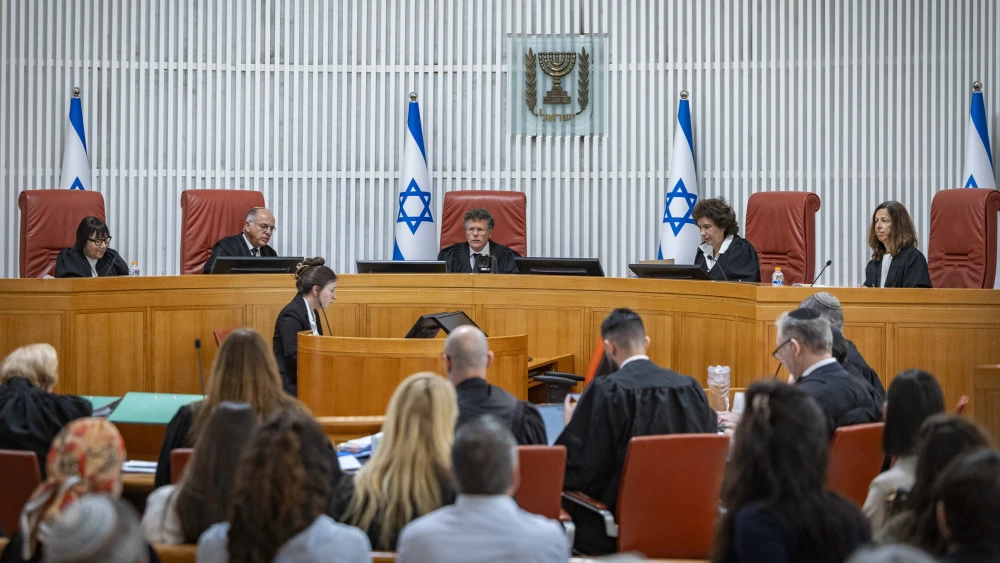
While the trial court has cast doubt on the indictment, the Supreme Court holds the final word. On Nov. 25, a panel led by Judge Rivka Friedman-Feldman questioned whether a news site gave Netanyahu special coverage in Case 4000 (Bezeq-Walla) with his knowledge, and whether any offense occurred in Case 2000 (Netanyahu-Mozes). The judges proposed taking only Case 1000, the gifts affair, to a verdict, noting no ruling had yet been written. Netanyahu immediately declared that the trial had collapsed and offered his opponents reconciliation.
However, news reports indicate that Baharav-Miara will accept a plea deal only with a finding of moral turpitude (kalon), which would end Netanyahu’s political career. He refuses, and so prosecutors are prepared to appeal any bribery acquittal to the Supreme Court led by Isaac Amit—a bench that in 2025 overturned the dismissals of both Israeli Security Agency (Shin Bet) chief Ronen Bar and Baharav-Miara herself.
The legal standoff ultimately centers on forcing Netanyahu from politics, aligning with Eisenkot’s demand that he “cannot remain at the head of the government for a minute longer.”
Since 2023, the High Court has struck down limits on judicial review, reversed senior dismissals, and, ahead of the election, restored to the ballot the Arab parties that handed the “Change Bloc” its majority. For much of the right, the court helped the opposition win the Knesset and is collecting its powers in return.
Every security agency presently sits on the fault line between ministerial authority and legal oversight. The High Court upheld Netanyahu’s appointments of David Zini to lead the Shin Bet and Roman Gofman to head the Mossad by narrow 2-1 votes over the attorney general’s objections, siding with the government. Elsewhere, Maj. Gen. Yifat Tomer-Yerushalmi resigned as military advocate general after admitting that she authorized the leak of a video showing detainee abuse at the Sde Teiman base.
Disputes over certain military enforcement of the law remain equally sharp. The High Court froze and struck down a law barring the arrest of Haredi draft evaders—a measure that reservists strongly opposed. In the West Bank, The Washington Post reported that soldiers stood by while settlers besieged Palestinian homes in Qusra, after Israeli Defense Minister Israel Katz ended administrative detention for extremist settlers over Shin Bet objections.
The right-wing and religious camp views the elected majority as sovereign, and treats the High Court and the attorney general as partisan actors. Justice Minister Yariv Levin refuses to recognize Amit as Supreme Court president, and Likud has denounced the Knesset majority as stolen via Arab parties, despite the Central Elections Committee finding no decisive fraud.
Conversely, the “Change Bloc” treats the courts as final arbiters while restoring their powers the exact way the 2023 overhaul passed: by a narrow majority over the fierce protest of the rival camp.
A governing coalition reliant on Arab parties has fractured religious leadership. Rabbis from the national-religious Torat HaAretz HaTova group declared such a government forbidden by the Torah, while Rabbi Gedalia Axelrod, former head of the Haifa rabbinical court, invoked din rodef—the religious law of the pursuer permitting the killing of someone endangering others, famously cited by Yitzhak Rabin’s assassin. More than 500 rabbis and Diaspora leaders countered with an appeal for a Jewish-Arab coalition, even as right-wing protesters outside the Knesset on Nov. 10 warned of civil war.
As Dec. 6 approaches, Israel faces an institutional impasse, regardless of how coalition talks end.
If Eisenkot forms a government, Levin exits the Justice Ministry and the boycott of the Supreme Court ends—yet repealing the overhaul will freeze the rift rather than heal it, risking street conflict if rulings are enforced on a camp that rejects both the coalition and the court. If talks fail, Israel enters an election under dual power, pitting Netanyahu’s caretaker cabinet against the Knesset, High Court and attorney general.
When contradictory orders clash, the decisive question becomes whom the Israel Defense Forces and Shin Bet obey—and who holds the legitimate right to enforce the law on a society divided in half.
Eleven days remain to find out.